

 Checking an electric or hybrid car before buying
A used car from Germany is attractive for many buyers – but the crucial question is which rights and guarantees you actually have as a buyer. Whether you are well protected or left alone in case of problems depends mainly on who sells the car: a private person or a professional dealer.
In this article we look at typical scenarios when buying a used car in Germany and explain what kind of legal protection you can expect and where the pitfalls are. At the same time we show how you can significantly reduce your risk with a smart vehicle check and a VIN-based report (e.g. with a carVertical report).
Buying a used car from a private seller
Buying from a private seller is usually the cheapest option – but from the buyer’s point of view also the riskiest. In Germany, private sales contracts almost always include the phrase “gekauft wie gesehen” / “sold as seen” – without any liability for defects.
Standard contract templates often contain a clause excluding statutory liability for defects (Sachmängelhaftung). This means: if problems with the car appear after handover, you usually have no claim for free repair or for reversing the contract.
Which rights does the buyer have in a private sale?
In legal terms, a private seller is allowed to exclude liability for defects completely. If this clause is in the contract, the buyer has very little room to maneuver. Two exceptions are important:
- Fraudulent misrepresentation. If the seller knew about a major defect (for example serious accident damage or mileage manipulation) and actively concealed it or even claimed the opposite, they can still be held liable. In practice it is difficult to prove intent – many lawsuits end in deadlock.
- Explicitly guaranteed characteristics. If the contract explicitly states “accident-free” or “original mileage” and you can later prove the opposite, you may have claims. The important point is that this is a clear, written guarantee in the contract – not just vague marketing in the online advert.
In summary, the buyer carries almost all of the risk in a private sale. That is why a thorough check is crucial: look at the car yourself, take a proper test drive, check all papers and ideally book a professional pre-purchase inspection. The lower purchase price always comes with a “risk premium”: you save money at the beginning but you take over the responsibility.
Buying a used car from a dealer
The situation is very different if you buy the car from a commercial dealer or dealership. Here, German consumer protection law with its clear rules on liability for defects applies.
In general, dealers must grant statutory liability for defects (Sachmängelhaftung) for up to two years. For used cars this period is usually reduced to one year – this is allowed, a complete exclusion towards a consumer is not.
What are the advantages of dealer liability?
If a significant defect that was already present at handover appears after the purchase, the dealer must repair it. Since the legal reform in 2022 there is a so-called reversal of the burden of proof during the first 12 months: the law assumes that a defect already existed at handover – the dealer has to prove that it did not.
After the first year the burden of proof gradually shifts back towards the buyer – then you usually have to show that the problem is not due to misuse but was already there from the beginning.
Depending on the situation the buyer can demand:
- Repair (rectification) – the dealer fixes the defect at their own cost; or
- Price reduction or contract cancellation – if the defect cannot be fixed or repair fails repeatedly.
Dealers are also expected to inform buyers about key aspects of the vehicle’s history. If the car is an accident car or was used as a rental car, this should be mentioned and ideally documented in the contract. If it later turns out that important information was concealed, the buyer may have the right to step back from the contract.
Ideally you combine this legal protection with a VIN check including a carVertical report (−20% for our readers), to match the dealer’s statements with database information.
Additional (voluntary) guarantees
Many dealers offer voluntary guarantees on top of statutory liability, for example:
- their own used-car guarantee programme,
- repair cost insurance,
- extended packages for engine, gearbox and electronics.
Such guarantees can make sense, but they never replace statutory liability – they only supplement it. It is important to read the conditions carefully: what exactly is covered, are there deductibles, and for how long?
Buying “on consignment” via a dealership
A special case is the so-called consignment sale (“Verkauf im Kundenauftrag”). The car is parked on the dealer’s premises, but the contract names a private person as the seller. The dealership only acts as an intermediary.
For buyers this often feels like buying from a “serious dealer” – legally, however, it is a private sale with all the risks described above.
Why is this tricky?
- No statutory defect liability from the dealer. Legally the contract is concluded between you and the private owner. The dealer is not liable for hidden defects; they only receive a commission.
- Perceived, but not real safety. The car is displayed in a showroom, the seller may wear company clothing – it all feels professional. But the contract shows a private name and an exclusion of liability.
Some providers use this structure deliberately to avoid liability, even though they practically manage and advertise the car like their own stock.
How to protect yourself when buying on consignment
If you consider buying a car “on consignment”, you should be especially careful:
- Read the contract carefully: who is listed as the seller? Is there an exclusion of liability?
- Be aware that legally you are in a very similar position to a private sale.
- Always insist on a VIN check and independent technical diagnostics (for hybrids/EVs ideally including a battery health check, see our article on EVs and hybrids).
- Ask yourself whether the price really justifies the higher risk – sometimes it is smarter to choose a slightly more expensive car sold directly by the dealer with full liability.
In principle you can also buy a consignment car safely – as long as you know exactly what you are doing and do not rely solely on the polished showroom impression.
What to do if a defect appears after the purchase
Even with good preparation, problems can still appear only after you have bought the car. How you should react depends on where you bought it.
Car bought from a dealer
In this case you should notify the dealer as quickly as possible – ideally in writing by e-mail or letter. Describe the defect and set a reasonable deadline for repair. Legally, you have to give the dealer the opportunity to fix the problem first.
If the repair is successful, the matter is closed. If the repair fails or the defect returns, you may – depending on the severity – be entitled to:
- a reduction of the purchase price; or
- in extreme cases, to cancel the contract and return the car.
Once the first year after purchase has passed, things often become more complicated because you may need to prove that the defect already existed at handover – an independent expert opinion can become necessary.
Car bought from a private seller
Here your options are usually very limited. If liability for defects was excluded in the contract, you can only rely on fraudulent misrepresentation. In practice this means a long and uncertain legal battle. Realistically, the chances of getting your money back are low.
Car bought on consignment
Legally, this scenario is similar to buying from a private seller. Your counterpart is the private person named in the contract, not the dealership. Of course you can try to find a friendly solution, but if that fails, your only option is legal action.
All of these scenarios highlight one thing: the best protection against trouble after the purchase is a clean, thorough check before you sign.
Reducing risk: vehicle check before buying
The most important tip for anyone buying a used car in Germany: invest some time and a reasonable amount of money in a thorough pre-purchase check. This is especially important for private sales, but also saves a lot of nerves when buying from a dealer.
1. Check vehicle history via VIN
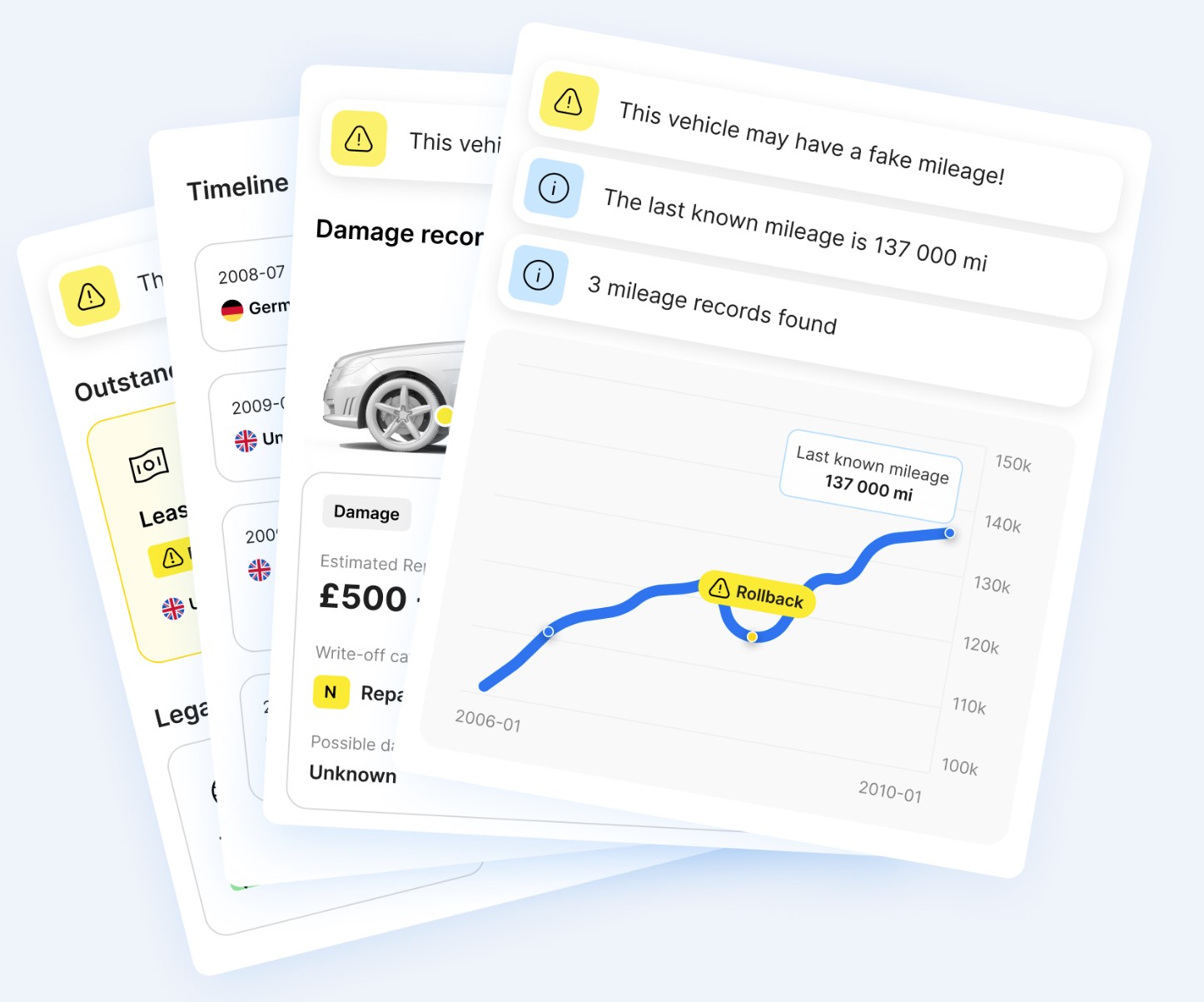
The Vehicle Identification Number (VIN) is the key to the car’s history. With VIN reports from services such as carVertical you can often check:
- accident and damage entries in databases,
- number of owners and usage type (for example rental, taxi, fleet),
- stored mileage readings and indications of odometer rollback,
- sometimes records of inspections and emissions tests.
We explain how to read such reports in more detail in our article on VIN diagnostics with carVertical. Important: no report in the world replaces a live technical inspection – but it is a powerful tool to spot “red flags”.
2. Check documents and service history
Ask to see the service book, workshop invoices, the last TÜV reports and all relevant documents. Do VIN and recorded mileage match everywhere? Are there signs of regular maintenance – or long periods without service?
3. Technical inspection and test drive
A calm, focused test drive and a look underneath the car on a lift are worth a lot. If you are not a mechanic yourself, get a neutral expert on board or use our mobile pre-purchase inspection on site. A professional will measure paint thickness, read fault codes and – if necessary – evaluate high-voltage batteries in hybrids and EVs (see also our article on EVs and hybrids).
4. Legal cleanliness of the paperwork
Check the registration documents, clarify whether the car is financed or otherwise encumbered, and make sure the sales contract is clear and complete. If you plan to export the car, inform yourself in advance which documents you will need in the destination country.
If you follow these steps, you drastically reduce the risk of a bad purchase. In many cases, just a few small warning signs in the VIN report or diagnostics are enough to prevent you from buying a “Monday car”.
Conclusion: a more relaxed path to a used car in Germany
To sum up, your level of protection when buying a used car in Germany depends strongly on the sales scenario:
- Best protected you are when buying from a dealer: statutory liability for defects applies, usually at least one year.
- Least protected you are when buying from a private seller – here you carry almost all of the risk yourself.
- Consignment sale is legally often a disguised private sale – with correspondingly limited rights for the buyer.
In every scenario one rule applies: keep your eyes open when buying a car. Take your time to read the contract, ask critical questions, check history and technical condition. If you feel unsure, involve professionals – for example for an independent inspection and a VIN-based report with carVertical.
What may sound like extra effort is usually an excellent deal in practice: avoiding just one major engine failure or not buying a badly repaired accident car saves far more money than a solid inspection costs.
Werbung / *Affiliate-Link
Links and banners marked with an asterisk (*) are affiliate links/banners. If you use such a link and subsequently request an offer, sign a contract or make a purchase, we receive a commission from the respective provider. For you, there are no disadvantages: the price and conditions remain the same.
FAQ – common questions about guarantees and rights when buying a used car in Germany
Is it worth paying more and buying from a dealer instead of a private seller?
In many cases yes. With a dealer you benefit from statutory liability for defects and have much better chances to get repair or contract cancellation in case of serious defects. In a private sale you pay less but take almost the full risk. The best combination is often: dealer purchase plus independent vehicle and VIN check.
How safe is buying a used car “on consignment”?
Legally this is usually a private sale with excluded liability. The perceived safety created by the showroom can easily hide the actual risk. If you value stronger protection, you should try to buy a car where the dealership itself is the contractual seller – or choose a different vehicle with full dealer liability.
Can a VIN report replace a real vehicle inspection?
No. A VIN report is a powerful tool to check history, accidents and possible mileage manipulation. But it does not show the current technical condition of the car. The ideal combination is a VIN report with carVertical plus a live inspection with OBD diagnostics and a proper test drive – especially for modern cars with complex electronics, hybrids and EVs.
Related posts
Checking an electric or hybrid car before buying
 VIN-based vehicle check with carVertical report (−20% for readers)