
 VIN check with carVertical report (−20%)
Top 10 popular used cars to buy in Germany
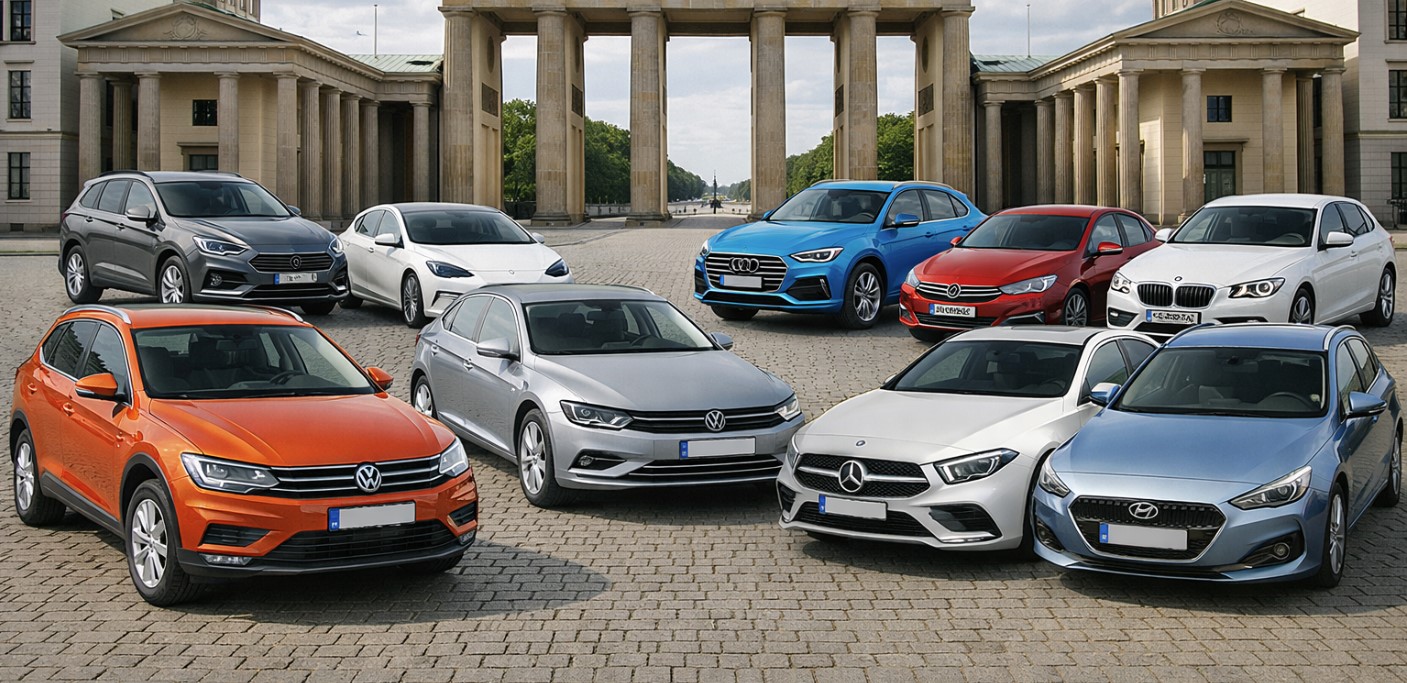
Below is a curated list of ten vehicles that consistently show high demand on the German used-car market. It includes mass-market models, premium sedans and practical SUVs. Prices are indicative and depend on production year, mileage, trim level and service history.
✔️ 1) Volkswagen Golf
Body type: compact hatchback · Engines: petrol TSI, diesel TDI.
The VW Golf is a benchmark of the European C-segment. It is valued for its balanced driving characteristics, reliability and excellent liquidity on the secondary market. A wide choice of generations and trims — from basic versions to GTI/R — makes it easy to match almost any budget. Average price: ~€10,000 for a solid 5–7-year-old example.
✔️ 2) Volkswagen Passat
Body type: sedan / Variant · Engines: TSI / TDI.
The Passat is a favourite among families and frequent motorway drivers. It offers generous interior space, excellent comfort on long trips and efficient diesel engines. Estate (Variant) versions are especially popular due to their practicality. Average price: ~€13,000.
✔️ 3) Volkswagen Tiguan
Body type: compact SUV · Engines: TSI / TDI, often with 4Motion.
One of Germany’s best-selling SUVs, the Tiguan combines comfortable seating position, modern safety systems and good everyday usability. All-wheel-drive versions are in demand for winter conditions and long-distance travel. Average price: ~€18,000.
✔️ 4) Skoda Octavia
Body type: liftback / Combi · Engines: TSI / TDI.
The Skoda Octavia is often described as the “smart choice”. It offers near-Passat interior space at Golf-level running costs. Built on Volkswagen components, it delivers strong reliability and excellent value for money. Average price: ~€10,000.
✔️ 5) Audi A4
Body type: sedan / Avant · Engines: TFSI / TDI, often quattro.
The Audi A4 appeals to buyers seeking premium quality in a mid-size format. Known for refined interiors, solid road manners and modern technology, it is widely available with full dealer service history. Average price: ~€15,000.
✔️ 6) BMW 3 Series
Body type: sedan / Touring · Engines: petrol / diesel, RWD or xDrive.
The BMW 3 Series is the go-to option for drivers who value handling and driving dynamics. It remains practical for daily use while offering an engaging driving experience. Service history is especially important when choosing higher-mileage diesel variants. Average price: ~€15,000.
✔️ 7) Mercedes-Benz C-Class
Body type: sedan / estate · Engines: petrol / diesel, some 4Matic.
The C-Class delivers Mercedes comfort and brand prestige in a compact business-class format. Many used examples come from corporate fleets with documented maintenance. Diesel versions are especially appreciated for durability. Average price: ~€16,000.
✔️ 8) Mercedes-Benz E-Class
Body type: executive sedan / estate · Engines: petrol / diesel / hybrid.
The E-Class is synonymous with comfort and long-distance capability. On the used market it offers exceptional value, often matching the price of new mass-market cars while delivering a far higher level of refinement. Average price: ~€20,000.
✔️ 9) Toyota RAV4
Body type: SUV · Engines: petrol, hybrid.
The Toyota RAV4 is chosen for reliability, low running costs and strong resale value. Hybrid versions are particularly popular in urban driving. A solid option for buyers prioritising long-term ownership. Average price: ~€20,000.
✔️ 10) Ford Focus
Body type: hatchback / estate · Engines: petrol / diesel.
The Ford Focus offers excellent driving balance at an attractive price point. It is often well-equipped and affordable, making it a strong entry-level choice for buyers new to the German market. Average price: ~€8,000.
Practical tip: always evaluate the vehicle’s history, not just the model. Two identical cars can differ dramatically in real condition. Documentation, diagnostics and a proper test drive matter more than brand or badge.
Quick comparison table
| Model | Body type | Typical engines | Avg. used price, € |
|---|---|---|---|
| VW Golf | Hatchback (C) | Petrol / diesel | ~10 000 |
| VW Passat | Sedan / estate (D) | Petrol / diesel | ~13 000 |
| VW Tiguan | SUV | Petrol / diesel | ~18 000 |
| Skoda Octavia | Liftback / estate | Petrol / diesel | ~10 000 |
| Audi A4 | Sedan / Avant (D) | Petrol / diesel | ~15 000 |
| BMW 3 Series | Sedan / Touring | Petrol / diesel | ~15 000 |
| Mercedes C-Class | Sedan / estate | Petrol / diesel | ~16 000 |
| Mercedes E-Class | Sedan / estate (E) | Petrol / diesel / hybrid | ~20 000 |
| Toyota RAV4 | SUV | Petrol / hybrid | ~20 000 |
| Ford Focus | Hatchback (C) | Petrol / diesel | ~8 000 |
Note: prices are indicative and depend on year, mileage, equipment and service history.
How to read listings on mobile.de and AutoScout24
Once you have chosen a model, the next step is filtering listings on mobile.de or AutoScout24. Both platforms work similarly: large catalogues, filters, detailed descriptions and seller contacts. Here is what to check in a listing before you invest time and travel.
✔️ Year of first registration and mileage
Look at Erstzulassung (first registration date) — it indicates the car’s age. Mileage (Kilometerstand) helps estimate wear: typical German annual mileage is about 10–15k km. Extremely low mileage on an older car can be a warning sign. Compare the interior condition with the claimed mileage.
✔️ Price and VAT (Brutto/Netto)
Dealer listings sometimes show two prices: Brutto (incl. 19% VAT) and Netto (excl. VAT). For private use within the EU, you usually pay the Brutto price. Netto pricing mainly matters in special export/VAT scenarios. If VAT refund is not mentioned, assume it is not available.
✔️ Accident-free claims (Unfallfrei) and service history
Unfallfrei means “accident-free” — typically based on the seller’s statement. It is still useful, but treat it as a claim that should be verified by inspection and documents. If you see “Unfallwagen” (accident car), proceed only if you clearly understand the damage and repair quality.
✔️ Service book: Scheckheftgepflegt
Scheckheftgepflegt indicates that the service book is maintained with recorded scheduled services. A complete service history is a major advantage: it suggests regular maintenance and makes the vehicle’s story clearer.
✔️ Owners and “strange” notes
1. Hand / 2. Hand indicates the number of owners. Fewer owners often means a cleaner history. Red flags include Verkauf nur an Händler oder Export — the seller only wants to sell to dealers/export. This can point to defects, very high mileage, or issues that the seller does not want to handle under consumer rights.
✔️ HU/TÜV
Listings typically show whether inspection is valid. “HU/AU bis mm/yyyy” means the inspection is valid until the stated month. Prefer cars with fresh HU/TÜV or at least 12–24 months left. “TÜV neu” is a plus (the seller will renew before sale), but confirm it in writing.
Important: if a seller avoids questions about VIN, documents, service history or HU/TÜV — this is not “personality”. It is risk. Also check the seller profile (ratings, reviews, time on the platform). Large platforms reduce fraud risk, but due diligence still matters.
How to organize the purchase
After you find a promising listing, structure the process: first contact, key questions, planning the visit, and negotiating. A clear sequence saves time and helps avoid emotional decisions.
🕑 Contacting the seller
Start with a polite message (German or English). Confirm the listing is still active and ask practical questions:
- Reason for sale. The answer and tone often reveal a lot.
- Condition and known issues. Ask about accidents, current defects, recent repairs.
- Documents. Service book, HU report, invoices/receipts, number of keys.
🕑 Negotiation and reservation
Ask whether negotiation is possible. If you need to travel far, you may ask the seller to reserve the car. Be cautious with deposits — only consider them with reputable dealers or when you can verify identity and paperwork.
Inspection and vehicle checks
Always inspect the vehicle in person or hire a professional. Even in Germany, defects can be hidden or downplayed. Key checks:
- Exterior: panel gaps, paint shade differences, rust hotspots, fluid leaks underneath.
- Test drive: at least 15–20 minutes; listen for noises, check gearbox behaviour, braking, suspension.
- Electrics: test every function (AC, windows, lights, sensors, camera, wipers). Warning lights matter.
- Diagnostics: read faults across modules (engine, transmission, ABS, airbags, etc.).
- Documents: VIN match on body vs papers; HU report validity; mileage consistency over time.
A strong option is a professional pre-purchase inspection (e.g., TÜV/DEKRA or an independent specialist): visual check, paint thickness, diagnostics, and a written report. Typical cost is around €250 — far less than the risk of buying a car with hidden defects worth thousands.
Contract, documents and registration basics
In Germany, private sales usually use a Kaufvertrag (sales contract), while dealers provide an invoice (Rechnung). What to watch:
- Contract wording. Private sellers often use an ADAC template and exclude liability: „verkauft wie besichtigt, unter Ausschluss der Sachmängelhaftung“. This is common for private sales.
- Documents from the seller. You should receive Zulassungsbescheinigung Teil I & II, HU report, service book (if available), invoices, and all keys.
- Deregistration and plates. Often the seller deregisters the vehicle before handover. You then need transport (trailer) or temporary/export plates. Plates require insurance (eVB) and proof of purchase.
- Insurance & eVB. To register, you need at least Kfz-Haftpflicht. You typically can arrange it online and receive the eVB code.
- Payment. Bank transfer is safest. Be careful with large cash amounts; prefer payment with documentation. Avoid sending full payment before you verify identity, VIN, documents and the actual car.
Once the contract is signed and payment is made, you are the owner. Next step is registration according to your country’s rules (Germany or another EU destination).
VIN report: why it can save you money
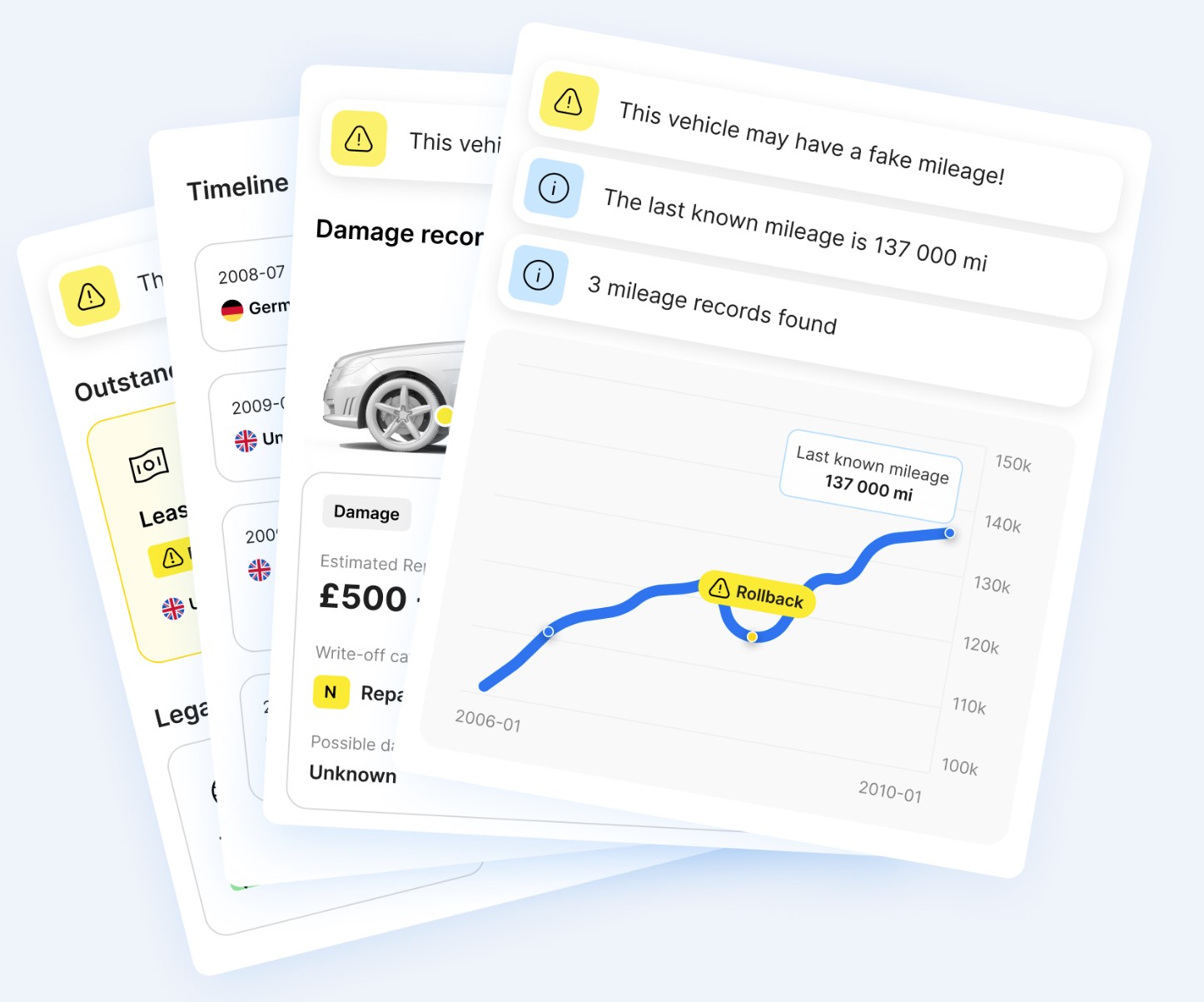
A VIN history check is a practical way to reduce risk before you travel or commit. A report can highlight warning signals such as mileage inconsistencies, cross-border registrations, and other red flags. We explain the process and provide a discount option on our dedicated page.
Useful before you visit:
VIN check with carVertical report (−20%)Tip: do the VIN check first, then the on-site inspection and diagnostics. It saves time and filters weak options early.
Insurance and eVB code: what matters
To register a vehicle at the Zulassungsstelle you need an eVB code (electronic proof of insurance), at least for Kfz-Haftpflicht. This applies to standard registration and to temporary/export plates. If this topic is new to you, start with the simple explanation page.
Recommended reading:
Car insurance in Germany & what the eVB code is (simple guide)In practice, it’s smart to request the eVB close to your registration date so it does not expire.
Werbung / *Affiliate-Link
Links and banners marked with an asterisk (*) are affiliate links/banners. If you use such a link and subsequently request an offer, sign a contract or make a purchase, we receive a commission from the respective provider. For you, there are no disadvantages: the price and conditions remain the same.
FAQ — common questions
What is more important: low mileage or service history?
Service history is often more valuable. Low mileage without supporting documents is not a guarantee. A complete service book, invoices and HU reports with consistent mileage progression matter more than a single number.
How can I filter “bad” listings before travelling?
Look for sufficient photos, clear text, valid HU/TÜV, transparent ownership and maintenance, and willingness to share VIN/documents. Pressure to send a deposit and refusal to answer basic questions are strong reasons to walk away.
Do I still need a VIN report if the seller says “accident-free”?
Yes. A VIN report is an additional verification layer. It helps spot inconsistencies and warning signals that are not obvious from the listing.
When should I arrange insurance and get the eVB code?
You need eVB at the registration stage. Often it’s best to obtain it close to your registration date. The step-by-step explanation is on our insurance & eVB page.
Related posts
VIN check with carVertical report (−20%)
 Car insurance in Germany: what eVB is (simple guide)