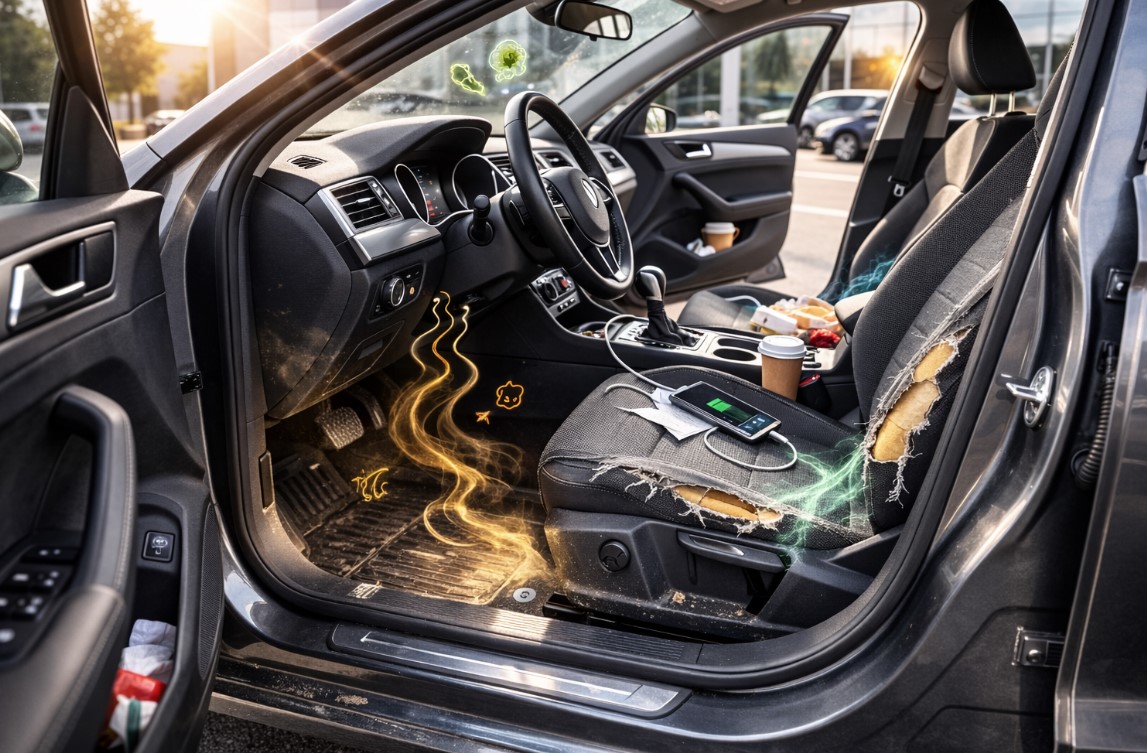
What a healthy used car should smell like
A normal used car smell is typically neutral: no strong damp/musty odor, no aggressive “chemical perfume”,
no burning smell, and no fuel or coolant odor. A slight plastic scent can be normal in newer cars.
A mild “technical” smell in the engine bay can also be acceptable—if it is not sharp and there are no signs of leaks.
If the car smells “too pleasant”, that can also be a warning sign.
Strong fragrances are often used to mask dampness, cigarette smoke, or technical odors (oil/coolant).
Why smell is a strong tool in a pre-purchase inspection in Germany
During our used car inspection Berlin, we check:
- cabin odor with windows closed;
- odor after switching the heater on;
- odor after switching the A/C on;
- trunk odor;
- spare-wheel well and under-carpet areas;
- engine-bay odor after warming up.
Smell often reveals what you can’t see: moisture under carpets, small coolant leaks,
overheating wiring, oil mist in the engine bay, or consequences of poor repairs after an accident.
Common odors in used cars and what they usually mean
1) Damp / musty smell (mold-like)
What it can mean:
- water damage or flood history;
- leaking windshield seal or door seals;
- clogged drains (sunroof/cowl area);
- water intrusion after an accident repair;
- moisture trapped in the trunk well / under carpet insulation.
Why it’s dangerous: corrosion of wiring/connectors, electronic failures, control unit issues,
oxidized contacts. Musty smell is hard to eliminate completely—mold often returns if the source remains.
Advertisement / *Affiliate link
Links and banners marked with an asterisk (*) are affiliate links. If you use them to make a purchase (e.g., order a report),
we may receive a commission from the provider. There is no extra cost for you: the price and terms remain the same.
2) Coolant smell (sweet odor)
Common causes:
- heater core leak;
- hose/connection leak;
- micro-crack in the cooling system;
- engine overheating in the past.
A sweet coolant odor in the cabin is a serious sign.
Depending on the model, repairs can be expensive—especially if the heater core is involved.
3) Burnt oil smell
Often noticeable after the engine warms up.
Typical causes: oil leaking onto the exhaust manifold, valve cover gasket seepage, turbo oil issues.
We always correlate the smell with visible leak traces and the condition of the engine bay.
4) Gasoline or diesel smell
Can indicate:
- fuel system leak;
- damaged fuel lines;
- injector leakage;
- leaks around the fuel filter / connectors.
This can be costly and potentially dangerous.
5) Burnt wiring / electrical smell
One of the most alarming signals. Possible causes: short circuit, alternator overheating,
fuse box problems, accident aftermath, or poor aftermarket installations.
Risk: fire hazard. Proper electrical diagnostics is required.
6) Cigarette smoke smell
Nicotine gets embedded into the headliner, seats and HVAC system.
Fully removing smoke smell is very difficult—ozone treatment helps, but it’s not always a 100% solution.
7) Strong air freshener / heavy perfume
If the car smells intensely “fresh”, it often means someone tried to mask:
dampness, cigarette smoke, or technical odors (oil/coolant).
Before buying, check hidden areas: trunk, spare-wheel well, carpets and air vents.
Odors under the hood and after a test drive
During a pre-purchase inspection in Berlin we evaluate:
- ✔️ smell after cold start;
- ✔️ smell after warm-up;
- ✔️ exhaust smell;
- ✔️ smell of oil/burning after a short test drive.
Burning smell after driving
It can mean:
- ☝ clutch slipping (manual);
- ☝ brakes overheating (stuck caliper / worn pads);
- ☝ transmission overheating under load (automatic/DSG);
- ☝ oil on hot components (manifold/turbo area).
What is almost impossible to remove completely
| Odor |
Can it be fully removed? |
Buyer note |
| Smoke (tobacco) |
Usually only partially |
Deep cleaning + ozone can help, but odor often returns from HVAC and upholstery. |
| Dampness after water damage |
Very difficult |
If moisture is trapped in insulation/carpet, the interior may need disassembly to fix it properly. |
| Burnt wiring |
No (not “a smell problem”) |
This is a symptom of an electrical fault—diagnostics and repair are required. |
| Coolant smell |
Only after repair |
The leak source (heater core/hoses/radiator) must be fixed first. |
| Mold in insulation |
Almost impossible |
Often comes back if the moisture source is not found and eliminated. |
How to fight odors (realistic steps)
- 📜 Deep interior cleaning — effective for surface contamination.
- 📜 Ozone treatment — helps reduce bacteria and some odors.
- 📜 Replace cabin filter — mandatory if odor comes from ventilation.
- 📜 HVAC cleaning — reduces mold risk in the evaporator area.
If the odor source is a hidden technical issue (e.g., water in insulation), you can’t solve it by “masking”.
When buying, it’s more important to find the cause than to “cover the smell”.
Real cases from Berlin inspections
Case 1: BMW with hidden water intrusion
The car looked perfect. Slight musty smell in the trunk.
Inspection found moisture traces under the trunk carpet and in hidden wells.
Risk: corrosion of connectors and future electronics issues.
Case 2: VW Passat with coolant smell
Clean interior, visually fine. After turning the heater on—a sweet smell.
Diagnostics pointed to a heater core leak (the source was not visible without deeper checks).
Why DIY checks often fail
- people adapt to smells quickly (nose “gets used to it”);
- sellers may pre-ventilate the cabin or warm up the car;
- air fresheners mask problems for a short time;
- odor sources are often hidden: under carpets, spare-wheel well, HVAC ducts.
Smell is a symptom. It is usually linked to a fault, corrosion, poor repairs or hidden damage.
That’s why we evaluate odors together with OBD diagnostics, body inspection and a test drive.