
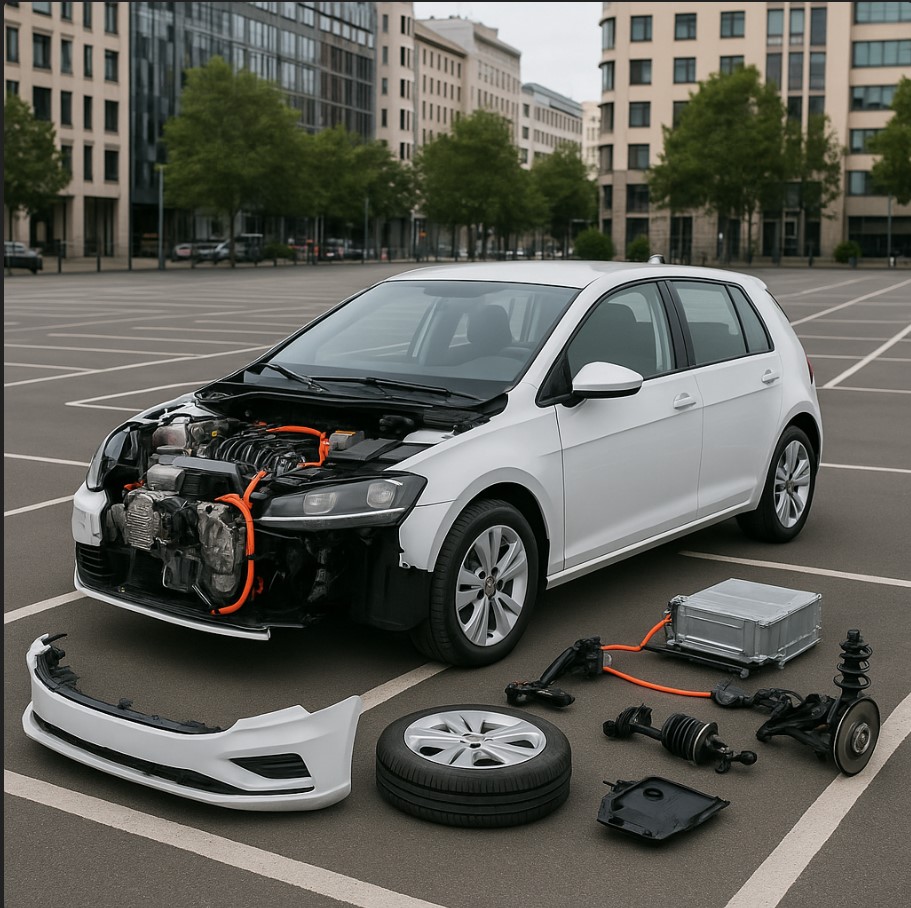
Introduction. Hybrid and electric cars are becoming more and more common on the used car market in Germany. On paper they sound perfect: lower running costs, modern technology, quiet drive. But when buying a used hybrid or EV there are a few extra boxes you must tick — most of them related to the high-voltage battery and electronics. A normal pre-purchase check is not enough here: it should be complemented with specialised diagnostics of the hybrid or electric system. Not every workshop has real experience with such cars, so the approach needs to be expert-level.
In this article we’ll go through what to look at in detail when checking hybrids and EVs before buying. We’ll cover battery diagnostics, electric motors and inverters, share some interesting facts about reliability and efficiency and give a few practical tips on how to look after these cars so that your purchase serves you well for years.
Why the battery is the key component in a hybrid or EV
In a conventional car, the “heart” is the combustion engine. In a hybrid — and even more so in an electric car — this role is taken over by the traction battery. It is also one of the most expensive components: for some EVs the battery alone can represent up to half the value of the car. Misjudging its condition means taking a very expensive risk. Battery replacement on an EV can cost anything from around €6,000 to €20,000 depending on model and capacity. Hybrid packs are smaller and cheaper, but still usually run into several thousand euros.
That’s why checking the battery before you buy is task number one. You cannot assess its health from the outside: you need a diagnostic tool. Many hybrids and EVs show some battery data on the dashboard, but the full picture comes only from computer diagnostics of the high-voltage battery.
What battery diagnostics includes (SoH, cell balance, BMS & more)
-
📌 State of Health (SoH):
SoH shows how much capacity the battery can still store compared to when it was new. A new pack is at 100%. Over time this number goes down. On average you might see around 2–3% loss per year, but it strongly depends on use and climate. Many modern EVs still have 80% or more capacity after 5–7 years, which is better than early pessimistic forecasts — but there are also examples of heavy degradation when the car was used poorly (fast charging to 100% every day, heat, constant motorway abuse and so on). -
📌 Cell balance (voltage spread):
The traction battery consists of many individual cells. A good scanner can read the voltage of each cell or module. If the spread is too high (for example, 0.2–0.3 V difference or more in a hybrid module), this shows that some cells are tired and the pack is imbalanced. In an ideal world all cells are at very similar voltage. A large imbalance means the battery can neither charge nor discharge efficiently and may soon need repair or partial replacement. -
📌 Charge / discharge cycles:
Some systems record how many full cycles the battery has gone through. A very high number of cycles naturally correlates with ageing. Access to this information is often limited to dealer tools, but where available it provides another piece of the puzzle. -
📌 Internal resistance & temperature behaviour:
Increasing internal resistance is another indicator of ageing: the voltage drops more under load and the pack heats up faster. Diagnostics can reveal if the battery runs unusually hot or if certain modules stand out. -
📌 BMS error history:
The Battery Management System (BMS) stores error codes and events: past overheating, insulation faults, activation of safety limits, too many deep discharges, etc. All this helps to understand whether the battery has been stressed or abused in the past.
On hybrids the same principles apply, just on a smaller scale. For example, in popular Toyota hybrids the high-voltage pack consists of multiple Ni-MH modules: if one module is weak, the whole system suffers. Proper diagnostics will show which modules are out of line.
How to inspect a hybrid before buying
Besides the battery, a hybrid combines a combustion engine with an electric drive. When inspecting a hybrid, pay attention to the following:
🛠️ Engine behaviour in hybrid mode
- Watch how often and when the engine starts. In a typical full hybrid the ICE starts periodically to charge the battery or provide extra power. Ideally the start should be smooth and quick, without strong vibrations or knocking. Rough starts, shaking or smoke from the exhaust pipe are red flags.
- The engine should not constantly run at high revs without good reason. Irregular idling, rough running or strong vibrations are reasons for deeper inspection.
🛠️ Switching between EV and engine
- During a test drive, observe how the car changes between pure electric and hybrid modes. At low speed and gentle throttle it should be able to drive on the electric motor alone (if the battery is charged). Transitions between EV and engine should be barely noticeable.
- If the engine runs almost all the time, even with a full battery, this may be a sign of reduced battery capacity or issues in the control logic.
🛠️ Transmission (e-CVT and others)
- Many hybrids use an e-CVT (electronically controlled continuously variable transmission) based on a planetary gear set that connects ICE and e-motors. It should feel smooth and quiet. No loud whining, grinding or harsh jerks when accelerating.
- These units are usually very reliable, but if they do fail, repairs are expensive – so any strange noises deserve attention and a professional check.
🛠️ Cooling for inverter & battery
- Hybrids have an inverter that can get very hot under load. Make sure there are no error messages related to hybrid system overheating. Some models have a separate coolant pump for the inverter: if it fails, the system overheats and warning lights appear.
- Check visually for coolant leaks around the inverter and the battery cooling pipes. In many cars the battery has an air intake grille in the cabin or boot — if it’s clogged with dust, the pack may overheat and age faster. The intake should be clean and the fan unobstructed.
🛠️ Brakes & recuperation
- Hybrids use regenerative braking: the electric motor works as a generator and slows the car while charging the battery. At light braking you should feel mostly smooth deceleration from recuperation, with hydraulic brakes coming in more under strong pedal pressure.
- Jerky transitions, strange noises or inconsistent pedal feel may indicate problems with the brake system or with the blending between recuperation and friction brakes.
🛠️ “Normal” components
- Don’t forget: a hybrid is still a car. Suspension, bodywork, steering, electronics — all the usual checks apply. Just keep in mind that repairs on high-voltage parts (inverter, battery, electric motors) are usually more expensive than work on a normal ICE car, so you want to know exactly what you’re buying.
Specifics of checking a pure electric car (EV)
When inspecting a pure EV there is no combustion engine at all, so your attention naturally shifts to the electric drivetrain:
-
🔥 Range & indicated state of charge:
Look at the dashboard: what is the current state of charge and what range is predicted? If possible, do a longer test drive (20–30 km) and compare how the percentage and predicted range change. A worn battery can show unstable SOC readings (percentage drops quickly under load) and unrealistic range estimates. -
🔥 BMS diagnostics:
As with hybrids, only proper diagnostics can tell the full story. For some models there are specialised apps (like LeafSpy for the Nissan Leaf) that read SoH and cell data. If the seller says “everything is perfect”, ask whether you may plug in an OBD adapter or bring an expert to scan the car. -
🔥 Charging behaviour:
If you can, check how the car charges. Plug it into a home wallbox or at least a normal socket and watch the process: does charging start reliably, is the power level as expected, are there interruptions or error messages? Faults in the charging port or onboard charger are not always obvious, but can be expensive to fix. -
🔥 Battery cooling:
Some EVs have liquid-cooled packs (Tesla, many newer models), others have passive air cooling or none at all. Overheating leaves traces: frequent fan noise, messages about high battery temperature, strong throttling of fast charging. Visually check radiators where relevant and the coolant level in the dedicated HV coolant circuit if the car has one. -
🔥 Electric motor & reduction gear:
The electric motor itself is simple and usually very durable. During the test drive listen for its sound: typically you should hear only a smooth, quiet whine that changes with speed. Loud howling, grinding or rumbling can indicate issues with the reduction gear (single-speed gearbox). -
🔥 Brakes, suspension & tyres:
Because of recuperation, brake pads on EVs wear more slowly — but they can also seize from lack of use. Check braking at various speeds and listen for noises. Suspension carries more weight because of the battery, so shocks, springs and bushes deserve careful inspection. EVs also tend to wear tyres faster thanks to instant torque and higher mass. -
🔥 High-voltage cabling & safety:
High-voltage cables are usually orange and well protected under the car. If you can safely look underneath, check for obvious damage or amateur repairs. In the engine bay all HV connectors and covers must be present and properly locked — missing caps or improvised fixes are a no-go.
Interesting facts about electric drivetrains: reliability, efficiency & software
-
👓 Electric motors are extremely robust.
An electric motor has far fewer moving parts than a combustion engine: essentially rotor, stator and bearings. No pistons, valves, timing chains, oil filters, etc. This simplicity translates into high potential longevity: many EVs cover hundreds of thousands of kilometres on original motors without issues. -
👓 Recuperation saves brakes (but not tyres).
Thanks to regenerative braking, many EV owners only change brake pads and discs after very high mileage. Tyres, however, can wear faster because of the high torque and extra weight — sometimes up to 20% quicker than on a comparable ICE car. -
👓 Energy efficiency is far higher.
The efficiency of an electric motor is often above 90%, while a typical combustion engine manages roughly 30%. That means far more of the stored energy is converted into movement, not heat. Many EVs cover 5–8 km per kWh, which roughly corresponds to less than 2 litres of petrol per 100 km in energy terms. -
👓 Temperature matters.
EVs are more sensitive to ambient temperature. In winter the range drops due to cold batteries and heating demands; in summer, air conditioning and battery cooling increase consumption. Cold itself is not very harmful to batteries (mainly it temporarily reduces capacity), whereas heat is the main enemy: high temperatures accelerate degradation. -
👓 Software plays a big role.
Many aspects of hybrid and EV behaviour are controlled by software. Manufacturers regularly release updates that can change charging strategies, range estimation or power delivery. Having up-to-date software can noticeably improve everyday usability — dealer diagnostics often includes checking module firmware versions.
Tips for battery & hybrid system care
Since the lifetime of the battery strongly depends on usage, here are a few simple rules for future hybrid and EV owners:
📜 Charging habits
- Avoid extreme states of charge whenever possible. Don’t keep the battery at 100% all the time and try not to run it down to 0% regularly. For daily EV use, charging to around 80% and staying above 10–20% is a good compromise.
- Use fast DC charging (rapid chargers) mainly on long trips. At home or work, slow AC charging is kinder to the battery and helps keep temperatures down.
📜 Temperature management
- If your car offers pre-conditioning, use it: heating or cooling the battery and cabin while plugged in reduces stress in daily use. Avoid leaving the car parked in direct summer sun for long periods; in winter be aware that range will be lower and plan accordingly.
- Where possible, park in the shade or in a garage. For liquid-cooled packs, keep an eye on coolant levels and leaks in the dedicated HV cooling circuit.
📜 Hybrid maintenance
- Hybrids still have combustion engines, so oil, filters, spark plugs and coolant all need regular changes according to schedule. The coolant for the inverter / battery circuit also has a service interval.
- Don’t forget the small 12-volt battery: paradoxically, many hybrids and EVs “fail to start” simply because the 12 V battery is weak, even if the main pack is fine.
📜 HV safety & service
- High-voltage systems require specific training and equipment. Do not attempt DIY repairs on HV components. Choose workshops with proven experience in hybrids / EVs.
- For pre-purchase checks, involving a specialist who works with these drivetrains every day is usually cheaper than discovering a battery or inverter problem after you have paid for the car.
Conclusions: let professionals check the hybrid or EV for you
Computer diagnostics of hybrids and electric cars before buying in Germany is not a luxury – it’s a necessity. Compared to buying a conventional ICE car, you have a few extra things to consider, and the high-voltage battery is at the top of that list. Only when you know its true condition can you realistically judge range, running costs and the real value of the car.
If you don’t have the tools or experience to evaluate a hybrid or EV on your own, it makes sense to get support from specialists. Sicher-Check provides car-buying assistance and expert pre-purchase inspections across Germany, including modern hybrids and electric cars. We perform full diagnostics: reading battery SoH, checking cell balance, analysing BMS data, testing electric motors and inverters and, where relevant, inspecting the combustion engine and all “normal” car systems.
Our car buying service in Berlin / Germany is designed to protect you from unpleasant surprises with complex modern vehicles. We prepare a clear written report and a simple recommendation: buy / don’t buy, plus comments on potential costs in the near future.
SoH, BMS, inverter, electric motor and recuperation should all be checked before the deal. If you don’t have the equipment or experience, the Sicher-Check team will take care of the complete inspection for you and prepare a detailed report in English, German or Russian.
Werbung / *Affiliate-Link
Links and banners marked with an asterisk (*) are affiliate links/banners. If you use such a link and subsequently request an offer, sign a contract or make a purchase, we receive a commission from the respective provider. For you, there are no disadvantages: the price and conditions remain the same.