
In a nutshell: there are more technologies now — comfort and safety are higher. But when buying a used modern car you must do a full computer diagnostics, check the VIN history, measure paint thickness and do a proper test drive. We can help with pre-purchase inspections in Berlin, Potsdam and across Germany.
Imagine a driver with 30 years of experience who has always driven cars from the 1990s and 2000s. Hundreds of thousands of kilometres behind the wheel, everything is familiar: a metal key turns in the ignition, the dashboard has a minimum of warning lights, and parking is done using mirrors and gut feeling. Now this very experienced driver decides to upgrade — he looks at something from, say, 2015… and suddenly everything is different. No ignition lock, just a Start/Stop button. The car beeps and flashes constantly while driving, the engine switches off by itself at traffic lights and on top of that there is some mysterious AdBlue that has to be filled up. A bit scary? Yes. In this article we explain which new technologies you’ll find in modern cars and how to use them, so that moving from an “old-school” car to a newer one is smooth and stress-free.
Keyless entry and push-button start — how to live without a metal key?
Keyless Go makes access easier: keep the fob on you and the car will unlock and allow you to start the engine with the Start/Stop button. A few useful points:
The first surprise for many “old-school” drivers is the keyless entry system. There is no traditional ignition lock: instead you get an electronic fob and a start button. The logic is simple: the car detects the fob near the doors, unlocks them automatically and lets you start the engine with one press of the button. No need to take the key out of your pocket — the electronics recognise it by radio signal. The main advantage is comfort. The downside is a higher risk of relay-attack theft with electronic “signal boosters”. That’s why we recommend storing the fob at home in a shielding pouch and not keeping it right by the front door.
Using the Start/Stop button is easy: press the brake (or the clutch in a manual) and press the button — the engine starts. Press it again to switch the engine off. A short press without brake usually turns on ignition and accessories (ACC/ON) without starting the engine. The button itself is reliable, but don’t forget to change the fob battery every 1–2 years. If the battery is empty, the car might not see the key. Fortunately, all keyless cars have a backup solution: there is a hidden mechanical key inside the fob for the door, and there is usually a special slot or marked area in the cabin where you can hold the fob so the car can read it even with a weak battery (details are in the owner’s manual).
- ✔️ Security: use an RFID-shielding pouch at home to protect against relay attacks and avoid storing the fob right by the entrance door.
- ✔️ Flat fob battery: a mechanical key is hidden inside the fob for the driver’s door; to start the car, hold the fob near the marked area in the cabin and press the button while pressing the brake / clutch.
- ✔️ Button modes: a short press without pedals usually enables ignition / accessories (ACC/ON) without starting the engine.
Stop-start system: engine switches off by itself — and that’s normal
Our experienced driver finally sets off in his new car… and at the very first traffic light his heart skips a beat: the engine suddenly dies! There is no key to turn, he reaches for the hazard lights in panic… and then, as soon as he lifts his foot off the brake, the engine starts again. No magic here — this is the automatic stop-start system doing its job. It switches off the engine at short stops to save fuel and reduce emissions. In city traffic this feature can noticeably reduce consumption.
Many drivers don’t like it: frequent restarts feel odd and there is a myth that it “kills the starter”. In practice, starters and batteries in cars with stop-start are reinforced and designed for these cycles. If you still don’t like the system, there is usually a separate button (often with an A) that allows you to switch it off. On many cars the system will turn back on automatically at the next start — this is just how manufacturers configure it for emissions tests.
The key message: the engine shutting down by itself at a red light is not a breakdown but a feature. The car will restart automatically when you want to move off.
Parking sensors, cameras and auto-parking — less stress in tight spaces
Parking sensors beep faster the closer you get to an obstacle; a reversing camera shows coloured guidelines; more advanced systems offer a 360° surround view and even auto-parking. You can always interrupt auto-parking by touching the steering wheel or pressing the brake.
The next surprise often comes on the car park. In older cars you had to “feel” the distance with mirrors and experience. In a modern one, as soon as you select reverse, the cabin fills with beeps — that’s the parking sensors. The closer the obstacle, the more intense the beeping. A continuous tone usually means just a few centimetres remain. Most cars also show a simple visual representation of the distance on the screen.
A reversing camera makes life even easier. When you select reverse, a full-colour image appears on the infotainment screen. Guidelines show where the car will go. Many drivers are sceptical at first and still turn around, but quickly get used to trusting the camera. Some models add a 360° view — several cameras combine to show a bird’s-eye view of the car as if a drone hovered above it.
Top-spec cars can even park themselves. Auto-parking systems search for a suitable space, then take over the steering and sometimes throttle and brakes. Your job is just to monitor and be ready to intervene. If you touch the steering wheel or press the brake, auto-parking is cancelled. At first it feels strange to give control to the car, but in tight city streets it quickly becomes a very useful tool.
Driver assistance systems — an electronic guardian angel
On the way home our driver notices that the car sometimes “wants” to steer and brake by itself. The steering wheel vibrates and gently resists if he drifts towards the lane markings while checking the sat-nav. A warning chime and a symbol on the dashboard appear when the car ahead slows down too quickly. Welcome to the world of ADAS — Advanced Driver Assistance Systems.
Lane assist uses a camera to detect road markings and gently keeps the car in the centre of its lane. If you start to leave the lane without indicating, it assumes this is unintentional and either corrects the steering or warns you with vibration / sound. Forward collision warning monitors the traffic ahead with radar; in an emergency it warns you and, if you don’t react, can apply the brakes to reduce the impact.
In traffic and on motorways adaptive cruise control makes life easier — it keeps the set speed and automatically adjusts the distance to the car in front, slowing down and accelerating the car for you. Headlight systems have also improved enormously: automatic high beam switches between high and low beam for you and modern matrix LED headlights can selectively shade out other road users while still illuminating the rest of the road.
All this is no longer science fiction but reality in many 2015–2020 cars. At first the beeps and interventions can be annoying, but once you understand what each system does, they make driving safer and less tiring. The main thing is to read your car’s manual, learn which assistants are installed and where their settings and on/off buttons are — just in case a particular function doesn’t suit your driving style.
Diesel and AdBlue: extra tasks in exchange for lower emissions
AdBlue is a 32% urea solution used in the SCR system. It is stored in a separate tank and is injected into the exhaust. Typical consumption is around 1–2 litres per 1,000 km. If the tank runs completely dry, most modern diesels will refuse to start until you refill the system. Keep an eye on the AdBlue warning light and, for the DPF, give the car an occasional “hot run” on the motorway so it can regenerate the filter.
Almost all Euro 6 diesels are equipped with an SCR (Selective Catalytic Reduction) system using AdBlue. For the driver this means: in addition to diesel fuel you have a second fluid to top up at intervals. The filler cap is usually next to the fuel cap or under the bonnet. AdBlue consumption is roughly 3–5% of fuel consumption by volume, depending on engine and driving style. If you ignore the warning and drive until the system is empty, the car will not start again until you refill — manufacturers are required to enforce this to meet emissions law.
Apart from that, owning a modern diesel is straightforward: use good-quality fuel, don’t interrupt DPF regenerations too often and occasionally drive a longer stretch at higher speeds so the filter can regenerate. Then a Euro 6 diesel can be a very efficient, long-lasting companion.
| Key point | Why it matters |
|---|---|
| ❗ Separate AdBlue filler | Don’t confuse it with the diesel filler — AdBlue always has its own cap / connector. |
| ❗ Don’t ignore warnings | At zero AdBlue level the car will block engine start until you refill. |
| ❗ Use quality fluid | Buy certified AdBlue and avoid storing it for long periods in high heat. |
Other modern features: electronic handbrake, Auto Hold, CarPlay, digital dash
The list of modern technologies could go on for pages. Here are a few more things that often puzzle drivers who are used to older cars:
- 📌 Electronic handbrake and Auto Hold — the classic lever is replaced by a small switch. One pull engages the brake via electric motors. Many cars release it automatically when you drive off. Auto Hold keeps the car stopped at traffic lights so you don’t have to keep your foot on the brake — strange at first, very convenient once you get used to it.
- 📌 Hands-free tailgate — instead of juggling bags and keys, you just move your foot under the rear bumper (with the key in your pocket) and the boot lid opens by itself.
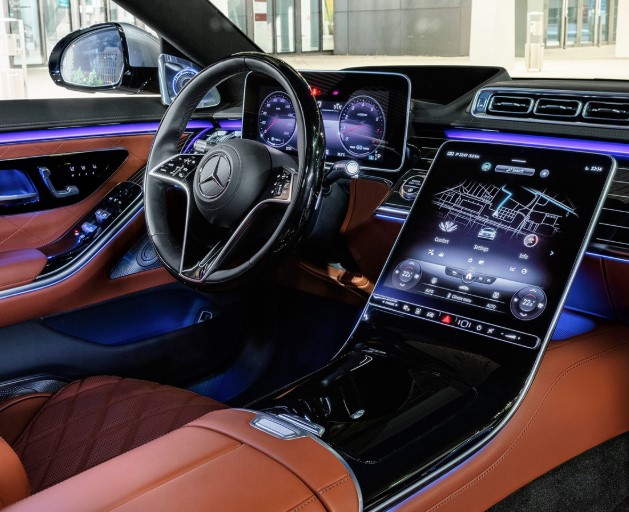
- 📌 Digital instrument cluster — analogue dials are increasingly replaced by screens. You can often customise the layout, change styles and even display the navigation map between the “dials”. It looks very modern but may take a little time to get used to if you grew up with simple clocks.
- 📌 Apple CarPlay / Android Auto — connect your phone and use its apps on the car’s screen. Music, calls, messages and navigation all integrate into the infotainment system and steering-wheel buttons. For someone used to a simple radio this is a mini-computer on wheels — but it makes travelling much easier and safer once set up correctly.
Buying a modern used car? Don’t skip professional diagnostics
Modern technologies make cars more comfortable and safer, but they also add complexity when buying used. For an untrained eye it is almost impossible to assess the condition of all these systems. If you are looking at a modern car (roughly 2015 or newer) on the German used market, we strongly recommend a full pre-purchase inspection and diagnostics. Our team helps you buy the right car at the right price — without nasty surprises.
Professional car sourcing in Germany is what we do every day. We react quickly (often with same-day visits), thoroughly inspect the car with trusted diagnostic equipment, measure paint thickness, perform a test drive and carry out a complete visual and technical check. You receive a detailed written report with photos and an independent verdict on the car’s condition. A history check is included: our standard package (from €200) includes a VIN report via CarVertical and other sources.
We speak English, German, Russian, Polish and Ukrainian, so we can handle communication with the seller and paperwork for you. With our help, switching to a modern car becomes a controlled process instead of a gamble — you’ll know what you are buying and can negotiate with confidence. Get in touch with Sicher-Check for a consultation and let modern car tech become a pleasure, not a source of stress.
- 💯 VIN report & history: mileage, owners, accidents, service records, valid TÜV (we provide a report, including CarVertical).
- 💯 Computer diagnostics: error codes in all ECUs, mileage / engine hours, gearbox adaptations, battery and sensor status.
- 💯 Electronics: keyless operation, buttons, cameras / radar, matrix lights, parking sensors, Auto Hold, infotainment / CarPlay.
- 💯 Mechanics: paint thickness, leaks, brakes / suspension, fluid levels and condition; for diesels — DPF / AdBlue.
- 💯 Test drive: Start/Stop behaviour, vibrations, gearshifts, auto-lights, assistants and noises at motorway speeds.
Werbung / *Affiliate-Link
Links and banners marked with an asterisk (*) are affiliate links/banners. If you use such a link and subsequently request an offer, sign a contract or make a purchase, we receive a commission from the respective provider. For you, there are no disadvantages: the price and conditions remain the same.