
 Keyless entry, AdBlue and other surprises of modern cars
Buying a used car in Germany is a serious step, especially if you want to avoid nasty surprises. Shiny paint and low mileage on the odo do not guarantee that the car is technically sound. Combine VIN history, a proper body and paint inspection, checks of the engine, electronics, a thorough test drive and a OBD scan. In Berlin and across Germany we can help you go through the whole process quickly and officially.
Below you will find a step-by-step guide to inspecting a used car before purchase — relevant for the whole of Germany, with a special focus on the large used-car market in Berlin.
Step 1: Check the documents and vehicle history (VIN)
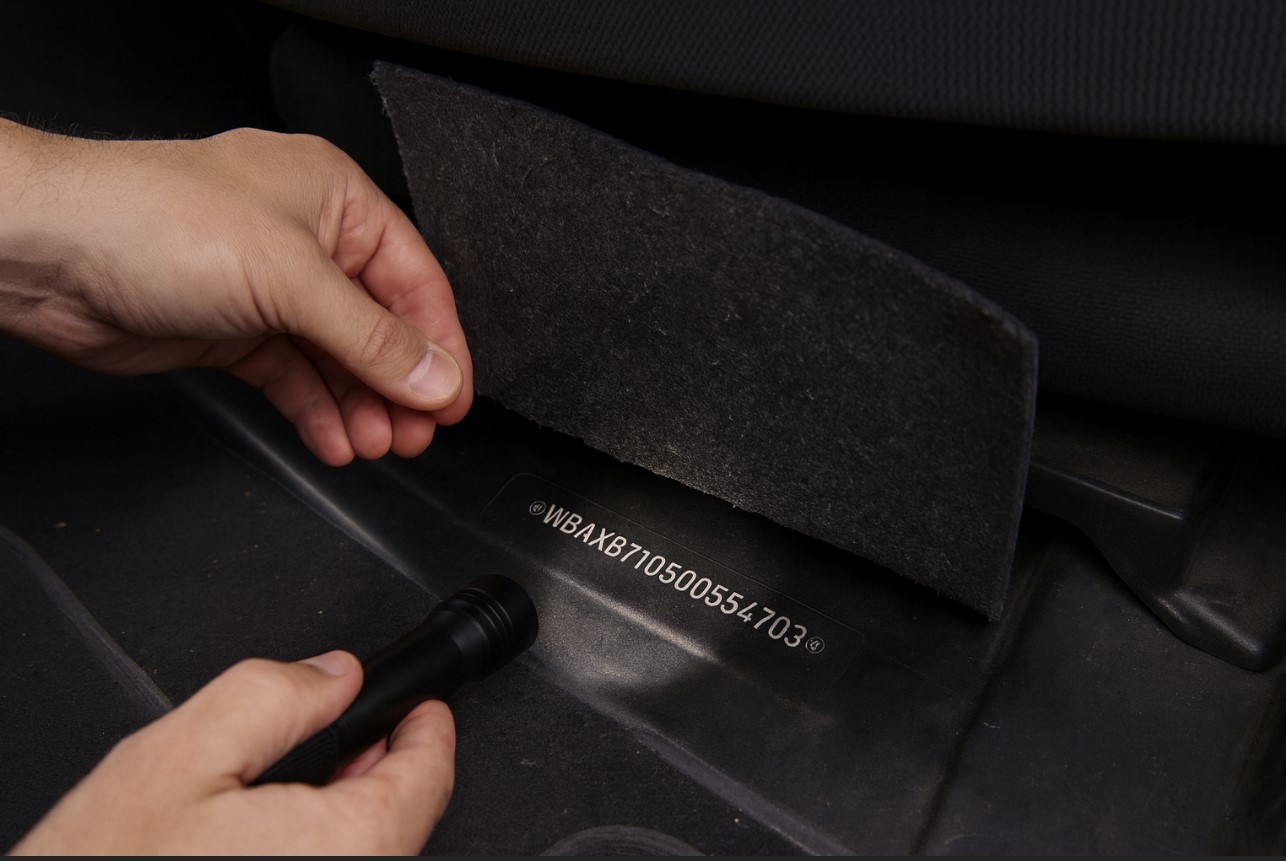
Start with the paperwork. The seller should provide a complete set of documents: registration certificate (Zulassungsbescheinigung Teil I & Teil II), a valid TÜV (HU/AU), and, ideally, a stamped service book or digital service history. Compare the VIN (vehicle identification number) stamped on the body with the VIN in the documents. Any mismatch or missing documents is a red flag. Also make sure the seller is actually the owner or legally authorised to sell the vehicle (ID check, company papers if it is a dealer).
VIN history. With the VIN you can try to get additional history — for example via a report from carVertical or Carfax. Such a report may show previous registrations, recorded accidents, mileage entries and service events. Keep in mind though: in Germany there is no single mandatory database where every car’s full history must be recorded (unlike, for example, CarPass in Belgium). Due to strict privacy laws, a lot of data is only transmitted with the owner’s consent. That’s why a VIN report is a helpful tool, but not an ultimate guarantee. It is good to reveal obvious issues (recorded accidents, odometer rollbacks), but a “clean” report does not automatically mean that the car is perfect.
Ask for the full pack: Zulassungsbescheinigung Teil I/II, current TÜV (HU/AU), and service records. Check the VIN on the body, plates, and documents, and verify the seller’s identity. Missing or inconsistent items should make you cautious.
VIN reports (carVertical/Carfax) help you filter obvious risks, but in Germany data is fragmented and depends on the source and owner consent. Use reports as a filter, not as a replacement for on-site inspection and diagnostics.
| What to check | Why it matters |
|---|---|
| Teil I/II, HU/AU, service records | Confirms legal ownership and validity of technical inspection |
| VIN match (body ↔ documents) | To rule out tampering and legal risks |
| Seller’s identity / power of attorney | Confirms the right to sell the car |
| VIN report (carVertical/Carfax) | Helps detect obvious problems or inconsistencies |
Step 2: Exterior inspection — bodywork and paint
Inspect the car in good light (ideally in daylight, dry weather). Look for signs of body repairs or accidents: colour differences, misaligned gaps, unusually new headlights or panels on one side.
- ✔️Colour and panel gaps. Check if the colour shade and paint texture are the same on all panels. Freshly repainted elements, slightly different tone or orange-peel texture may indicate repairs after an accident. Pay attention to gaps between doors, bonnet, wings and bumpers — they should be even. Crooked gaps and panels that sit too deep or stick out may signal structural damage.
- ✔️Rust spots and dents. Look at the sills, wheel arches, and lower edges of doors and tailgate for rust. Light surface rust on older cars is acceptable, but perforation or bubbling paint is a serious warning. Scan the car for dents, especially on bumpers and door edges – typical parking damage.
- ✔️Glass and lights. Check the windscreen for cracks and large chips. All lights should be intact and free of water inside. Very new headlights on just one side can also point to accident repair.
If possible, use a simple magnet and a paint thickness gauge. A thickness gauge will reveal filler and heavy repaint under the surface. A magnet helps to detect areas where there might be a thick layer of filler instead of metal.
Step 3: Under the bonnet
Open the bonnet and carefully inspect the engine bay:
- ✔️Leaks and fluid levels. Check engine oil, coolant and brake fluid levels. Oily dirt around the engine, gearbox or undertray, or fresh traces of coolant, may indicate leaking gaskets, seals, radiators etc. An engine that is suspiciously steam-cleaned and shiny right before sale can also be a sign that someone tried to hide leaks.
- ✔️Belts and hoses. Drive belts should not be cracked or frayed. Coolant hoses should be flexible without deep cracks. Make sure the battery is firmly mounted and its terminals are not heavily corroded. If possible, look at the radiator and intercooler with a torch – are there bends, leaks or stone damage?
- ✔️Start-up and exhaust smoke. If you can, start the engine cold and later again when warm. Listen for abnormal noises (knocking, rattling). Rough idle, misfires or strong vibrations are a bad sign. Pay attention to the exhaust: blue smoke points to oil burning, thick black smoke on a diesel can indicate injector or turbo issues.
Step 4: Interior and electronics
The interior also tells a lot about mileage and how the car was treated:
- ✔️Wear and tear. Check the driver’s seat, steering wheel, gear knob and pedals. If the advertised mileage is low (e.g. 80,000 km) but the steering wheel is heavily worn, the seat is sagging and the pedal rubbers are almost gone, the odo value is suspicious. On the other hand, very fresh seat covers, a brand-new steering wheel cover and new pedal rubbers can sometimes be used to hide heavy wear.
- ✔️Instrument cluster and warning lights. Turn on the ignition and make sure all warning lights come on and then go off after the engine starts. No warning lamps such as “Check Engine”, ABS, Airbag etc. should remain lit. If any stays on, you need to investigate – that can hide serious issues.
- ✔️Climate control and electrics. Test the air conditioning and heater — the AC should blow cold, the heater hot. Check power windows, mirrors, central locking, lights, wipers, seat heaters and other options. These faults are not always critical, but they affect comfort and add to your repair budget.
Step 5: Test drive
A proper test drive is essential. Ask for a drive before making any decision. During the drive, pay attention to:
- ✔️Engine and gearbox. The car should accelerate confidently without hesitation. On a manual gearbox the gears should engage without grinding; on an automatic or DSG, shifts should be smooth and predictable. Jerks, delays or slipping are a warning sign for engine or transmission issues.
- ✔️Brakes. On a clear, straight road try a few brake tests. The car should slow down evenly without pulling to one side. Strong squealing, grinding noises or a very soft pedal can point to worn pads/discs or problems in the braking system.
- ✔️Suspension and noises. When driving over bumps you should not hear loud knocks from the suspension. The car must keep a straight line, and the steering wheel should not vibrate strongly at speed. Listen for wheel bearing hum, whistling belts or any strange vibrations.
Compare your driving impressions with the seller’s story and the indicated mileage. If the car with “low mileage” feels very tired, something doesn’t add up — the odo may be wrong or the vehicle has had a very hard life (e.g. as a taxi or rental).
Step 6: OBD diagnostics (computer scan)
If possible, bring in a specialist with a professional OBD scanner. Computer diagnostics before purchase is highly recommended, especially for newer cars and anything above the very cheapest segment. By connecting a diagnostic tool to the OBD port the specialist can:
| Check | Benefit |
|---|---|
| Error codes from all ECUs | Even if no warning light is currently on, there may be stored fault codes in engine, transmission, ABS, airbag and other systems. This helps detect hidden issues (e.g. misfires, sensor faults) that an unscrupulous seller may have tried to erase. |
| Odometer vs ECU mileage | Compare the mileage on the instrument cluster with data stored in different control units (engine, ABS etc.) to detect odometer manipulation. |
| Gearbox adaptations and parameters | Early signs of transmission wear, overheating or incorrect shifts can be spotted in adaptation values and temperature logs. |
This way you can uncover things that are invisible during a visual check. A competent diagnostician will quickly see whether the mileage is plausible and whether there are hidden defects in electronics or engine management. For modern cars full of control units this step is extremely valuable.
Step 7: Final analysis and purchase decision
After going through all steps you should have a fairly complete picture of the car’s condition. Do not rush to hand over the money — calmly evaluate the findings:
- ✔️Make a list of all defects (technical and cosmetic) and missing items (e.g. only one key, no service book).
- ✔️Roughly calculate the cost of repairs and bringing the car up to your standard. Some issues are minor but still cost money — new tyres, brake pads, fixing oil leaks etc. Add this to your total budget.
- ✔️Compare asking price and condition. If the car needs significant investment and the seller refuses to reduce the price accordingly, it may be better to walk away. The German and Berlin market is big; there is almost always another car.
- ✔️Double-check legal aspects: make sure the car is not reported stolen and not pledged as collateral. In the contract, there should be a clear statement whether the car is free from third-party rights.
- ✔️Always insist on a written purchase contract. Write down the odometer reading at the time of sale and any important statements by the seller (e.g. “no accidents”, “original mileage”). If a hidden defect surfaces later, these notes can help your legal position.
If you are unsure about technical details or your German language skills, involve a specialist. Skipping professional inspection is one of the most expensive mistakes when buying a used car. The cost of an expert check is usually much lower than the potential loss from buying a problem car.
Fast, affordable, official: support from Sicher-Check in Berlin
The full pre-purchase inspection process takes time and experience. If you need fast, affordable and official help in Berlin or elsewhere in Germany, get in touch with Sicher-Check Auto. Our team performs mobile inspections on site with full diagnostics and document checks. You receive a written report and a clear recommendation whether the car is worth buying.
Our car search and inspection service in Berlin/Germany covers not only finding a suitable car based on your criteria, but also a full check of history, technical condition and legal status. We support you at every step — from talking to the seller to signing the purchase contract.
Need a mobile inspection in Berlin or anywhere in Germany? We can perform a complete check: documents and VIN, paint thickness measurement, full visual inspection, full OBD scan, test drive and written “buy / do not buy” report. On request we can also add a VIN report (CarVertical).
- 💬 We speak German, Russian, Polish and Ukrainian.
- ⚡ Fast response: in many cases we can come the same day.
- 💶 Transparent: see our prices and tariffs, a standard report always includes VIN and diagnostics.
Werbung / *Affiliate-Link
Links and banners marked with an asterisk (*) are affiliate links/banners. If you use such a link and subsequently request an offer, sign a contract or make a purchase, we receive a commission from the respective provider. For you, there are no disadvantages: the price and conditions remain the same.
FAQ — frequently asked questions
Is a VIN report alone enough to make a decision?
No. In Germany data depends on the source and on owner consent. A report is a filter for obvious risks, not a guarantee. Always combine it with an on-site inspection and OBD diagnostics.
Should I insist on a test drive?
Yes. Without a proper drive it is hard to notice gearbox jerks, suspension noises, vibrations and how assistance systems work. It is also a strong argument in price negotiations.
Can you accompany me during a purchase in Berlin?
Yes. Sicher-Check performs a full inspection, provides a written report and can help you with negotiations. You can contact us via the contact form or WhatsApp.
Related posts
Keyless entry, AdBlue and other surprises of modern cars
 Car search in Berlin — full pre-purchase inspection | Sicher-Check