Blog / Auto · Publication date: 28.10.2025 · Germany

VIN Check Before Buying a Used Car: Why It Matters & How to Get a Full carVertical Report (−20% Promo Code)

Rolled-back mileage, hidden accident damage, loans or seizure, “ex-taxi sold as one private owner” – you can spot all of this by VIN long before you even meet the seller. In this article we explain what a VIN history report shows, how it saves money at the negotiation table and how to get it with a discount.

VIN check Used car purchase Berlin / Germany carVertical
VIN check before buying a used car – accidents, mileage and theft history
A VIN history report shows the truth about the car long before the deal.

Buying a used car is always a risk. The seller may “forget” to mention serious accidents, mileage rollback or legal issues around the vehicle. Studies show that in some countries more than 20% of checked used cars show signs of odometer fraud. Even in Western Europe around 3–5% of cars are sold with manipulated mileage. In other words, roughly every twentieth car on the market may have a fake odometer – and that’s without counting all the other hidden problems. That’s why checking the history of a car before you buy it is a mandatory step if you care about your money and peace of mind.

On top of mileage fraud there are plenty of other “surprises”. A car may have been in a serious crash and quickly patched up for sale. It might still be listed as stolen or under finance (which can lead to the car being taken from you). Cars used in taxi or car-sharing fleets are often sold as “carefully driven by one owner”. Without a VIN history report, all of these facts stay hidden behind polished ads and nice photos.

Below we’ll go through why a VIN check is so important, what exactly you can learn from a full report (using carVertical as an example), where the data comes from and how this helps you avoid very expensive mistakes. I’ll also share some personal experience and explain why I like carVertical, even though other services exist too.

Why you should always check a used car by VIN

A proper VIN check lets you see the car’s past before you even leave your home. It confirms (or disproves) what the seller tells you and shows hidden problems: accidents, mileage manipulation, legal restrictions and more. When you know these things in advance, your chances of being scammed drop dramatically – and you have strong arguments when negotiating the price. The more you know about the car’s past, the harder it is for anyone to trick you.

Here are the main risks a VIN history report helps to reduce:

  • ✔️ Mileage rollback. The odometer may have been rolled back to make the car look “low-mileage” and more expensive. In reality the car is much more worn and you simply overpay (often 20–25% above a fair price). Later you face unexpected repair bills and it’s harder to resell such a car. A VIN history report gathers all recorded mileage entries and highlights suspicious jumps so you can see manipulation immediately.
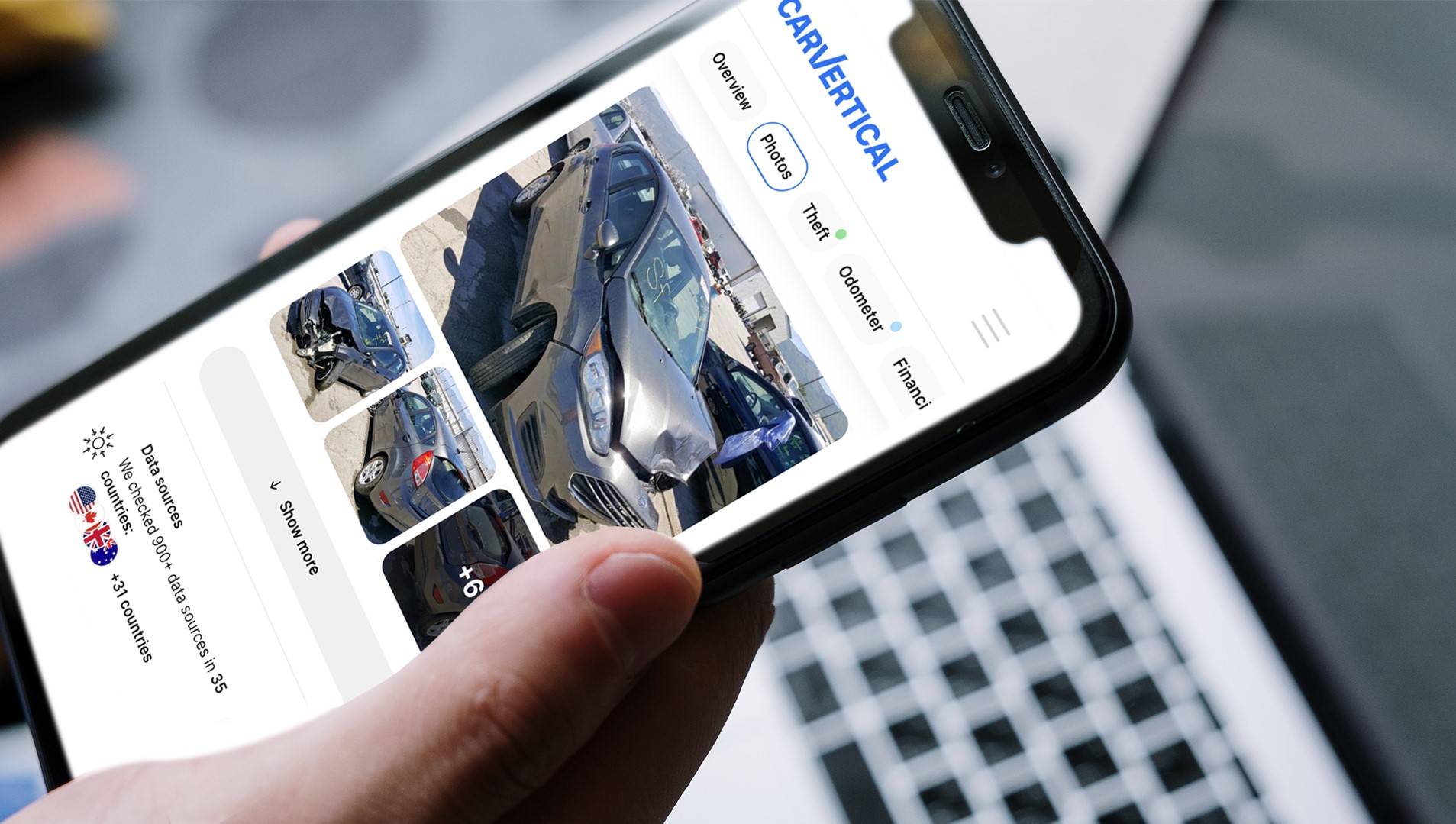
  • ✔️ Hidden accidents and body damage. The car might have been in one or several serious crashes with chassis or structural damage. After a cosmetic repair it can look great in photos. VIN history shows insurance claims and assessed damage amounts. A full carVertical report can list accidents, repair costs and sometimes even photos from salvage auctions – very helpful when evaluating how serious the damage was and how well it was repaired.
  • ✔️ Theft, finance and legal issues. A VIN check runs the car through international databases to see if it’s stolen, under finance, repossessed or has any legal restrictions. There are real cases where a buyer loses their newly bought car because it was still collateral for a bank loan. A proper report warns you in advance.
  • ✔️ Number of owners and how the car was used. The report can show how many owners the car had and where it was registered. Sometimes you also see if it was used commercially – taxi, car-sharing, rental or fleet. Such cars are usually worn out much more than a private car, but that fact is rarely highlighted in ads.
  • ✔️ Spec and equipment mismatch. The VIN encodes the original spec of the car. A good report compares this with what you see today. carVertical usually lists factory engine, fuel type, gearbox, drive type and other options. If someone is trying to sell you a lower-spec car as a higher trim, you will see it in the report.
  • ✔️ Recalls and known defects. Many reports include information about recalls and critical defects affecting that model. You can see if there are any unresolved safety issues (for example faulty airbags) or important campaigns from the manufacturer that were never done.

We could continue this list, but the main point is simple: a VIN history report gives you objective data from official and industry sources instead of just a nice story from the seller. For the cost of a dinner you get a tool that can save you thousands on repairs or even prevent a disastrous purchase.

What is a VIN and where do you find it?

VIN (Vehicle Identification Number) is a unique 17-character code assigned to every vehicle. Since 1981 all mass-produced cars carry this code – it’s like the car’s fingerprint. It encodes the manufacturer (WMI), model details (VDS: body, engine, etc.) and the serial number (VIS) including model year. In practice the VIN lets you uniquely identify a car and its factory configuration.

Where to find the VIN on a car:

  • 👓 A metal plate under the windscreen on the driver’s side (visible from outside).
  • 👓 On the B-pillar / door frame on the driver’s side.
  • 👓 Stamped in the engine bay (bulkhead) or on the chassis.
  • 👓 In the registration document / vehicle title.

Important: the VIN must match in all locations and in the documents. If it’s missing or different in some places, walk away. It can mean structural work, identity change or serious legal issues.

What’s inside a full VIN history report?

Free VIN decoders on the internet usually show only basic data: make, model, engine, year. A full history report gives you much more. Using carVertical as an example, here’s what you can usually expect (depending on how much data is available for that specific car):

  • 📌 Accident and damage history. The report shows recorded accidents and damage claims. You see whether the car was involved in crashes, how serious they were and the estimated repair costs. Where possible, the report lists damaged parts (for example “front bumper and right fender”) and sometimes even includes photos from previous auctions. This is priceless when judging the real condition of the car.
  • 📌 Mileage (odometer readings). All recorded mileage entries from different points in the car’s life are collected into a timeline: inspections, services, registrations, auctions and so on. If the mileage suddenly drops or behaves strangely, the report flags it as possible rollback. Suspicious entries are highlighted so you don’t miss them.
  • 📌 Theft check. A separate section checks the car in international stolen vehicle databases. If the car is (or was) listed as stolen and never officially recovered, you’ll see a clear warning. Buying such a car is a direct road to having it confiscated later.
  • 📌 Owners and registrations. Many reports show how many owners the car had and in which countries or regions it was registered. You can see if the car was imported, when it changed hands and whether the “one owner” claim in the ad matches reality.
  • 📌 Title status for US/Canada and other regions. For cars that spent part of their life in North America, you can see title brands such as salvage, rebuilt, junk, flood and so on. If a car was declared total loss after a serious accident or flood and later exported to Europe, a history report will usually show it – even if the seller now calls it “never accident-damaged”.
  • 📌 Factory spec and equipment. The report lists the car’s original technical specification and options: engine type and power, gearbox, drive type, body style, paint colour, interior trim and many factory options. It lets you check whether the car still matches its original spec – or if, for example, the engine, gearbox or interior were swapped.
  • 📌 Estimated market value. Many VIN services show an approximate market price range based on the car’s age, mileage, country and other parameters. This is handy to see if the seller’s price is realistic or completely out of line.
  • 📌 Technical inspections and servicing. Official inspection dates (TÜV, MOT, etc.) and sometimes dealership service entries are included. You see whether the car was regularly maintained or had long gaps with no records at all.
  • 📌 Use as taxi / rental / fleet. The report may indicate if the car was used in taxi, rental or corporate fleets. These cars typically have harder lives, even if they look clean now. It’s very useful to know this before you buy.
  • 📌 Safety and emissions info. For some models you also see crash-test ratings and emissions standard (Euro 5/6 etc.), which may be important for low-emission zones and taxes.
  • 📌 Historical photos. One of the most valuable parts: old photos from auctions and adverts (if available). With them you can see how the car looked years ago, how bad the damage really was and whether the mileage on the cluster roughly matches the car’s wear and tear.
  • 📌 Timeline of events. All collected data is often summarised as a timeline: production, registrations, ownership changes, inspections, accidents and other key events. It gives you a clear “biography” of the car.

Of course, not every single car will have all this information available – coverage depends on country and how the car was used. But even a partial report is far better than buying blind. In most cases you will at least see mileage history, some technical entries and whether there are any red flags like accidents or theft.

Important: if something is not in the report, that doesn’t 100% mean it never happened. For example, a small accident repaired off the record may not appear anywhere. That’s why a VIN report is not a replacement for a physical inspection – it’s a powerful first filter.

Where carVertical gets its data: 900+ sources worldwide

A natural question: where does all this information actually come from? The value of a report depends entirely on the quality and breadth of its data sources. In carVertical’s case, data is collected from hundreds of official and industry databases around the world. The system searches more than 900 sources in 40+ countries for a given VIN. These include vehicle registers, police and Interpol databases, insurance companies, service and dealership records, leasing and finance institutions, salvage auctions and more.

To assemble the same information manually, you’d have to separately check police databases (accidents and theft), insurance databases, dealer records, loan and lien registries and so on – often in several countries and languages. Many of these systems are not accessible to private individuals at all. carVertical automates this: you enter the VIN, and within seconds the system aggregates data from all available sources and presents it in a clear format.

Another interesting point: carVertical uses blockchain technology to ensure data integrity. Once a piece of information is added to the report database, it cannot be altered behind the scenes. That means neither a seller, nor an intermediary can “edit” the history to make a car look cleaner. From a buyer’s perspective, this increases trust in the report.

For imported cars this broad coverage is crucial. Imagine a car that spent its early life in the US, then went through a big accident, was declared total loss, rebuilt and exported to Europe. Local checks in your country might show nothing suspicious – but carVertical still sees American and European records and warns you. That’s one of the main reasons I recommend using an international service, not just a local database.

Typical data sources include:

  • 🚗 national vehicle registration databases;
  • 🚗 police and international wanted lists (stolen vehicles);
  • 🚗 insurance companies (accidents, damage assessments);
  • 🚗 dealerships and service centres (repairs, maintenance);
  • 🚗 leasing and finance companies (liens, loans, repossessions);
  • 🚗 salvage and insurance auctions with photos.

carVertical aggregates information from hundreds of such sources in dozens of countries. In practice, an ordinary buyer simply can’t replicate this manually – that’s what you pay the report for.

How to check a car with carVertical (step by step)

Ordering a history report with carVertical is very straightforward, even if it’s your first time:

  • 💎 1. Get the VIN. Write down the 17-character VIN of the car you’re interested in. Ideally compare it in several places (on the car and in the documents) to make sure it matches everywhere.
  • 💎 2. Go to the carVertical website. You can go there directly or via a partner landing page. For example, via this special link you’ll get a 20% discount automatically applied. Enter the VIN into the main input field – the system will show whether it has data for this car.
  • 💎 3. Apply a promo code for a discount. If you have a promo code, enter it during checkout. For readers of this blog there is a −20% discount with the code sichercheckde*. Just type it in on the payment step or use the link above where the discount is already included.
  • 💎 4. Pay and get your online/PDF report. Choose a payment method, complete the purchase and wait 1–2 minutes while the system assembles your report. You can view it online and download it as PDF. carVertical also keeps it in your account and sends a link by email.

Or simply follow this link right away: −20% carVertical discount*

Links and banners marked with an asterisk (*) are affiliate links/banners. If you use such a link and subsequently request an offer, sign a contract or make a purchase, we receive a commission from the respective provider. For you, there are no disadvantages: the price and conditions remain the same.

That’s it. In a few minutes you have a full picture of the car’s past. Problems are clearly highlighted with red icons (mileage rollback, accidents, theft etc.). Take your time, go through all sections, compare the data with what the seller told you – and then decide whether this car is worth your money or not.

How much does a VIN report cost – and how to save money

Of course, a full VIN history report is a paid service. It saves you hours of research and gives you access to databases that are normally closed to private individuals, so a reasonable fee is fair. For carVertical, a single report usually costs around 20–35 € depending on the country and currency. However, there are several ways to pay less:

  • 💯 Use a promo code or partner link. As mentioned, partners of carVertical can offer discount codes. My promo code sichercheckde* gives you −20% on a report. Enter the code during checkout or use the link with the discount already applied.
  • 💯 Watch for promotions. carVertical occasionally runs promos – seasonal discounts, Black Friday, holiday sales, “second report cheaper” etc. If you’re not in a rush, it can make sense to wait a few days and catch a better price.
  • 💯 Buy a bundle of reports. If you’re actively searching and will check several cars, bundle offers (2–3 reports) are usually cheaper per report than buying them one by one. This is particularly useful if you are choosing between multiple options.

No serious service will give you a detailed history report completely free. Free VIN decoders are good only for basic specs. Valuable data about accidents, mileage, theft and photos lives in paid databases, and access to them is what you actually buy. But compared to the cost of a wrong purchase, the price of a report is tiny. Often a single report either saves you from buying a disaster or lets you negotiate a discount much larger than the report price.

How does carVertical compare to other checks?

There are different ways to check a car’s history. Many countries have their own official databases and local services. For example, in some places you can see accidents or technical inspections via state portals, in the US and Canada Carfax is well known, in Europe there are regional solutions and paid services from classifieds. These tools are useful – but each of them usually covers only one country or region, and often only one type of data.

carVertical is a commercial VIN service that focuses specifically on international coverage. Alongside it there are other players – Carfax, AutoCheck, AutoDNA, etc. In my experience, carVertical has several practical advantages for buyers in Europe:

  • 🌍 Very broad geography. For every VIN I’ve tried, if there was data somewhere in Europe or North America, carVertical typically found it. For imported cars that’s critical.
  • Fast and simple interface. The report is generated in minutes, problems are visually highlighted and easy to understand even for non-experts.
  • 💸 Good value for money. With promos and discounts, carVertical often comes out cheaper than many competitors while offering very detailed information.
  • 🧩 Extra features. For some cars you get historical photos, AI-based damage interpretation and a compact “summary” PDF – handy when sending the report to someone else.

This doesn’t mean other services are useless – in some cases it’s worth combining several checks for maximum confidence, especially for expensive cars. But as a baseline check, carVertical today looks like one of the best “price/quality” options on the market.

Real-life example: how a VIN report saved my purchase

Let’s move from theory to practice. Not long ago I was looking at a 2015 crossover. The ad said “excellent condition, no accidents, genuine 80,000 km, one owner”. The car looked good, the engine sounded fine and the seller was very convincing. Still, I decided to spend a few euros on a VIN report.

The result honestly shocked me. The carVertical report showed that two years earlier the car had already had about 170,000 km recorded – and then the mileage suddenly “jumped back” to around 75,000. In other words, at least 100,000 km had been rolled back. On top of that, the history contained two serious insurance claims: a frontal crash in 2018 and a side impact in 2020 with repair costs in the tens of thousands. There were even photos from one of the salvage auctions – and the pictures spoke for themselves.

Needless to say, after seeing this I walked away from the deal. The seller claimed he “didn’t know, the car was imported like that”, but that didn’t really matter anymore. The few euros I paid for the report saved me from buying a heavily crashed, high-mileage car at a premium price.

I’ve seen similar stories countless times with my clients. People send me carVertical reports where the ad looks perfect, but the history is full of red flags: rolled-back mileage, total loss in the past, taxi usage, outstanding finance. Without that report they would probably have gone ahead and bought the car.

Buying a used car in Germany? We can check it for you

We specialise in pre-purchase inspections and car finding in Berlin, Potsdam and across Germany. What you get with Sicher-Check:

  • 🔎 Document and history check (including VIN, damage records and mileage).
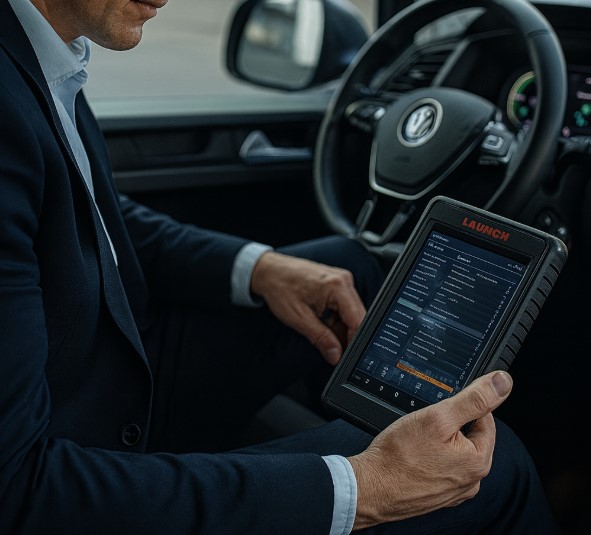
  • 💻 Full OBD diagnostics with professional equipment (reading and interpreting fault codes in all major ECUs).
  • 🛠 Visual inspection of body, paint, interior, suspension + test drive.
  • 📝 Written conclusion “buy / don’t buy” and clear arguments for negotiation.
  • ⚡ Often same-day appointments in Berlin/Brandenburg – and we also travel further across Germany.
  • 💬 Communication in English, German, Russian, Polish and Ukrainian.
  • 💶 Transparent prices and an online request form on the contact page.

My personal conclusion: I never buy a used car without a history report anymore. For me a VIN check is just as standard as looking under the bonnet or putting the car on a lift. carVertical has proven very useful, so I’m happy to recommend it here.

And as a small bonus: readers of this blog get −20% off the full carVertical report – just use promo code sichercheckde on their site or go via the partner link above.

Werbung / *Affiliate-Link

Links and banners marked with an asterisk (*) are affiliate links/banners. If you use such a link and subsequently request an offer, sign a contract or make a purchase, we receive a commission from the respective provider. For you, there are no disadvantages: the price and conditions remain the same.

FAQ — frequently asked questions

Do I really need a VIN check for every used car?

Yes. It’s the only quick way to see hidden accidents, mileage rollback, theft and finance issues. Without it you are effectively buying blind and hoping for luck.

Can’t I just “feel” whether the mileage is real?

No. Modern sellers know exactly how to prepare a car: deep cleaning, steering wheel and seat restoration, dash reprogramming. The odometer figure can be anything someone puts there. Only historic entries and inspections show the truth.

How much is a proper VIN history report?

Usually between 20 and 35 euros per VIN, depending on the country. Compared to the cost of one wrong purchase, that’s nothing. Plus you can use the promo code sichercheckde for about −20% off.

If the report is clean – does that guarantee the car is good?

Not 100%. Minor unreported repairs will not appear anywhere. The right order is: first VIN report (to filter out obvious rubbish), then a thorough in-person inspection by a professional.

Haftungsausschluss / Disclaimer:
Die Inhalte in unseren Blogartikeln spiegeln die persönliche Meinung der Autoren wider und dienen ausschließlich allgemeinen Informationszwecken.
The content in our blog articles reflects the personal opinion of the authors and is provided for general information only. Despite careful research, we cannot guarantee completeness, accuracy or timeliness of the information. You use all information from this website at your own risk.

← Back
Chat