

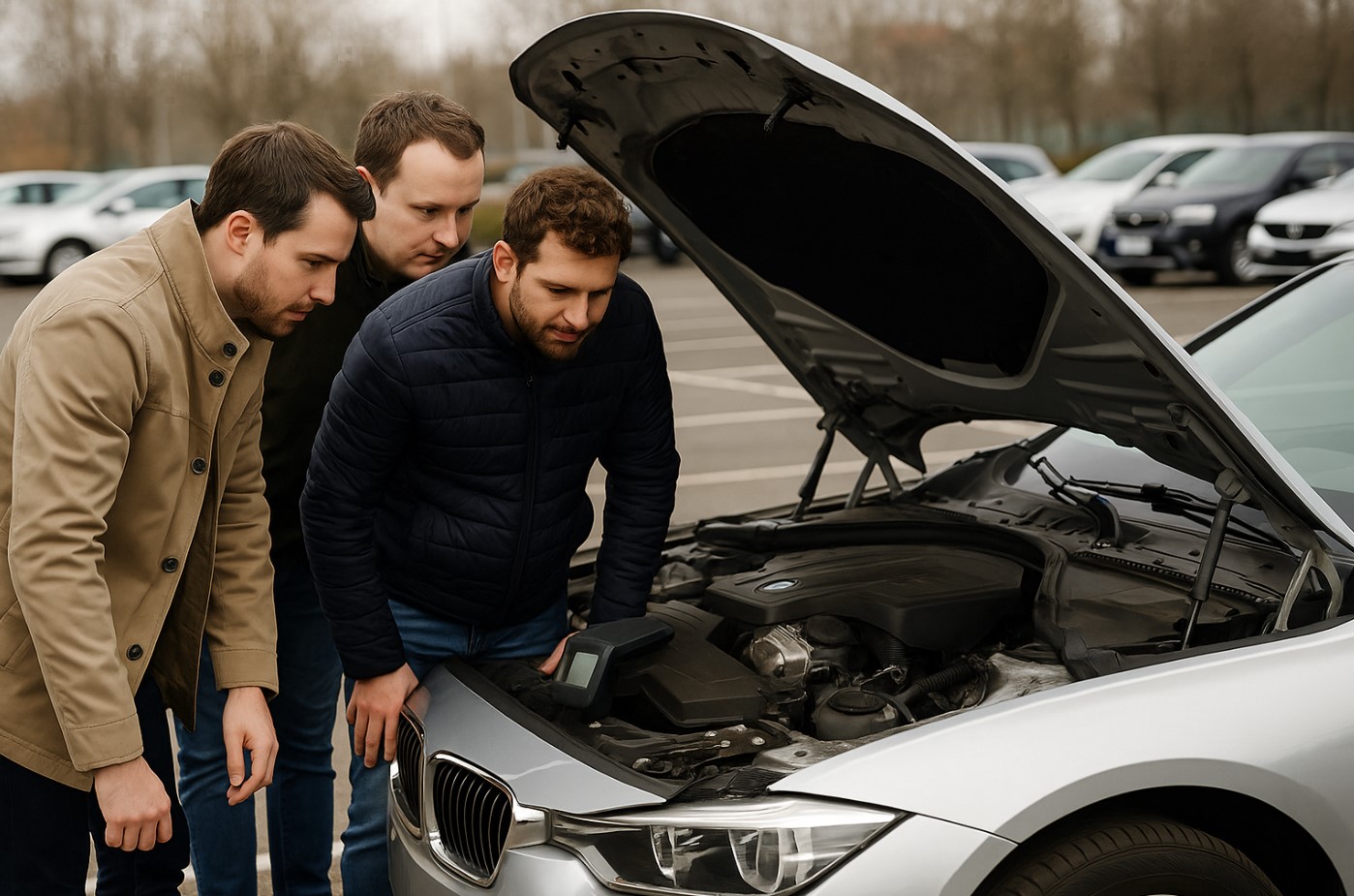
 Help for inexperienced car buyers — how we work and why it pays off
Introduction
Mileage is like the age in a passport. The difference is: on cars it gets “edited” much more often than faces in Instagram filters. You can easily find entire car parks of “young” cars with 89,000 km on the clock – even though the steering wheel, pedals and seats clearly say they have lived a much harder life.
The good news: you don’t have to rely on the seller’s story. With OBD diagnostics you can ask the car itself how far it has really travelled. If you have a professional scanner like Launch X-431, you can literally “interview” the vehicle. These values are stored inside the control units and are much harder to fake than the odometer display in the cluster.
What is OBD and why it knows more than the seller
OBD (On-Board Diagnostics) is a built-in self-diagnostic system that keeps a digital diary of the car’s life. It records operating parameters and fault codes and stores mileage and operating hours in various electronic control units: engine ECU, transmission TCU, ABS/ESP, airbag/SRS, climate control, steering and many more.
Even if the instrument cluster looks “perfect”, other modules still store traces of the real mileage. Think of it as a collection of black boxes on an aircraft – you can repaint the fuselage, but the internal logs remain.
Which control units hide the real mileage
| Control unit | What it stores | Comment |
|---|---|---|
| ECU (engine) | Mileage, engine hours, number of starts | The most reliable source if the ECU has not been reflashed or replaced |
| TCU (automatic transmission) | Mileage based on gear changes | DSG / ZF gearboxes keep their own counters regardless of the cluster |
| ABS / ESP | Mileage from wheel speed sensors | Very accurate; fraudsters often forget to reset this value |
| Airbag / SRS | Mileage at crash events or diagnostics | Very useful on VAG, BMW, Mercedes – helps spot accident and mileage history |
| Climate / lights / steering | Operating hours of subsystems | Helps detect swapped modules and inconsistencies in age |
| Key / immobiliser | Ignition cycles, sometimes mileage | BMW, Mercedes and VAG store surprisingly detailed data in keys and EIS/CAS |
By comparing readings from these control units you can spot almost any tampering. A difference of 20,000 km or more between ECU and ABS usually means that someone “rejuvenated” the dash.
Brand examples: where to look for the truth
VAG (Audi / VW / Škoda / SEAT)
On VAG cars mileage is duplicated in at least three places: the instrument cluster, the ECU and the ABS module. When the odometer is rolled back, most “specialists” only edit the cluster. In a Launch X-431 report the mismatch is obvious: the cluster shows 120,000 km, while the engine ECU and ABS speak about 190,000 km. That’s what we call “young dash, old engine”.
BMW
BMW stores mileage in up to seven modules: CAS, DME/DDE, EGS, LCM, KOMBI, DSC, airbag. In a diagnostic report you see a table with values from each module. If one of them shows significantly higher mileage than the rest, the “eternal youth” of the cluster is clearly artificial.
Mercedes-Benz
In Mercedes, mileage is stored in the key, EIS (electronic ignition switch) and cluster. Even if someone has “cleaned up” everything in the dashboard, the key often gives away the real usage. Through the OBD II port we can read ignition-on time, engine hours and remaining service intervals – all of that helps reconstruct the true story.
Opel, Ford, Toyota, Hyundai, Kia
These brands do not always duplicate mileage in many modules, but most of them store engine hours. A rough rule of thumb: about 40 engine hours ≈ 3,000 km. If the logs show 5,000 hours and the odometer claims 80,000 km, that would mean an average speed of 16 km/h over the car’s whole life – highly unrealistic for a vehicle that spends time on motorways.
Normal difference vs obvious mileage fraud
- A difference of up to around ±5% (depending on module accuracy and tyre size) can be normal.
- A difference of more than 10% or 20,000 km between key modules is almost always a sign of tampering.
- If one control unit cannot be read at all, this may be a trace of reflashing or replacement after an attempt to “clean” data.
- Launch X-431 shows the dates of the last logs. A sudden “rejuvenation” after a certain year – for example, 2019 – is a classic pattern for odometer rollback.
VIN report + OBD: the safest combination
Important: even if you use detailed VIN reports, remember: they do not replace a live inspection. CarVertical shows history based on external databases, but it does not read live data from your control units. The ideal sequence is: first a VIN report, then on-site OBD diagnostics.
You can check the VIN with a discount via our partner link (−20%): CarVertical → Check a car with 20% off* .
Tricks and small details to watch out for
- Some “experts” know how to wipe values even in ABS and transmission, but then forget to reset engine hours or service intervals.
- On BMW it is very useful to look at “Distance since last service”. If it shows 30,000 km and the cluster shows 90,000 km total, something is clearly off.
- On VAG cars check “Operating time”. As a rough indicator, 100,000 km usually corresponds to around 1,500–2,000 engine hours.
- On Mercedes the key can show “ignition on time” – that’s a very honest indicator of how much the car has actually been used.
Why a cheap adapter is not enough and you still need a pro
A 15 € Bluetooth dongle only talks to the engine ECU and shows basic fault codes. It will not access deep data in ABS, transmission, SRS, keys or EIS. A professional diagnostic tablet connects to all modules via CAN and reads the internal counters.
It shows real mileage, engine hours, service history and dates of the last records. But even with a good tool you still need experience to interpret what you see. Sometimes a difference is simply due to a replaced control unit, not fraud.
Bottom line: the true mileage lives in the car’s “brain”. Only proper OBD diagnostics can show it without make-up and filters.
Werbung / *Affiliate-Link
Links and banners marked with an asterisk (*) are affiliate links/banners. If you use such a link and subsequently request an offer, sign a contract or make a purchase, we receive a commission from the respective provider. For you, there are no disadvantages: the price and conditions remain the same.
FAQ — frequently asked questions
Can I check mileage myself with my phone and a cheap OBD adapter?
You can, but you will only see basic engine fault codes. The real mileage stored in ABS, automatic gearbox, SRS, EIS or keys is only available to professional scanners – and to people who know how to read and interpret these values.
The seller says “mileage is genuine, German car, full service history”. Should I still check it?
Yes. “German origin” is not a protection against fraud. The car may have already changed owners several times or been imported from another country. OBD diagnostics and a VIN report are your insurance policy.
How long does such diagnostics take?
Usually 15–30 minutes on site. We connect the scanner, read all control units, compare the readings and give you our comments. On request we can prepare a short written report you can show to the seller to support your negotiation.
Can an expert really see if the odometer has been rolled back?
In most cases – yes. Mismatching data between modules, empty or strange fields, odd dates of the last entries, a huge number of ignition cycles with low mileage – all these are clear markers of manipulation.
If you find inconsistencies – what should I do?
Don’t panic – use it to your advantage. With a diagnostic report you can negotiate a discount or simply walk away from a suspicious car. We will help you formulate clear arguments.
Related posts
Help for inexperienced car buyers — how we work and why it pays off
 Why a CarVertical report does not replace a live inspection by an expert
First we check the VIN history (with 20% off), then we go to a real-world inspection with OBD – this way your chances of buying a “rolled-back” car drop to near zero.