Introduction: why an EV is increasingly the first choice
Since the mid-2010s, electric cars in Germany have moved from “toys for enthusiasts” to a full-fledged market segment. Back in 2015 a buyer only had a handful of options. By 2025, the choice already runs into dozens of models across all classes – from tiny city hatchbacks to premium SUVs.
According to German registration statistics for new vehicles
(best-selling-cars.com),
in the first quarter of 2025 there were 112,968 new EVs registered, accounting for around 17% of all new car sales. Ten years earlier, the share of EVs was only a fraction of a percent. This clearly shows that “car search in Germany” more and more often means “search for a suitable electric car”.
For us as a pre-purchase inspection and car-sourcing service in Berlin and Brandenburg this means something very simple: more and more clients ask not “which diesel should I buy”, but “which EV should I buy so that the battery doesn’t die after a year and I can actually charge it where I live and work?”. That’s why we have put together this overview of the most successful and in-demand EVs on the German market in 2015–2025.
When choosing the “best” EV, you need to look at several factors: real-world range, charging infrastructure, battery reliability, running costs and of course the reputation of the brand. Below we go through the most interesting and popular EVs of 2015–2025 on the German market. These models have proven themselves in terms of technology and everyday usability. We work all across Germany, with a focus on Berlin/Brandenburg, so we see in practice which EVs are actually popular here – and which ones are better to avoid.
Market dynamics source: registration statistics for new cars in Germany, 2025 — sector analytics website best-selling-cars.com (link above).
Top EVs 2015–2025 on the German market (author’s view)
There have been many interesting models over this decade. Below is a list of EVs we think are worth a closer look when buying used. We’ve included city hatchbacks, family crossovers and premium sedans – all available on the German market and well-known to local drivers.
Tesla Model 3
Tesla Model 3 is one of the most popular and recognisable electric cars worldwide. Since its European market launch in 2019 the model has quickly become a common sight on German roads. The compact Tesla sedan offers an impressive range (up to ~500 km on a single charge, depending on version) and access to the Supercharger network. Owners praise the Model 3 for its strong acceleration, minimalist hi-tech interior and over-the-air software updates. On the German used-car market it remains highly sought-after, but you need to pay attention to battery health and mileage when doing a pre-purchase inspection. Even with strong competition from German brands by 2025, the Model 3 still sets the benchmark for a relatively affordable “premium” EV.
What to check: remaining battery capacity, any signs of damage to the battery pack or underbody (many cars came from the Netherlands and Scandinavia), the correct functioning of driver-assistance systems. Always request a detailed VIN report – some cars have had collision damage to the floor or battery that doesn’t show in pictures.
Volkswagen ID.3
VW ID.3 is a Golf-class hatchback that effectively opened VW’s new electric era. Launched in 2020, the ID.3 quickly became a bestseller in Germany thanks to its relatively accessible price, decent range (up to ~420 km depending on battery) and a very familiar form factor. For many German drivers ID.3 was their first EV, combining the trust in the Volkswagen brand with a modern electric platform. By 2025 the ID.3 has firmly established itself among the top-selling EVs, often chosen by families as their main city car.
What to check: software and electronics (early cars had some software bugs), battery condition via OBD/diagnostics, and complete dealer service history. Also compare the VIN report carefully – a noticeable proportion of ID.3s sold in 2022–2024 were ex-fleet or ex-car-sharing cars.
Volkswagen ID.4 / ID.5
VW ID.4 is an electric SUV launched in 2021, with its coupe-style sibling ID.5 following in 2022. These models broadened the ID family and quickly became hits among crossover fans. ID.4 offers a spacious cabin, higher driving position and a range of around 400–500 km (depending on battery and drivetrain). With optional all-wheel drive and a modern set of driver-assistance systems, ID.4/ID.5 are perfectly capable of long-distance touring, not just city runs. Interestingly, by early 2025 it was the larger VW ID.7 sedan that became the top-selling EV in Germany – underlining how successful Volkswagen’s EV strategy has been. Within a few years they managed to bring a whole family of popular EVs to market, from compact to large.
What to look at: condition of high-voltage cables (especially on cars frequently charged at public DC stations), correct operation of the heat pump, and any signs of bumper removal/refit (tow bars and bike racks are common, sometimes with DIY wiring).
BMW i3
BMW i3 is a pioneer of electric mobility from a German premium brand, introduced back in 2013 and produced until 2022. Between 2015 and 2020 it was one of the most visible EVs in German cities. Instantly recognisable thanks to its futuristic design and carbon body, i3 offers great manoeuvrability and lively performance despite its compact size. Early versions had a real-world range of around 150 km; later updates with larger batteries pushed this to close to 300 km (plus optional REx range extender). When buying a used i3, pay careful attention to battery health (older cars may already have noticeable degradation) and electronic systems. In our Berlin/Brandenburg car-sourcing work we see a lot of i3s on the used market – they’re a popular choice as a second city car.
When choosing a used i3 we always: run full OBD diagnostics, check the body thoroughly for repairs, and verify service history (ideally BMW main dealer). Many i3s come from other EU countries, so a proper VIN report is essential.
Nissan Leaf (2nd generation)
Nissan Leaf is one of the world’s first mainstream EVs and is well known to European buyers. In Germany, first-generation Leaf (2010–2017) was relatively rare, but the second generation (from 2018) became a much more common sight thanks to improved styling, 40–62 kWh batteries and a realistic range of 270–350 km. Leaf is attractive on the used market due to its comparatively low purchase price and modest running costs. It’s a proven “workhorse” EV for everyday commuting. However, you should pay attention to its history: many Leafs were imported from the US, repaired after accidents and then sold in Europe – here a thorough pre-purchase inspection including battery health and hidden faults is vital.
Important: a noticeable share of Leafs on the German market come from the US or Norway, sometimes after damage and cosmetic repairs. So before buying: always get a proper VIN report from a reputable provider (see below for our discounted link) and combine it with a good workshop inspection.
Renault Zoe
Renault Zoe is another very popular European electric hatchback. Sold in Germany primarily as a budget city EV, Zoe is praised for its compact size (easy parking), simple mechanicals and relatively low ownership costs. Range varies from ~200 to 400 km depending on version, which is more than enough for most urban and suburban use cases. On the German used-car market Zoe is particularly interesting for buyers looking for a cheap EV with modest running costs. One nuance to watch out for: early Zoe models had battery rental schemes – the traction battery remained the property of a leasing company. This contract needs to be clarified before purchase.
Checks: battery contract status, condition of the charge port, electronic fault codes, remaining battery life. A VIN report will help you see whether the car has come from France/Belgium after an insurance write-off.
Audi e-tron / Q4 / Q8 e-tron
Audi e-tron and its later relatives Q4 e-tron and Q8 e-tron form Audi’s EV crossover/SUV family. For German buyers they combine a familiar premium interior with electric drive. Early e-tron models are now entering the used-car market in larger numbers. The cars are generally well built, but you need to look very carefully at service history, particularly high-voltage components, cooling system and adaptive air suspension, which can be expensive to repair.
In our inspections we always: scan all control units with a professional diagnostic tool, check the battery cooling circuit for leaks, and measure paint thickness (some cars were repainted after accidents). A detailed VIN report is mandatory here too – there were plenty of ex-lease and ex-fleet e-trons.
Porsche Taycan
Porsche Taycan (from 2019) showed the world that an EV can be a “real” sports car. For the German market this is a matter of pride: Taycan is Porsche’s first series-production electric sports saloon. High-performance versions (Turbo S) sprint from 0–100 km/h in under three seconds, and the chassis tuning means a Taycan corners like a proper Porsche. At the same time it can do around 400 km on a charge in favourable conditions. Taycan quickly gained popularity among enthusiasts and Porsche fans, despite the high price.
Because of this, sourcing a Taycan is not a task for beginners. You need to check: full dealer service history, condition of all high-voltage components and the bodywork (sports cars are more likely to have seen spirited driving or track days). Our “car sourcing Germany” service helps find the right Taycan and check it properly.
If you’re considering a Taycan, make sure you:
1) run a VIN check using a paid report
20% discount*,
2) measure paint thickness over the whole body (individual resprays are common),
3) request full service records from an official Porsche dealer.
Also worth mentioning: Tesla Model S (flagship Tesla liftback, popular in the business segment), Hyundai Kona Electric and Kia e-Niro (compact crossovers with very decent range), Mercedes-Benz EQC/EQS (the first electric Mercedes models launched around 2019–2021). They have all contributed to the variety of EVs on the German market.
Why even EVs need a VIN check (and where to get a discount)
Many buyers think: “It’s an EV, there’s no combustion engine, so there’s nothing to hide.” In reality it’s the opposite. EVs are often sold at higher prices, which means they’re just as likely to be “made pretty” and imported from other EU countries or the US after major accidents. This applies to Tesla, VW ID, Nissan Leaf and others.
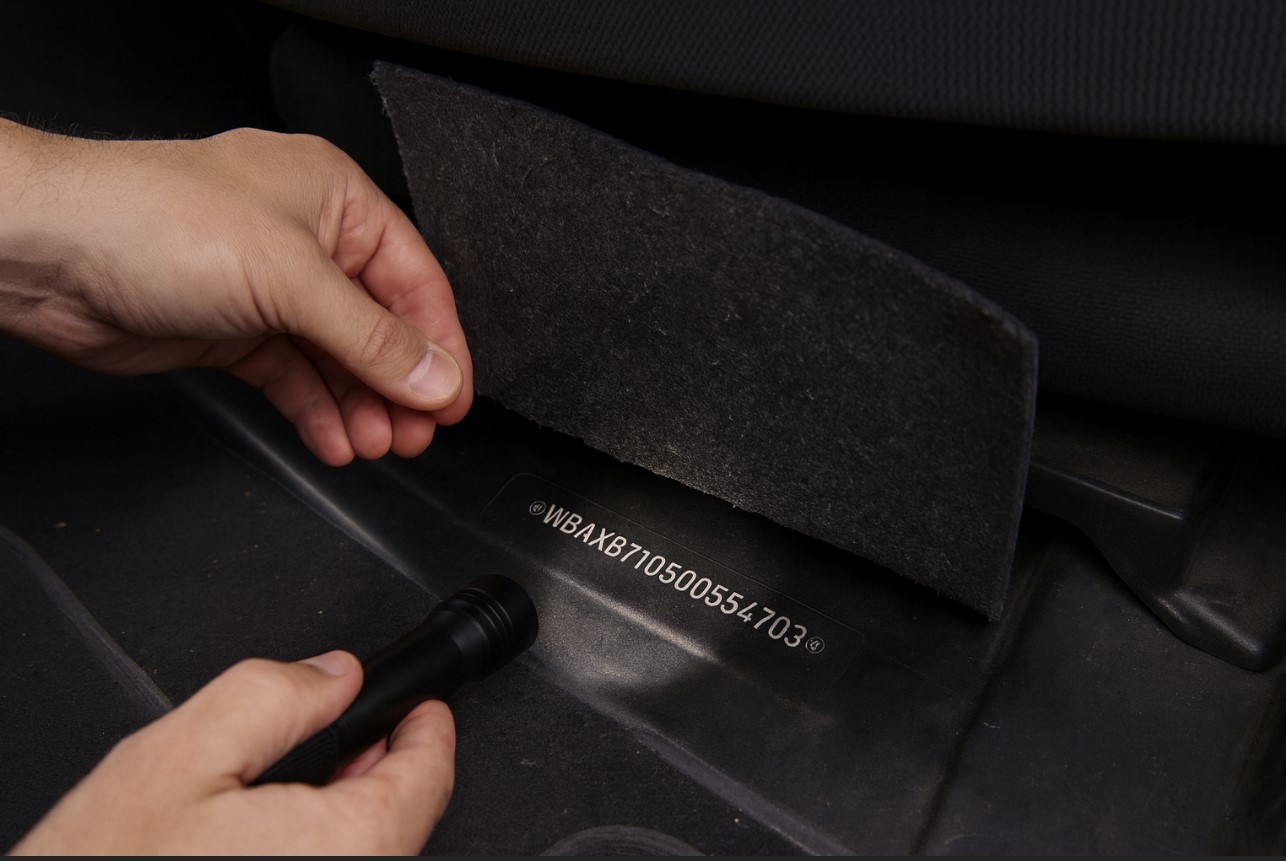
That’s why we always recommend getting a paid VIN report before you commit. It will show:
previous registrations, import/export information, accident and insurance records, recorded mileage, whether the car has been used as a taxi or in car-sharing fleets, and any restrictions or write-offs.
One of the services we work with is CarVertical. They have strong coverage for Europe and the US – crucial if your EV has crossed borders. For our readers we use the promo code
sichercheckde, which gives around a 20% discount on reports.
You can use our partner link:
Check an EV by VIN with discount*
.
This is one of those cases where a paid report genuinely saves you money: either you discover earlier damage to the battery pack and negotiate a lower price – or you walk away from a bad car.
Important: if the report doesn’t show any events, it doesn’t always mean nothing ever happened. Accidents that were repaired without going through insurance won’t show up in databases. That’s why we always combine VIN report + live diagnostics + body inspection.
Practical tips for choosing a used EV
When you choose an EV you should look beyond brand and brochure specs, and focus on the condition of the specific car – especially on the used market. The key component is the traction battery. Its capacity naturally degrades over time. Ask the seller for battery health data (State of Health, % of original capacity) or have it measured independently. Many manufacturers offer an 8-year or ~160,000 km battery warranty – check whether this is still valid for the car you’re considering.
Besides the battery, during a pre-purchase inspection you should also check:
- Charging system. Sockets (Type 2 / CCS) must not be damaged; there should be no faults in the onboard charger.
- Service history. Ideally, the car should have been serviced at main dealers or specialist EV workshops that actually understand high-voltage systems.
- Suspension. Battery packs are heavy, so suspension components carry more weight than in comparable ICE cars. Check for worn shocks, uneven tyre wear and any body misalignment.
- Instrument vs. real mileage. Through OBD we can read engine hours and other counters – this is part of our inspection package.
- Rental / fleet use. VIN reports often show whether the car has been in rental or car-sharing fleets, which usually means harder use and more fast-charging cycles.
20% discount*
— the report typically costs around 15–25 € with the promo.
- Electric motor(s). During the test drive, listen for unusual noises and check for smooth, linear power delivery. Diagnostics will show any stored faults in motor and power electronics.
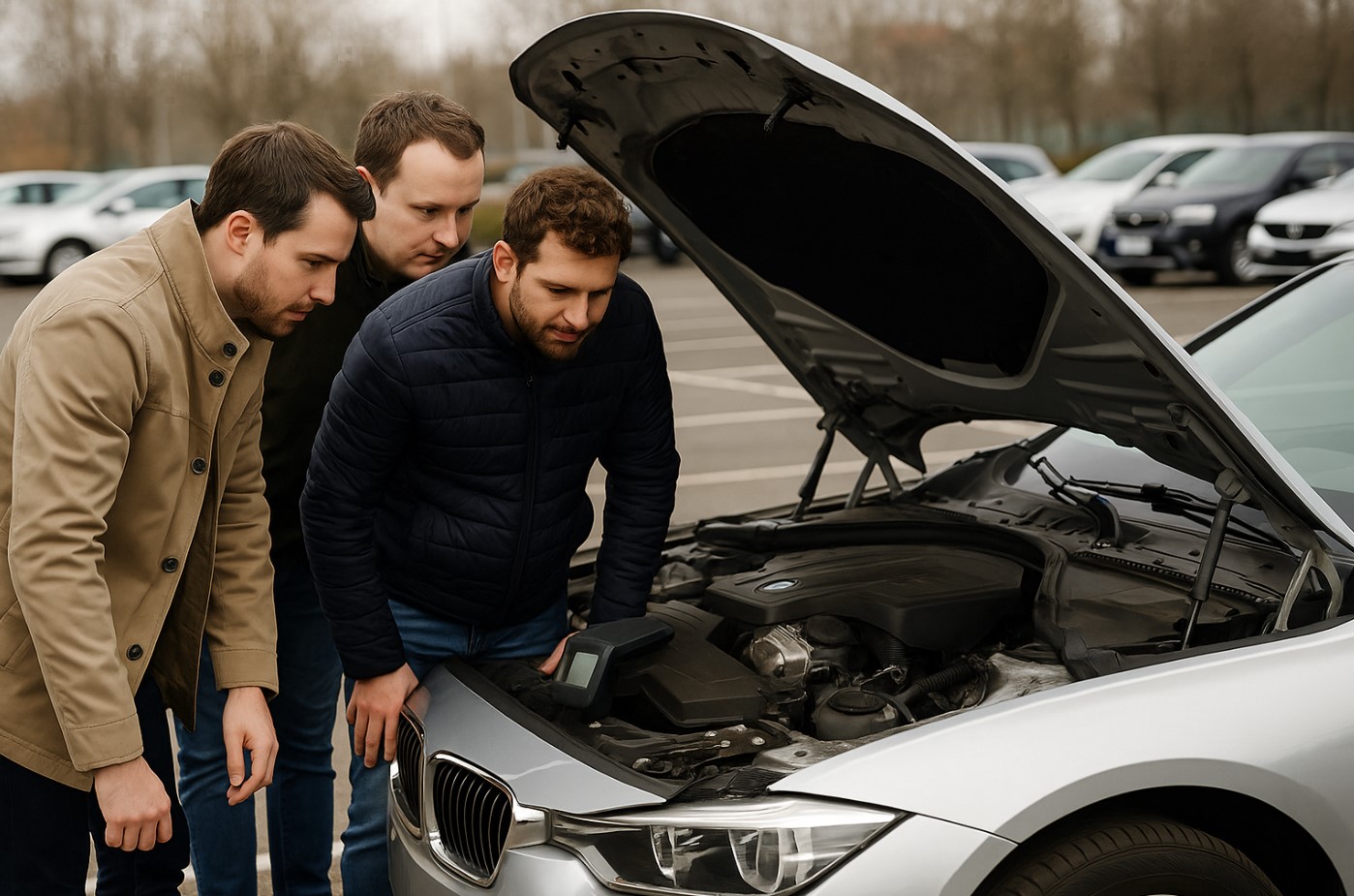
Finally, if you are not fully confident in your own judgement, it makes sense to bring in professionals. Our team can help you with car sourcing in Germany: we measure paint thickness, run full pre-purchase diagnostics (including a comprehensive scan with a professional tool) and provide a structured report. EVs are still relatively new technology; a competent inspection will protect you from surprises that could otherwise be very expensive.
We at Sicher-Check work officially and transparently – car sourcing Germany, based in Berlin / Brandenburg, with clear pricing and reports after every inspection.
Werbung / *Affiliate-Link
Links and banners marked with an asterisk (*) are affiliate links/banners.
If you use such a link and subsequently request an offer, sign a contract or make a purchase,
we receive a commission from the respective provider. For you, there are no disadvantages:
the price and conditions remain the same.
FAQ — frequently asked questions about EVs
❓Should I be afraid of the battery on a used EV?
Not if its State of Health is still reasonable. Ask for the SoH figure. For most models 85–95% is a good result. Below 80% is a warning sign, especially on cars like Tesla or BMW i3 where a battery replacement is expensive.
❓Can the battery be checked before purchase?
Yes, via OBD diagnostics. We connect a professional LAUNCH X-431 scanner, read operating hours, charge cycles and remaining capacity – this is included in our inspection packages.
❓Do I still need a VIN report if I do diagnostics?
Ideally yes. A VIN report covers legal and insurance history (accidents, exports, write-offs), while OBD diagnostics shows the technical side. Only together do they give you the full picture.
❓How long do EVs last?
Modern batteries are designed for 8–10 years or up to around 500,000 km. It helps if the car was mostly charged slowly on AC, not constantly on fast DC chargers – that has a big impact on battery life.
❓Is it worth buying an EV from the US or Norway?
Only after a very careful VIN check and in-person inspection. Imports often have had battery or structural damage. Use a detailed CarVertical report with the promo code sichercheckde (−20%) and then have the car inspected on a lift.