
 Guarantees and buyer rights when purchasing a used car in Germany
We are happy to support you with choosing and buying a car in Germany – in Berlin and Brandenburg as well as in any other region of the country. Our team offers a full service: searching for suitable cars, pre-purchase diagnostics, VIN checks, support with paperwork and, if needed, arranging transport to your destination.
With our car sourcing services in Germany you avoid unnecessary risk and save time – professionals know where to look, which technical issues are critical and how to structure the deal. We also recommend reading our article on guarantees and buyer rights when purchasing a used car in Germany so you understand the legal side as well.
Where to start your car search❓
Before you start scrolling through listings, it pays to get clear on what you actually need. Define the main purpose of the car (city use, commuting between cities, family trips with luggage, work), your budget (total cost including insurance, tax and plates) and your preferences for brand and model. Also write down your must-haves: body style (hatchback, estate, SUV, etc.), engine type (petrol, diesel, hybrid, EV), boot space, equipment (climate control, heated seats, driver assistance systems), gearbox type and similar criteria.
📜Usage and driving profile
Think about where and how you will drive. If it is mostly city driving with short trips and tight parking, a compact car is often the best choice. For a family, estates, MPVs or crossovers are usually easier to live with. For long motorway runs you might value comfort and low fuel consumption more – mid-size saloons and efficient diesels often work well here, while hybrids and EVs shine in stop-and-go city traffic.
📜Budget and ongoing costs
Define a realistic budget that includes more than just the purchase price. On top of what you pay the seller you will face:
- registration fees and, for dealer cars, usually 19% VAT already built into the price,
- insurance (at least third-party liability, often partial or fully comprehensive cover),
- annual Kfz tax, fuel or electricity costs, scheduled maintenance and wear parts.
Having a clear budget helps to filter out tempting but unrealistic options early on.
📜Brand, model and technical requirements
❗Shortlist a few brands and models that fit your budget and usage profile and check typical issues and maintenance costs. Then define your key requirements:
- equipment such as climate control, heated seats, parking sensors or a reversing camera;
- number of doors and seats;
- gearbox type and engine displacement;
- model year and acceptable mileage range;
- fuel consumption and emission standard (important for environmental zones).
Clear answers to these questions make your search far more focused. Instead of clicking through hundreds of random cars you quickly zoom in on a handful of realistic candidates.
Where to look: dealers, traders and private sellers
In practice there are two main ways to buy a car in Germany: offline (dealerships, used-car lots) and online (classifieds and dealer websites). Each option has its own pros and cons.
⚠️Official dealerships
Official brand dealerships sell new cars and certified used vehicles with documented history. Buying there usually means:
- manufacturer or dealer warranty (typically 2 years on new cars, around 1 year on approved used cars),
- transparent service history and clear paperwork,
- support with insurance, registration and financing on site.
The trade-off is price: you pay for the brand name, warranty and infrastructure. However, for many buyers the extra legal protection and easier process is worth the surcharge – especially if you are new to the German market. We discuss legal guarantees in more detail in our article on buyer rights when purchasing a used car in Germany.
⚠️Independent traders and used-car dealers
Independent dealers (“Händler”) specialise in used cars of various brands. Their strengths:
- a large selection of vehicles on one forecourt,
- room for negotiation and more flexible deals,
- frequently updated stock and fresh offers.
On the downside, warranty coverage may be shorter and some traders try to minimise their responsibilities. That is why a professional technical inspection and a VIN report are particularly important in this segment.
⚠️Private sellers
Buying from a private owner – via online platforms or personal contacts – is often the cheapest route. There is no dealer margin and usually no VAT in the price. In return you accept more risk: private sellers can exclude liability for defects, so the car is sold “as seen”. A thorough inspection and VIN check becomes absolutely essential.
⚠️Online platforms for car search
The German market is heavily digitalised. The most popular platforms include:
- Mobile.de and AutoScout24 – hundreds of thousands of listings from dealers and private sellers nationwide;
- heycar, PKW.de, eBay Kleinanzeigen;
- websites of individual dealerships and dealer groups.
On these portals you can filter by make, price, mileage, location and many other criteria. Listings typically show build year, mileage, VIN, last TÜV inspection and sometimes full service history. German cars often come with complete documentation – if you take the time to read and verify it.
| Option | Advantages | Disadvantages |
|---|---|---|
| Dealer | Warranty, transparent history, “all-inclusive” paperwork | Higher price, VAT and potential add-on products |
| Independent traders | Wide choice, flexible conditions, room for negotiation | Less formal protection, quality varies, more homework needed |
| Private sellers | Lower prices, no dealer margin | No guarantee, buyer carries almost all the risk |
If you work with us, we support you at every step: we shortlist suitable offers from dealers and private sellers, arrange viewings and test drives and help you negotiate a realistic price based on the real condition of the car.
Pre-purchase inspection: what to check
Once you have found a promising car, a careful inspection is the key to a good deal. If you are based in another German state or abroad, we can handle the entire inspection process for you and provide a detailed report with photos and videos.
👓Initial VIN and paperwork check
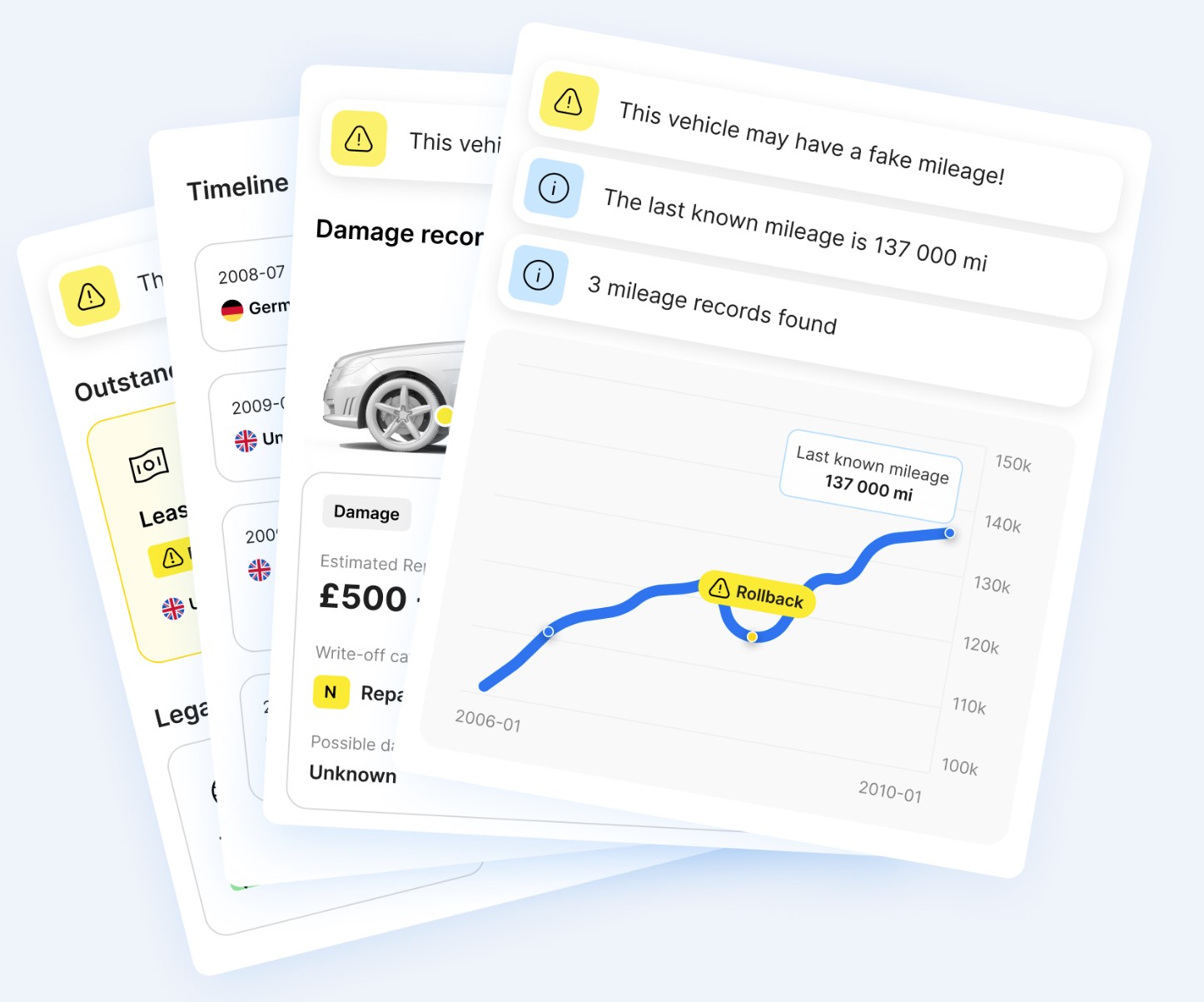
Ask the seller for the VIN and run a report with services like carVertical or Carfax. A good VIN report can show:
- serious accidents and insurance claims,
- possible mileage rollback and number of previous owners,
- whether the car was used as a taxi, rental or fleet vehicle,
- if the car is reported stolen or subject to liens.
We explain in more detail how we work with such reports on our dedicated page VIN diagnostics with carVertical (−20% for our readers). At the same time, ask for scans or photos of the documents: Zulassungsbescheinigung Teil I and II, service book, TÜV reports.
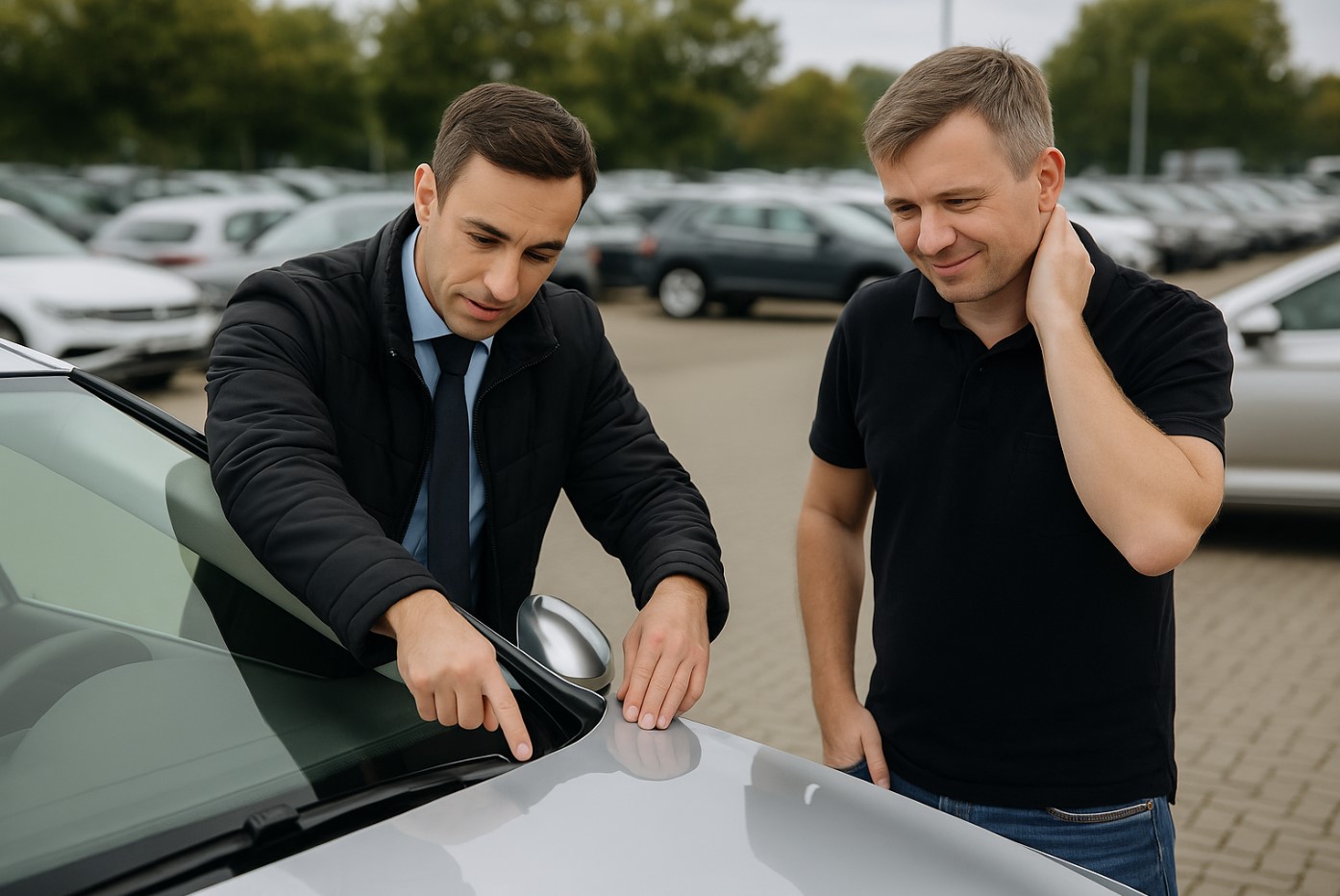
👓Visual inspection of bodywork and interior
Inspect the car in daylight on a dry, level surface. Pay attention to:
- colour consistency, even panel gaps, signs of rust or poor repairs,
- markings on windows and headlights – their production year should roughly match the age of the car,
- interior wear: steering wheel, pedals and driver’s seat should match the stated mileage.
Using a paint thickness gauge helps to identify repainted or heavily filled panels. Inside the car, test all functions: heaters, electric windows, climate control, infotainment, assistance systems and lighting.
👓Checking mileage
Compare the current odometer reading with service stamps and TÜV reports. A consistent, gradually increasing mileage is a good sign. Red flags for mileage manipulation include:
- excessively worn pedals, steering wheel or seat bolsters on a “low-mileage” car,
- mismatched mileage between documents and diagnostic data from control units,
- VIN reports from carVertical that show higher mileage at earlier dates.
👓Engine, mechanics and diagnostic scan
Look under the bonnet: check oil level and condition, look for leaks, inspect belts and hoses. An underbody inspection on a lift or pit reveals corrosion, oil leaks and the condition of the exhaust and suspension components.
Always perform an OBD diagnostic scan. Connecting to the car’s control units allows you to see:
- fault codes for engine and gearbox,
- problems with ABS, ESP and airbag systems,
- hidden errors that may have been cleared shortly before the viewing.
Our team uses professional OBD scanners and workshop-grade equipment similar to what TÜV or Dekra use. This significantly reduces the risk of unpleasant surprises after you have paid.
👓Test drive
A proper test drive is non-negotiable. Drive the car in different conditions (city traffic and higher speeds on the motorway) and check:
- gearbox behaviour – no slipping, jerks or long delays,
- steering and brakes – the car should track straight without pulling,
- suspension – no loud knocks or excessive bouncing.
The ideal scenario is to have a neutral expert with you. We can provide a full pre-purchase report with photos, videos and a clear buy/don’t-buy recommendation.
Documents from the seller and legal checks
Once you are satisfied with the technical condition and price, it’s time to put everything on paper and check the legal side of the deal.
📌Purchase contract (Kaufvertrag)
The contract should clearly list the buyer and seller details, VIN, equipment, price, known defects and whether the car is accident-free or not. In Germany a written contract is not strictly required by law – but in practice it is essential if something goes wrong later. We can help you draft or review the contract based on proven templates.
📌Registration documents (Zulassungsbescheinigung Teil I and Teil II)
These are the key documents proving registration and ownership. Teil I (“Fahrzeugschein”) is the small document that stays in the car; Teil II (“Fahrzeugbrief”) proves ownership. Without both parts you will not be able to register the car.
📌Service book, invoices and TÜV reports
Service stamps and workshop invoices show how well the car has been maintained and whether important wear parts such as timing belts have been changed on time. TÜV reports reveal what issues were found during inspections and how they were rectified.
📌Keys and accessories
Make sure you receive all keys (main and spare) and any additional items such as winter wheels, roof racks or detachable tow bars. List these items in the contract so there is no dispute later.
📌Insurance and eVB code
To register a car in Germany you need an electronic insurance confirmation – an eVB number issued by your insurer. Even if you intend to export the car, you will need appropriate insurance for Kurzzeitkennzeichen (short-term plates) or Ausfuhrkennzeichen (export plates).
📌TÜV / HU documents
If the car has a valid technical inspection, take the corresponding report with you. You will need it for registration and when applying for temporary or export plates.
Plates and registration in different scenarios
After buying the car you have to get it home – ideally in a way that is legal and insured. The right type of plates depends on where you live and what you plan to do with the car.
🚗Buyer from another city in Germany
In Germany sellers usually deregister the car before handing it over so they no longer pay tax and insurance. In that case you will need Kurzzeitkennzeichen – yellow short-term plates valid for up to 5 days. They are intended for test drives and transfers within Germany.
You can apply for Kurzzeit plates at the local Zulassungsstelle (registration office); many municipalities allow you to start the process online. Typically you need:
- your passport or ID and proof of address,
- Zulassungsbescheinigung Teil I and II,
- an eVB code for short-term insurance,
- a valid HU/AU (TÜV) report,
- often a copy of the signed purchase contract.
With these plates you can legally drive the car to your home town and then register it on standard plates there.
🚗Buyer from another EU country
Within the EU there are no customs duties on used cars. The typical process is: the car is deregistered in Germany, you obtain Exportkennzeichen (export plates) and then drive home. At the border you may need to present the car and documents so that export can be recorded and you receive the necessary papers (for example an Export Accompanying Document) for registration in your country.
🚗Buyer from a non-EU country (for example Ukraine)
Exporting a car outside the EU requires Ausfuhrkennzeichen – white export plates with a red stripe, valid for a set period (from a few weeks up to several months). To obtain them you usually have to show at the Zulassungsstelle:
- your passport,
- both parts of the registration document,
- an eVB code for export insurance for the desired period,
- a valid HU/AU report,
- proof that road tax and, if applicable, customs fees have been paid.
The car is deregistered in Germany and you receive an international registration document for the journey. Once the car arrives in your home country, you must handle customs clearance and local registration according to national rules.
It is also worth asking the seller about VAT (Mehrwertsteuer): in some constellations non-EU buyers can reclaim VAT (around 19%) when exporting the car. This has to be agreed in advance – either you receive an invoice without VAT or you sign forms that allow the dealer to refund the VAT after proof of export.
In all three scenarios we can help you prepare the necessary documents and arrange the right plates so that you can bring your new car home without hassle.
Our services and benefits
Clients come to us for reliable car sourcing in Germany, comprehensive pre-purchase inspections and practical support with registration and transport. We know the German market well and use professional equipment (OBD diagnostic tools, paint thickness gauges, etc.) to examine every car in detail.
What we can do for you
- ✔️Car sourcing based on your brief. We search on major platforms (Mobile.de, AutoScout24, eBay Kleinanzeigen and others) and directly with dealers, filtering hundreds of listings by make, price, equipment, mileage and location.
- ✔️On-site inspection and diagnostics. We inspect the car at the seller’s location: bodywork, engine, gearbox, suspension, electronics, paint thickness, plus a detailed photo and video report.
- ✔️Document checks. We verify that all relevant documents are present and that VIN and registration details match the car.
- ✔️VIN diagnostics. We order a VIN report (for example from carVertical), compare mileage and accident entries with the service book and TÜV reports. Learn more on our VIN diagnostics page.
- ✔️Support with paperwork and plates. As an additional service we assist with understanding the purchase contract, and help you obtain Kurzzeit or Ausfuhrkennzeichen and the right insurance (eVB) for the required period.
- ✔️Transport and delivery. If needed, we can drive the car on temporary plates or organise transport by car carrier as a separate service.
We work transparently, without hidden fees or unnecessary extras. Our reputation as a reliable partner is built on long-term client relationships: we accompany your purchase from the first enquiry until the car is registered in your name.
If you are searching for “how to buy a car in Germany”, “pre-purchase car inspection Germany” or “best websites to find used cars in Germany”, our team is ready to advise you and map out a strategy that fits your budget and plans.
Conclusion: buying a car in Germany without unnecessary risk
Buying a car in Germany is a very realistic way to get a well-maintained vehicle with verifiable history – often at a better price than in many other markets. The key is preparation: define your needs, use trustworthy search channels, carefully check the car’s condition and history, and handle the paperwork and plates correctly.
Keep in mind that your level of legal protection depends strongly on where and how you buy. In our article on guarantees and buyer rights we explain the differences between buying from a dealer, from a private seller and via “Verkauf im Kundenauftrag”. Combined with solid technical checks and a VIN report, this knowledge will help you avoid most typical mistakes.
We are happy to assist you at every stage: from shortlisting suitable cars and inspecting them to arranging plates, insurance and delivery to your city. Get in touch – and your car purchase in Germany can be a smooth, transparent and surprisingly enjoyable experience.
Werbung / *Affiliate-Link
Links and banners marked with an asterisk (*) are affiliate links/banners. If you use such a link and subsequently request an offer, sign a contract or make a purchase, we receive a commission from the respective provider. For you, there are no disadvantages: the price and conditions remain the same.
FAQ – frequently asked questions about buying a car in Germany
Can I buy a car in Germany remotely without travelling for the viewing?
Technically yes. You can appoint us to handle the entire inspection and purchase process. We carry out the on-site check, VIN diagnostics and test drive, prepare a detailed report with photos and videos and then support you with the paperwork and plates. The final decision to buy, of course, is always yours.
Do I need an interpreter for the purchase if I don’t speak German well?
It is highly recommended that someone who understands German contracts is involved. We can help you understand the purchase agreement, explain the key clauses and point out anything unusual before you sign.
Is a VIN report alone enough or do I still need a live inspection?
No. A VIN report is an excellent filter to spot suspicious cars early, but it does not show the current mechanical state. The best approach is a combination of a VIN report and a full technical inspection on site, ideally carried out by an independent expert.
I am from Ukraine – how long does it take to arrange export plates and export the car?
In most cases obtaining Ausfuhrkennzeichen and preparing export documents takes a few working days, depending on the workload of the local Zulassungsstelle and whether the car already has a valid TÜV inspection. We plan the route, timing and required documents with you in advance so that your trip is as efficient and stress-free as possible.
Related posts
Guarantees and buyer rights when purchasing a used car in Germany
 VIN-based vehicle check with carVertical report (−20% for readers)