
Engine inspection before buying a used car in Germany
How to read noises, vibrations, smoke, OBD data and engine behaviour during the test drive.
 Sicher-Check
Oil on the engine or at the engine–gearbox joint is not a diagnosis by itself. It is only a direction for further investigation. The same wet area seen from below can mean harmless age-related sweating, a cheap gasket, an expensive rear crankshaft seal or oil that is actually leaking from above and simply running down.
If you want to check a used car before buying in Germany, especially in Berlin or Brandenburg, oil traces should not be judged “by eye in 30 seconds”. A proper check requires inspection from above and below, verification after warm-up, a short test drive, OBD diagnostics and a clear understanding of the original source.
In this article we explain how to distinguish old sweating from an active oil leak, where to inspect the engine, what a wet gearbox bell housing may mean, which repairs can be cheap or expensive, and when it is better to order an independent Sicher-Check inspection before signing the contract.
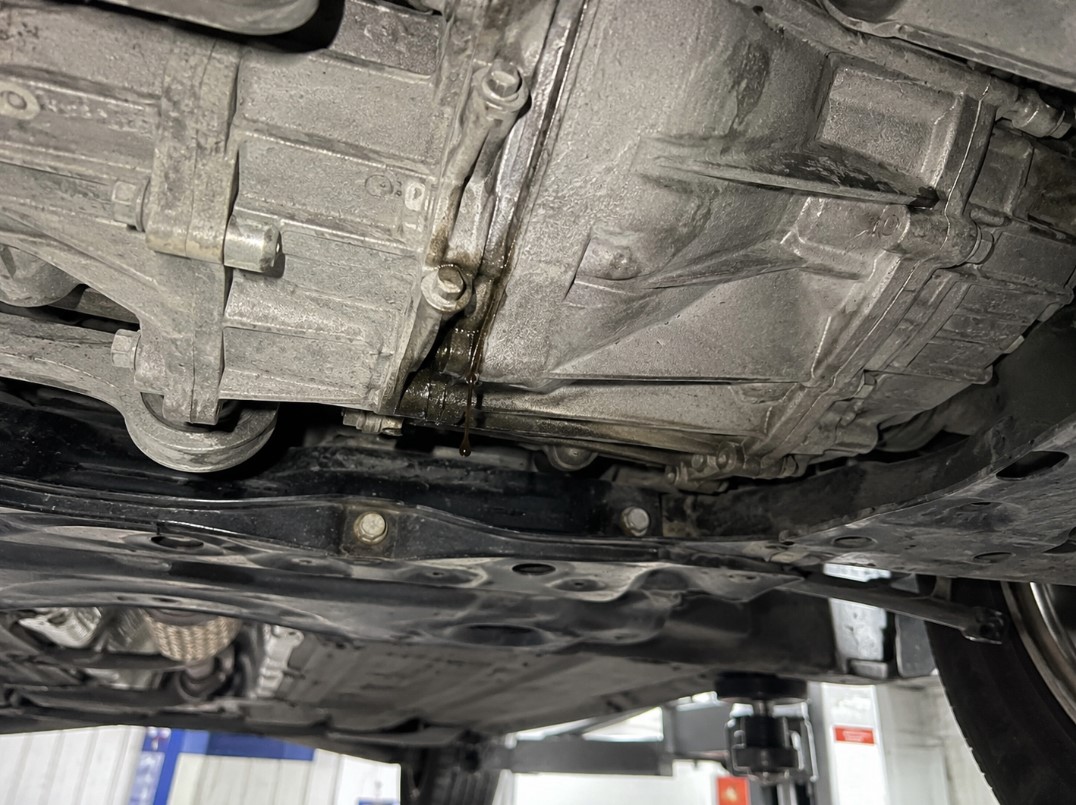
Oil traces on the engine do not automatically mean that the engine is “dying”. On older vehicles you may see light sweating: a thin oil film, dark dusty residue, old dampness without drops and without fresh trails running down.
An active leak is different. Fresh drops, a wet shiny surface, oil on neighbouring parts, oil on the undertray or ground, a burning-oil smell after driving or a falling oil level are no longer cosmetic details.
The biggest buyer mistake is to judge one wet spot in isolation. Oil often runs from top to bottom. For example, a valve cover gasket or oil filter housing can create the impression that the engine–gearbox joint is leaking. Correct diagnostics always move from top to bottom.
Oil traces on used cars are not rare and become more common with age. In TÜV Report-related materials, Ölverlust bei Motor und Getriebe is repeatedly mentioned as a typical defect on older vehicles. For 12–13-year-old cars, oil loss at engine or gearbox is often one of the key recurring inspection findings.
| Vehicle age | Practical risk | What the buyer should do |
|---|---|---|
| Up to 3 years | Oil traces are rare, but especially suspicious | Check warranty, service history and repair quality |
| 5–7 years | First gaskets, seals and oil coolers may start leaking | Inspect above and below, read OBD, test drive |
| 8–11 years | Risk increases, especially on diesels and high-mileage cars | Do not accept “normal for this engine” without verification |
| 12–13 years and older | Ölverlust becomes a common inspection remark | Include repair in negotiation or walk away if leak is active |
For the buyer, the difference between normal age-related sweating and a real leak can be the difference between a small price negotiation and a repair bill of several thousand euros. The problem is that visually they can sometimes look similar.
Light sweating usually looks like a dry dark film that has collected dust and dirt, but does not form drops. An active leak usually creates a fresh shiny surface, wet trails running down, wet neighbouring components and sometimes oil on the engine cover or undertray.
| Sign | More likely sweating | More likely active leak |
|---|---|---|
| Surface | Dusty, matt | Shiny, wet |
| Drops | No drops | Drops or visible trails |
| After driving | Almost unchanged | Fresh moisture appears |
| Undertray / ground | Usually clean | Oil marks or stains possible |
| Oil smell | Often absent | Burning-oil smell possible |
| Oil level | Stable | May slowly decrease |
Another problem is engine cleaning before sale. An unusually “shiny” engine bay on an older vehicle is not always a positive sign. Sometimes it simply hides the source of the leak.
If you want to check a used car before buying in Germany properly, the inspection should go from top to bottom and ideally be done twice: before the test drive and again after warm-up.
This is why an underbody inspection without checking the upper part of the engine is a common mistake when buying a used car.
In real inspections we often see cases where the seller scares the buyer with a “rear main seal”, while the actual source is a valve cover gasket or oil filter housing. But the opposite also happens: light sweating at the gearbox bell housing turns out to require gearbox removal and expensive labour.
| Where to look | Common source | What it means | Approximate cost |
|---|---|---|---|
| Valve cover | Valve cover gasket | Typical age-related issue | ≈150–300 € |
| Oil filter / heat exchanger area | Housing gaskets | Often creates a false “leak from below” | ≈200–600 € |
| Front of the engine | Front cover / seals | Needs exact localisation | From several hundred € |
| Oil pan | Gasket / drain plug | Should not be ignored | ≈200–900 € |
| Engine–gearbox joint | Rear crankshaft seal | Often requires gearbox removal | ≈1000–1500 €+ |
| Gearbox | Gearbox seals / housing | Requires precise diagnostics | From moderate to high costs |
Advertisement / *Affiliate link
Links and banners marked with an asterisk (*) are affiliate links. If you use such a link, we may receive a commission from the partner. For you, the price does not change.
The most dangerous thing for the buyer is not the oil itself, but the wrong interpretation of it.
An old local dry residue can remain almost unchanged for years. But a fresh wet edge after a short drive is a completely different story.
Be especially careful when:
For a buyer, the practical logic is usually simple:
In practice, buyers and sellers often make the same mistake: they draw a conclusion too quickly from a single wet area.
The car is lifted, the gearbox bell housing is wet from below, and the seller says “it is just a seal, they all do that”. After a proper top-side inspection, it turns out that oil is running down from the valve cover or oil filter housing.
For the buyer, that is a huge difference: instead of removing the gearbox for 1000–1500 €+, the real job may be a gasket repair costing only a few hundred euros.
Another version: the seller insists that “it is just old dry residue”. But after a short drive, fresh drops appear and new oil is visible on the undertray.
This is why proper diagnostics should not be done only on a cold car. The car must also be checked after warm-up and a test drive.
Oil around the turbocharger can look frightening. But the cause may not be the turbo itself. It can be a hose, seal or crankcase ventilation issue.
This is why independent pre-purchase inspection is especially important for high-mileage cars, diesel vehicles, cars used mostly in city traffic and models with tightly packed engine bays.
If you want to check a used car before buying in Germany and avoid an expensive repair immediately after registration, use this algorithm.
| What to do | Why it matters |
|---|---|
| Inspect before engine washing | An overly clean engine can hide the source of a leak |
| Inspect from top to bottom | Oil often runs from above and creates a false picture |
| Ask for a lift or inspection pit | Without underbody inspection, the assessment is incomplete |
| Repeat inspection after driving | Fresh leaks become easier to see |
| Check the oil level | A falling level is a serious signal |
| Read OBD errors | Oil-related issues may be connected to crankcase ventilation, turbo or exhaust systems |
| Do not accept “that is normal” without verification | For one engine it may be minor; for another it may be expensive |
| Compare with TÜV and service history | A fresh TÜV does not eliminate hidden problems |
For high-mileage diesel cars, it is especially important to check:
If the seller says: „Motoröl leckt, aber nur ein bisschen“, shows a fresh TÜV and insists that “this is normal for an old diesel” — that is exactly the moment when an independent inspection makes sense.
Especially if:
With Sicher-Check you receive:
Used car inspection in Berlin and Brandenburg — fast and practical. By agreement, inspections are also possible across Germany.
Not always. You need to distinguish old sweating from an active leak. Drops, behaviour after driving, oil level and the exact source matter.
It may be the rear crankshaft seal, gearbox seal or oil running down from above. Without proper diagnostics, you should not draw a final conclusion.
No. TÜV confirms roadworthiness at the time of inspection, but does not replace a full pre-purchase inspection.
Often yes, if there is no active leak and the oil level is stable. But before buying, it is important to know whether the issue is developing.
If there are fresh drops, oil on the undertray or ground, falling oil level, refusal to show the car from below or an attempt to hide the issue by washing the engine.
How to read noises, vibrations, smoke, OBD data and engine behaviour during the test drive.

Why hybrids and electric cars require separate diagnostics of the battery, electronics and charging system.
Disclaimer:
The content of this article is for general informational purposes only and does not replace individual on-site diagnostics, legal advice or a technical inspection.
Despite careful preparation, we do not guarantee the accuracy, completeness or timeliness of the information.
You use the information on this website at your own responsibility.