

 Why a CarVertical report cannot replace a live inspection by an expert
In a nutshell: don’t save on a proper expert inspection, always do a test drive, check the car’s history and documents, put everything into a written contract and keep a realistic budget buffer.
The German used-car market offers great deals – but also plenty of traps. Even experienced drivers make mistakes that later cost them money and nerves. Professionals who do car sourcing and pre-purchase inspections every day see the same patterns again and again. Below we look at the most common mistakes buyers make and explain why they are dangerous – and how to avoid them.
💯 Mistake 1: Skipping a professional inspection
The number one mistake is buying a car without showing it to an independent expert. Many people hope to save money by trusting their own eyes or the seller’s words. In reality, skipping a professional inspection is one of the most expensive mistakes you can make when buying a used car in Germany. A specialist can spot things a layperson usually misses: hidden accident damage, rolled-back mileage, structural rust, serious mechanical issues, bad repairs. Without a thorough diagnostic, you are effectively buying blind.
The inspection itself usually costs only a few hundred euro – but discovering a major issue after the purchase can easily cost thousands. In practice, the money spent on an expert check pays for itself many times over, either by helping you walk away from a bad car or by giving you strong arguments to negotiate the price down.
💯 Mistake 2: No proper test drive
The second big mistake is agreeing to a deal without a real test drive. A quick lap around the car park is not enough. A proper test drive of at least 15–20 minutes in different conditions (city, country road, higher speed) is essential. Only then will many defects show themselves: knocks in the suspension, humming wheel bearings, vibrations at speed, jerky shifts of an automatic gearbox, brake judder, overheating, pulling to one side under braking and so on.
Experts can tell many stories where the car looked and sounded fine on the yard – but on the motorway the temperature climbed, the steering felt vague or the gearbox started slipping. If a seller refuses a proper test drive or insists on only crawling around the block, that’s a huge red flag.
💯 Mistake 3: Not checking the car’s history (VIN report & service book)
Another common mistake is buying a car without looking into its past. Cars that have been in serious accidents or have had their mileage rolled back often end up on the market because the seller hopes the buyer won’t check. Today there are many online services to check history via VIN (for example, carVertical). Ignoring them means voluntarily giving up important information.
Always ask the seller for the service book and any invoices for maintenance and repairs. Compare recorded mileages and dates with the condition of the car. If there is no documentation at all, that is a warning sign. In Germany you can also check whether a car has been used as a taxi, rental or driving school – and whether it was previously registered in another country. If it was imported, try to understand from where and why. Buying without any history check means trusting nice stories instead of data.
💯 Mistake 4: Ignoring documents and legal aspects
It is not enough to look at the car itself – you must carefully check the paperwork too. In Germany, the registration certificate consists of two parts: Zulassungsbescheinigung Teil I and Teil II. If one part is missing, you should not buy the car. A car without proper documents is effectively worth nothing.
Always compare the VIN in the papers with the one stamped on the car – they must match character by character. Check the identity of the seller. If the person selling the car is not the registered owner, find out why and on what basis they are allowed to sell (for example, power of attorney, commission sale). Some traders pretend to be private sellers to avoid warranty obligations – that also affects your legal protection.
Pay attention to the TÜV (HU/AU) expiry date. If the inspection is about to expire or has already run out, there is a risk that the car did not pass TÜV due to defects. In doubtful cases, you can even suggest going to a TÜV/DEKRA station with the seller before buying – for around 100 € you will get a fresh report and transparency about critical faults. Also look at the number of previous owners and whether the car has been properly deregistered (Abmeldebescheinigung). Legal “cleanliness” is at least as important as technical condition.
💯 Mistake 5: Rushing, emotions and being too trusting
Many bad decisions are made because of time pressure or emotions. A buyer sees a rare or particularly nice car and immediately wants to secure it at any cost. Some sellers actively play on this: “another buyer is coming this afternoon”, “I can only hold it for you until tonight” and so on. Under pressure it is easy to overlook clear warning signs or skip important steps like an inspection or test drive.
Another risky pattern: falling in love with a car on first sight and ignoring logic. If the price is significantly below market level, you should become more suspicious, not less. There is usually a reason. Ask yourself basic questions: does this car really fit my use case, my budget and my parking situation? Huge SUV for the inner city, two-door coupe for a family with children – these things matter too. Take your time, compare several options and never sign anything in a hurry or in the dark. Good cars withstand daylight and a calm look.
💯 Mistake 6: “DIY” contract and poor documentation
You should always sign a written sales contract with clear, specific points: full details of buyer and seller, VIN, price, date and time of handover, declared accident status (Unfallfrei if applicable) and the actual mileage (a concrete number, not vague wording).
One of the big mistakes is to treat the paperwork as a formality and rely on a quickly scribbled note. In Germany, the written contract is your main protection. If the seller claims the car is accident-free, that must be stated clearly in the contract. Otherwise, it will be very difficult to prove anything later. The same applies to mileage: avoid phrases like “mileage according to odometer” – write down the actual reading and, ideally, refer to service documentation.
Make sure date and time of handover are also written down – from that moment, you are responsible for fines and liabilities. Many sellers use pre-printed contracts; read every paragraph carefully. Do not be shy to strike out or add points. Using templates from ADAC or mobile.de is often a good idea, as they are more balanced and better protect the buyer.
💯 Mistake 7: Unsafe payments and deposits
Never send deposits to unknown sellers in advance. Don’t transfer money just to “reserve” a car you haven’t seen. This is one of the most popular scam techniques. Until you have physically seen and checked the car and its documents, there should be no payments.
Even in genuine deals you should avoid handing over large sums without any proof. The safest way is a bank transfer or, if paying cash, doing the payment in a bank branch or at the registration office – not on a dark parking lot. Always ask for a written confirmation or a note in the contract that the full amount has been received.
Also make sure the car has been deregistered correctly and is not still subject to finance. If the vehicle was bought on credit, confirm that the loan has been paid off and that the original Teil II is physically with the seller. Otherwise you risk legal trouble later on.
💯 Mistake 8: Underestimating running and ownership costs
Finally, one of the most painful mistakes: using the entire budget on the purchase price and forgetting about everything that comes afterwards. Besides the price of the car itself, you will have to pay for insurance, tax, registration, tyres, fuel, parking, maintenance and unexpected repairs. In Germany, insurance and tax alone can be several hundred euro per year – and a single bigger repair can swallow a four-figure sum.
As a rule of thumb, plan for registration (around 30–100 €), annual insurance (roughly 300–1,000 € depending on car and profile), tax, running costs – and keep an emergency buffer of at least 500–1,000 € for surprises. It is usually smarter to buy a slightly cheaper car and keep money aside for maintenance than to stretch to the absolute limit and then have no reserves when something breaks.
Sicher-Check: how we help you avoid these mistakes
Knowing the typical mistakes is the first step towards a safe and successful used-car purchase in Germany. The second step is to act accordingly: stay calm, ask questions, check history and documents – and involve professionals where needed. If you are not sure you can assess the car and paperwork yourself, it is better to bring in an expert.
Sicher-Check can help you avoid all of the issues described above. We organise a thorough pre-purchase inspection, including a detailed check of the documents and (where possible) the car’s history. Our goal is simple: making your purchase fast, safe and transparent – without unpleasant surprises afterwards.
We can arrange a mobile inspection with OBD diagnostics, test drive and document/history check. You receive a written “buy / don’t buy” report and concrete arguments for negotiation.
- ⚡ Often available on the same day.
- 💬 We speak Russian / German / Polish / Ukrainian – no language barrier.
- 💶 Transparent tariffs, online request via form.
Werbung / *Affiliate-Link
Links and banners marked with an asterisk (*) are affiliate links/banners. If you use such a link and subsequently request an offer, sign a contract or make a purchase, we receive a commission from the respective provider. For you, there are no disadvantages: the price and conditions remain the same.
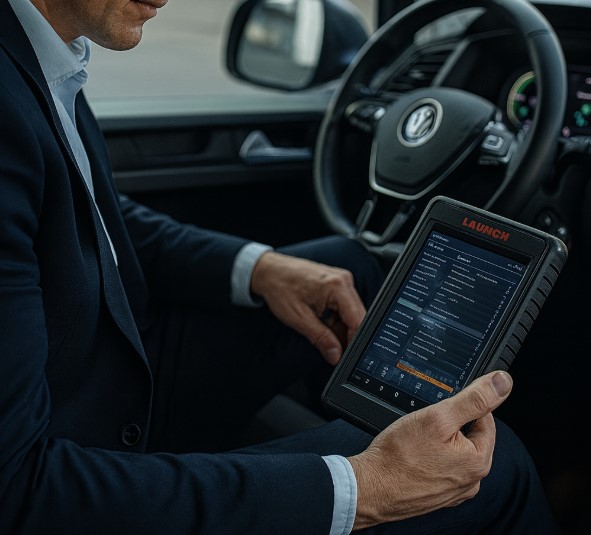 Car sourcing in Potsdam and Berlin – full inspection and diagnostics