Accident-Damaged Cars in Germany: How to Check a Used Unfallwagen and Avoid Mistaking Major Repairs for a “Minor Parkschaden”
Buying a car that has previously been involved in an accident in Germany is not automatically a bad idea. The real risk is an unknown original damage level, poor-quality repairs or a seller's description that does not match the vehicle's actual condition.
One repainted bumper may be nothing more than a cosmetic repair. But the phrase “it was only lightly damaged in a car park” can sometimes conceal a replaced wing and door, repairs to a pillar or sill, or previous work on the vehicle's safety systems.
That is why a proper inspection of an Unfallwagen requires much more than a paint-thickness gauge. The useful evidence comes from combining paint measurements, body joints, fasteners, structural areas, OBD diagnostics, the underbody, repair documents, the purchase contract and a road test.
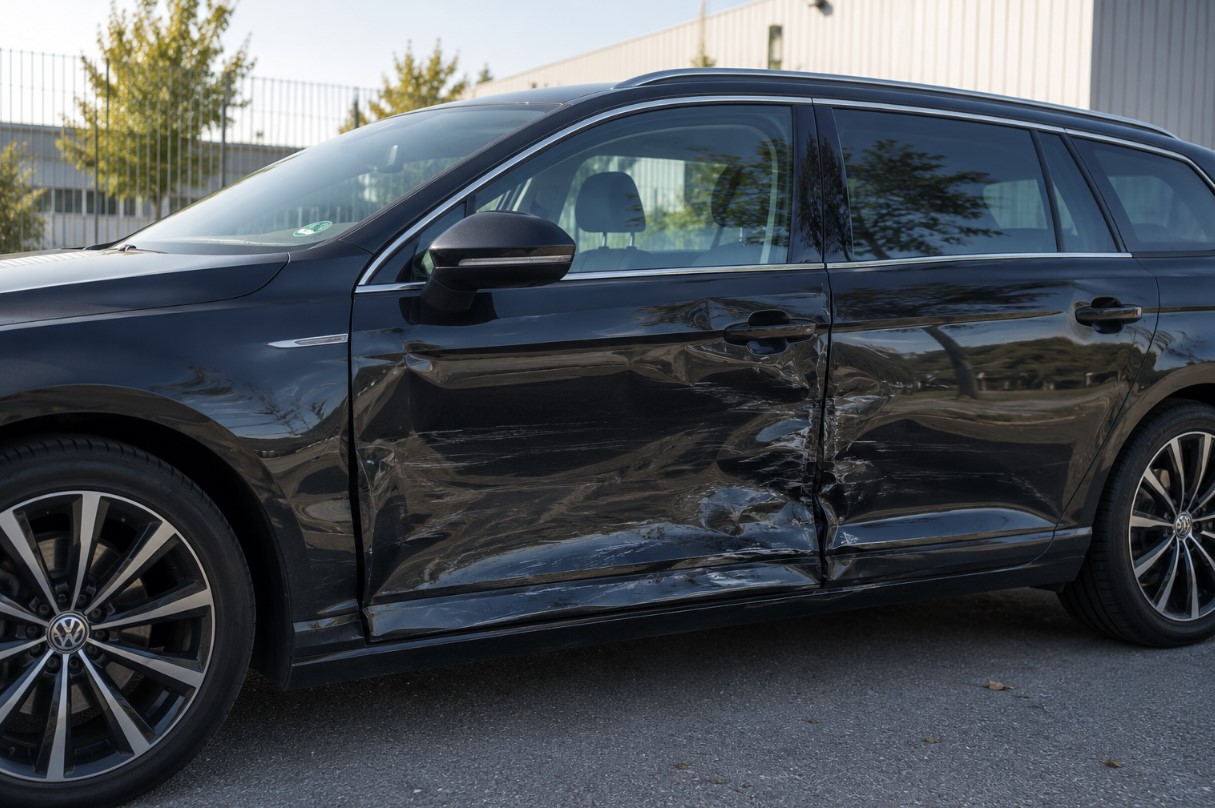
⚡ Is It Safe to Buy an Accident-Damaged Car in Germany?
Potentially, yes. A professionally repaired vehicle with a clearly documented, localised previous damage can still be a reasonable purchase if the repair history is transparent, the current condition supports the seller's explanation and the asking price reflects the accident history.
The risk increases considerably when the seller describes the damage as a minor Parkschaden, while the inspection reveals repairs to several adjacent panels, extensive filler, welding, work on the pillars or sills, or signs that the airbag system has previously been repaired.
Therefore, “repainted panel = bad car” is the wrong approach. A better rule is: “evidence of repair → establish the cause, extent and quality of that repair.”
📑 Contents
- Why accident history matters when buying a used car
- Unfallfrei, Vorschaden, Unfallschaden and Parkschaden
- Not every accident-repaired car is a bad buy
- Questions to ask the seller
- What to record in the Kaufvertrag
- Checking paint thickness
- Panel gaps, fasteners and welds
- Pillars, sills and structural areas
- Airbags and safety systems
- Underbody inspection
- Glass, headlights and component dates
- OBD diagnostics after an accident
- What a road test may reveal
- Repair invoices, Gutachten and photographs
- Practical accident-repair risk table
- Why a fresh TÜV is not enough
- Imported and US accident-damaged cars
- Accident history, resale value and negotiation
- Buy, negotiate or walk away?
- Accident-car inspection in Germany
- Used Unfallwagen buyer checklist
- FAQ
🚨 Why Hidden Accident History Is One of the Major Risks When Buying a Used Car
On Mobile.de, AutoScout24 and dealer websites in Germany, a few German terms can significantly change how a used vehicle should be assessed: unfallfrei, Vorschaden, Unfallschaden, reparierter Unfallschaden and Parkschaden.
A car can look especially attractive when it is priced slightly below comparable vehicles, has freshly polished paintwork and comes with a reassuring explanation such as: “only the wing was painted” or “the previous owner lightly touched a parking post.”
The difficulty is that attractive listing photographs rarely show how serious the original damage was before the vehicle was repaired.
❗ The key question is not: “Does the car look good today?” It is: “What happened before the repair, which areas were affected and how well was the vehicle restored?”
🎨 Cosmetic repair
A scratch, local paint repair or minor parking contact without meaningful structural damage.
🚪 Replacement of outer panels
A wing, door, bonnet or bumper may have been replaced without necessarily damaging the structural body shell.
🧱 Structural repair
Work involving pillars, sills, longitudinal members, the floor or other structural areas requires much closer assessment.
🛡 Safety-system repair
Airbag deployment, seat-belt pretensioners, impact sensors or related control units may have been involved.
📝 What Do Unfallfrei, Vorschaden, Unfallschaden and Parkschaden Mean?
English-speaking buyers in Germany often encounter these terms before they have any opportunity to inspect the vehicle. They are useful, but they should not be treated as complete technical descriptions of the car's past.
| German wording | What it means for the buyer | Recommended next step |
|---|---|---|
| unfallfrei | A statement that the vehicle is accident-free within the scope intended by the seller | Ask for written confirmation and still inspect the body |
| unfallfrei laut Vorbesitzer | The current seller is referring to information supplied by the previous owner | Do not treat it as an absolute guarantee; compare it with the physical inspection |
| Vorschaden | The vehicle has had previous damage | Establish what was damaged, how serious it was and how it was repaired |
| reparierter Unfallschaden | A previous accident is acknowledged and described as repaired | Ask for repair invoices, an expert report and photographs |
| Parkschaden | Usually suggests comparatively minor parking damage | Do not use the wording itself as proof of the actual damage level |
| Nachlackierung | A panel has been repainted, but the reason may vary | Inspect neighbouring panels and inner body areas |
| Smart Repair | A localised cosmetic repair | Confirm that the work was genuinely limited to a small area |
✅ The wording in an advert is useful information, but it is not a technical inspection report. The physical condition of the vehicle and what the seller is prepared to confirm in writing matter far more.
✅ A Previously Accident-Damaged Car Is Not Automatically a Bad Purchase
On the German used-car market, the rule “repainted panel = walk away” is too simplistic.
A panel may have been repainted because of a scratch, vandalism, a minor parking incident or a purely cosmetic repair.
At the same time, perfectly matched paint and an excellent finish do not prove that the original accident was minor. A professional body shop can make a previously damaged car look almost indistinguishable from an untouched one.
🔎 A Better Way to Assess Accident Repairs
⚠ The main problem is not the label Unfallwagen itself. The greater risk is an unknown, incomplete or misleading accident history.
💬 What to Ask the Seller Before You Travel to See the Car
The earlier you ask precise questions, the less likely you are to waste time on a vehicle with an unclear or misleading accident history.
Avoid vague questions such as “Has the car been crashed?” or “Was the accident serious?”. More specific questions usually produce much more useful answers.
🚗 Has the car ever been involved in an accident?
Ask for a direct answer: has the vehicle ever suffered accident damage, collision damage or any other body damage?
🔧 What exactly was repaired?
Wing, door, bonnet, bumper, pillar, sill, longitudinal member or luggage-compartment floor?
📄 Is there a repair invoice?
A proper invoice can help establish the scope and nature of the work that was carried out.
📷 Are there photos from before the repair?
Photos of the original damage are often more informative than a verbal description.
🧾 Is there a Gutachten?
An expert report may provide valuable information about the original damage, estimated repair scope and cost.
🏭 Where was the repair carried out?
At a recognised body shop, an authorised repair centre or a private workshop?
✅ It is especially useful to ask the seller to send photos of the damage, repair invoice and any expert report before you travel to see the vehicle.
❗ If the advertisement says unfallfrei, but the seller later says “I am not completely sure — that is just what the previous owner told me”, this does not automatically prove a problem, but it should make you inspect the car more carefully.
📝 Unfallfrei and the Kaufvertrag: What Should Be Recorded in Writing?
An online advertisement can disappear after the sale, phone conversations can be difficult to prove and verbal statements may later be interpreted differently by each side.
For that reason, important information about accident history should ideally be reflected in the Kaufvertrag.
| What the seller says | What is better to record in writing |
|---|---|
| “The car has never been in an accident” | A written statement about known accident history |
| “Only the wing was painted” | Which specific panel was repaired or repainted |
| “It was only a minor Parkschaden” | Which parts were damaged and which parts were replaced |
| “The accident happened under the previous owner” | What the current seller knows about that previous damage |
| “The repair was professionally carried out” | Repair invoice, expert report or workshop details |
⚠ If a seller confidently makes an important claim verbally, but categorically refuses to include it in the contract, it is worth finding out why.
🎨 Paint-Thickness Inspection: Why One Measurement Is Not Enough
A paint-thickness gauge is one of the most useful tools for detecting previous body repairs, but it is a mistake to judge the whole car from one reading.
What matters is the pattern across the entire vehicle. Symmetrical panels should be compared and abrupt changes in values should be investigated.
📊 What a Paint Map Can Reveal
✅ Consistent readings
Most body panels show broadly comparable values without dramatic variation.
🟡 One noticeably different panel
This may indicate a local repaint or cosmetic repair.
🟠 Several adjacent panels
This may indicate a larger repair area that deserves deeper inspection.
🔴 Very high paint thickness
This may indicate filler, multiple paint layers or an older body repair.
⚠ Factory paint thickness varies between manufacturers, models and even different body panels. A single universal number should not be used as an absolute threshold.
🧱 What Does Body Filler Mean?
The presence of filler does not automatically mean that the car is unsafe. But it does show that the shape of the metal was restored, which raises the next question: how far did the original damage extend?
Particularly important areas include:
- pillars;
- sills;
- rear quarter panels;
- inner door apertures;
- suspension mounting areas.
🔩 Bolts, Panel Gaps, Seam Sealer and Welds: The Body Can Tell You More Than the Paint
After measuring the paint, the next step is to look for signs that body panels have been removed and to determine whether the repair reached deeper into the vehicle structure.
🔧 Tool Marks on Fasteners
On bolts securing wings, the bonnet, doors and catches, you may find:
- damaged paint;
- tool marks;
- shifted washer positions;
- signs of repeated adjustment;
- non-original fasteners.
💡 A removed door does not by itself prove that the vehicle suffered a major accident. It may have been removed for a cosmetic repair. The combination of several signs matters more than one isolated clue.
📏 Body Panel Gaps
Useful comparison points include:
- bonnet and wings;
- doors and pillars;
- boot lid or tailgate;
- headlights and bumper;
- left and right symmetrical areas.
One unusual gap does not automatically prove anything. But several inconsistent lines in the same repaired area increase the level of concern.
🧴 Factory Seam Sealer
Factory seam sealer usually has a recognisable, consistent shape and texture.
After body repair, possible differences include:
- different thickness;
- unusual texture;
- obvious hand application;
- differences between left and right sides;
- fresh material applied over an older layer.
⚡ Spot Welds and Repaired Joints
When a body section is replaced, a repair shop may try to reproduce the original factory joints. Even then, an experienced inspection can sometimes reveal differences in weld spacing, shape or surrounding material.
❗ Disturbed factory structure around a pillar, sill, floor section or longitudinal member is much more significant than a repainted bolt-on door.
🧱 Pillars, Sills, Longitudinal Members and Floor: Where Cosmetic Damage Ends
External body panels are relatively easy to replace. The situation changes considerably when the impact reaches structural areas that contribute to body rigidity, suspension geometry or occupant protection.
| Area | Why it matters |
|---|---|
| 🅰 A-pillar | Connects the front structure, roof and door opening |
| 🅱 B-pillar | Important for side-impact structure and door mounting |
| 🚪 Sill | Forms part of the vehicle's load-bearing body structure |
| ➡ Longitudinal member | Deformation can indicate a significant frontal impact |
| 🧳 Boot floor | Can reveal the extent of a rear impact |
| 🛞 Suspension mounting points | Directly relevant to geometry, alignment and road behaviour |
⚠ Even a professionally repaired structural area should be assessed carefully. The buyer needs to understand which parts were replaced, how the repair was performed and how the previous damage may affect future resale value and risk.
🛡 Airbags, Seat Belts and the SRS System: Bodywork Is Not the Only Concern After a Serious Crash
In a significant collision, airbags, seat-belt pretensioners and impact sensors may have been activated.
Therefore, the absence of an illuminated airbag warning light is not enough to prove that every part of the system is original, correctly repaired or untouched.
🔍 What Should Be Checked?
- faults in the Airbag / SRS module;
- seat-belt condition;
- pretensioners;
- steering-wheel airbag cover;
- passenger-side dashboard area;
- side airbags in the seats;
- curtain airbags;
- connectors under the seats;
- impact sensors;
- evidence that interior trim has been dismantled.
❗ A general-purpose diagnostic scanner cannot always prove that all airbag components are original or correctly repaired. Where there is serious suspicion, additional specialist inspection may be necessary.
⬇ Underbody Inspection: Accident Repairs Often Leave Clues Where Listing Photos Do Not
The underside of a vehicle can reveal repair work that is almost invisible from above. This is especially important after frontal, rear or side impacts that may have reached the floor, suspension mounts, subframes or structural reinforcement areas.
🔍 What Should Be Checked Underneath?
- 🔩 subframe mounting points;
- 🧱 floor seams;
- ➡ longitudinal members;
- 🛞 suspension mounting areas;
- 🔧 visible welding or grinding marks;
- 🧴 fresh underbody coating;
- 🎨 overspray on components that should not be painted;
- 📐 asymmetry between left and right sides;
- 🔩 recently replaced bolts or brackets;
- 🧲 deformation around lifting points.
⚠ Fresh underbody protection is not automatically a positive sign. It may be legitimate corrosion protection, but it can also make older repair work more difficult to inspect.
🚗 Why Suspension Geometry Matters After an Accident
If the impact reached a suspension mounting point, subframe or wheel area, the car may later show:
- uneven tyre wear;
- steering that does not naturally centre;
- the vehicle pulling to one side;
- different wheel positions inside the arches;
- repeated wheel-alignment adjustments;
- abnormal suspension noises.
❗ A car can receive a successful wheel alignment and still have a significant accident history. Alignment is only one part of the assessment, not proof that the body structure is untouched.
🪟 Glass, Headlights and Date Codes: Small Details That Can Support a Larger Picture
Windscreens, side glass, headlights and rear lights often carry manufacturer markings or production-date codes.
These details cannot prove an accident on their own, because glass and lights can be replaced for many legitimate reasons. But they can help confirm or challenge the rest of the evidence.
| Component | Possible clue | How to interpret it |
|---|---|---|
| 🪟 Windscreen | Much newer date than the car | May simply mean stone-chip replacement |
| 🚪 Side glass | One door has a different production date | Could support evidence that the door was replaced |
| 💡 Headlight | One unit is clearly newer | May be consistent with a frontal repair |
| 🔴 Rear light | Different manufacturer or date | May support evidence of previous rear damage |
💡 Date codes are supporting evidence, not a standalone verdict. Their value increases when they match paint measurements, fastener marks and repair documents in the same area.
📟 OBD Diagnostics After an Accident: What Can Electronic Fault Memory Tell You?
Computer diagnostics do not tell you whether a panel was repainted. But they can reveal faults in systems that may have been affected by a collision or by later repair work.
🧠 Useful Systems to Scan
- 🛡 Airbag / SRS;
- 🚘 ABS / ESP;
- 📷 camera and radar systems;
- 🅿 parking sensors;
- 💡 lighting modules;
- 🚪 door and comfort modules;
- 🛞 steering-angle sensor;
- 🔌 battery-management or voltage-related modules;
- 🧭 driver-assistance systems;
- 🔧 chassis-control modules.
🚩 Faults That Deserve Attention After Body Repair
🛡 SRS / Airbag faults
Especially important if the body shows evidence of significant collision repair.
📷 Camera calibration faults
May appear after windscreen replacement, front-end repair or incorrect calibration.
📡 Radar / ACC faults
Relevant after bumper, front-panel or sensor-bracket repairs.
💡 Lighting faults
Can point to replacement lights, wiring repairs or incompatible components.
⚠ A clean fault memory does not prove that a car has never been in an accident. Faults can be deleted and many body repairs leave no permanent electronic record.
✅ OBD is most useful when combined with the physical inspection. If the front end shows repair work and there are also stored radar or camera faults, the combined evidence becomes much more meaningful.
🛣 Road Test: How Previous Accident Damage Can Affect the Way a Car Drives
A road test cannot tell you exactly how a car was damaged, but it can reveal consequences that are relevant to a purchase decision.
🔍 What to Observe
- does the car drive straight on a level road?
- is the steering wheel centred?
- does the steering return naturally?
- is there vibration at speed?
- are there unusual suspension noises?
- does braking remain straight and stable?
- are there wind noises around doors or windows?
- is there water leakage after rain or washing?
- do assistance systems behave normally?
❗ Wind noise, water ingress or a door that needs excessive force to close can sometimes indicate poor adjustment after a body repair.
📄 Repair Invoices, Gutachten and Photos: The Best Accident History Is a Documented One
If a seller openly declares previous accident damage, the next question is whether the history can be reconstructed.
Useful documents can include:
- repair invoices;
- parts invoices;
- insurance documents;
- expert reports;
- damage calculations;
- photographs before repair;
- photographs during repair;
- wheel-alignment reports;
- calibration reports for cameras or radar;
- body-shop documentation.
📷 Why Pre-Repair Photos Are So Valuable
They can show:
- which side was hit;
- how many panels were affected;
- whether wheels moved out of position;
- whether airbags deployed;
- whether the roof or pillars were involved;
- how deep the deformation actually was.
✅ A car with a clearly documented previous accident can be easier to evaluate than a supposedly “unfallfrei” vehicle whose body inspection raises unanswered questions.
📊 Practical Risk Table for a Previously Accident-Damaged Car
| Finding | Typical concern level | What to do next |
|---|---|---|
| One repainted removable panel, no other anomalies | Lower | Clarify the reason and compare with documents |
| Two adjacent repainted panels | Medium | Inspect fasteners, inner panels and repair quality |
| High filler readings over a large area | Medium to high | Determine whether deformation was limited to an outer panel |
| Replaced outer panel with documented repair | Medium | Assess workmanship, resale impact and price |
| Repaired pillar or sill | High | Consider specialist structural assessment |
| Longitudinal-member repair | High | Verify documentation, geometry and repair quality very carefully |
| Airbag deployment with incomplete documentation | High | Specialist SRS inspection is advisable |
| Seller's explanation conflicts with physical evidence | Very high | Do not proceed without clarification |
⚠ This table is only a practical orientation. The severity of a repair depends on the specific vehicle, repair method, affected area and the quality of the work performed.
🧪 Does a Fresh TÜV Mean the Car Has No Serious Accident History?
No. A valid HU / TÜV inspection is important, but it should not be interpreted as a complete accident-history inspection.
A vehicle can have:
- a valid TÜV;
- no warning lights;
- acceptable brakes;
- correct emissions;
- and still have significant previous body repairs.
❗ A fresh TÜV answers a different question: whether the vehicle passed the statutory inspection requirements at that time. It does not automatically certify that the car is accident-free.
🌍 Imported Accident-Damaged Cars: Why US and Other Foreign Histories Need Extra Attention
Imported vehicles can be attractive because of specification, colour, engine choice or purchase price.
But if the car was previously damaged abroad, the buyer may face an additional challenge: the accident occurred outside Germany, was repaired before import and the German seller may know only part of the earlier history.
🇺🇸 US Imports
In the case of vehicles imported from the United States, it can be especially useful to investigate:
- previous auction photographs;
- title history where available;
- recorded accident or insurance data;
- original mileage;
- airbag status before repair;
- which components were replaced during conversion for the European market.
⚠ A low purchase price on an imported premium car can sometimes be explained by a serious earlier damage event. The current appearance alone does not show the economics of how the vehicle entered Europe.
🇪🇺 Cars Imported From Other EU Countries
The same logic applies to vehicles previously registered in Italy, the Netherlands, Denmark, France, Belgium or other EU countries.
The existence of foreign documents is not in itself suspicious. The task is to reconstruct the vehicle's history and confirm that its current condition is consistent with that history.
💶 How Accident History Affects Value and Future Resale
Even a well-repaired accident car can be worth less than a comparable accident-free vehicle.
The size of the difference depends on:
- vehicle age;
- market segment;
- original damage severity;
- whether structural parts were affected;
- repair documentation;
- quality of workmanship;
- model demand;
- how transparently the history can be explained to the next buyer.
📉 Why Transparency Helps Resale
Imagine two visually identical cars.
Car A
Previous accident declared, photos available, repair invoice available, damage localised, repair quality appears good.
Car B
Multiple repainted panels, no documents, seller claims “nothing serious” but cannot explain the work.
Even if Car B looks just as good, Car A is often easier to understand, price and eventually resell.
💡 Accident history is not only a technical issue. It is also a future resale issue. When buying, ask yourself how easily you will be able to explain this same history to the next buyer.
🎯 Buy, Negotiate or Walk Away? How to Make a Decision After Inspecting an Unfallwagen
Discovering previous accident repair does not automatically mean that the car should be rejected. The decision should be based on the extent of the original damage, repair quality, transparency of the history, structural involvement, safety-system status and the asking price.
🎯 The Core Rule
One repainted panel is not automatically a reason to reject a used car. But every inconsistency is a reason to investigate further.
The less transparent the history and the more serious the affected areas, the more cautious the buyer should be.
🔍 Independent Accident-Damage Inspection in Berlin, Brandenburg and Across Germany
When you are buying a used car in Germany and suspect previous accident damage, a normal visual walk-around is often not enough. A professionally repaired vehicle can look excellent in photographs and still hide a much more complicated body history.
Sicher-Check can inspect the vehicle before purchase and help you understand whether the seller's description, the bodywork, the electronic systems and the available documents tell the same story.
🎨 Paintwork
We measure the paint thickness across the body rather than checking only the panel mentioned by the seller.
🧱 Body Structure
We inspect panel gaps, bolts, seams, sealant, accessible structural areas and signs of dismantling or welding.
📟 Diagnostics
We read available control units, including Airbag / SRS, assistance systems and other relevant modules.
⬇ Underbody
Where access is possible, the underside can reveal repairs that are difficult to identify from exterior photographs.
📄 Documents
We compare the VIN, repair information, service history, invoices and available reports with the physical vehicle.
🛣 Road Test
Steering, straight-line behaviour, braking, vibration, noises and assistance systems are assessed during the test drive.
The goal is not to “prove that the car was crashed”. The goal is to establish what was repaired, how serious it appears, whether the repair is acceptable and whether the car is still worth buying at its current price.
✅ Used Unfallwagen Buyer Checklist: 10 Things to Check Before Signing the Kaufvertrag
① Ask directly about accident history
Clarify whether the seller knows about previous accident damage, repainting or replacement body panels.
② Ask what exactly was damaged
A statement such as “minor parking damage” is too vague without knowing which components were affected.
③ Request documents
Ask for repair invoices, a Gutachten and photographs from before the repair, if they exist.
④ Measure the entire body
Do not measure only the panel the seller points out. Compare the whole vehicle systematically.
⑤ Inspect inner and structural areas
Check bolts, seams, sealant, pillars, sills and accessible structural sections.
⑥ Scan the electronics
Read the available modules, including safety and driver-assistance systems.
⑦ Look underneath
If significant impact damage is suspected, inspecting the underside can be extremely useful.
⑧ Perform a proper test drive
Check straight-line behaviour, steering, braking, vibration and unusual noises.
⑨ Record important statements in the Kaufvertrag
Important information about known accident history should ideally be documented in writing.
⑩ Compare the price
Compare the car with similar examples and take the accident history and future resale value into account.
📑 Vehicle-History Report: Useful as an Additional Source, Not as a Replacement for Inspection
A commercial vehicle-history report may provide additional information about recorded damage, mileage history, registration events or previous use.
However, not every accident, repaint or body repair necessarily appears in third-party databases. A history report should therefore be treated as one additional source of information, not as proof that the vehicle is accident-free.
Advertising / *Affiliate link
Links or banners marked with an asterisk (*) are affiliate links. If you use such a link and make a purchase, we may receive a commission from the provider. This does not increase the price for you.
❓ FAQ: Accident-Damaged Used Cars in Germany
Can you buy an Unfallwagen in Germany?
Yes. A previous accident does not automatically make a vehicle a bad purchase. What matters is the extent of the original damage, repair quality, documentation and whether the price reflects the history.
Does one repainted panel mean the car had a serious accident?
No. A panel may have been repainted because of a scratch, vandalism or minor parking damage. The neighbouring panels, fasteners and inner body areas should be checked before drawing conclusions.
Can a paint-thickness gauge prove that a car is accident-free?
No. It is a useful tool for identifying paintwork and filler, but it does not show the full repair history or prove that structural components are untouched.
Is Parkschaden always minor damage?
Not necessarily. The term often suggests a relatively minor event, but the actual extent should still be verified from the vehicle and available documents.
Does a fresh TÜV prove that the car is accident-free?
No. HU/TÜV confirms that the vehicle met the relevant statutory inspection requirements at the time of testing. It is not a full accident-history assessment.
What documents are useful for an accident-repaired car?
Repair invoices, a Gutachten, photographs of the original damage, body-shop documentation, wheel-alignment reports and calibration records can all help.
Is a US accident-damaged import automatically a bad car?
No. But its earlier auction, title, damage, mileage and repair history should be reconstructed as far as possible before purchase.
Where can I order an Unfallwagen inspection in Berlin?
Sicher-Check provides independent used-car inspections in Berlin and Brandenburg, with inspections in other parts of Germany available by arrangement.
🏁 Final Verdict: Accident History Is Not the Problem — Uncertainty Is
A used vehicle that has been repaired after an accident can still be technically sound and economically reasonable. The existence of previous damage alone should therefore not be used as an automatic rejection criterion.
What matters much more is:
- what exactly was damaged;
- how extensive the original damage was;
- whether structural parts were affected;
- whether safety systems were activated;
- how the vehicle was repaired;
- whether documentation exists;
- whether the current physical condition supports the seller's explanation;
- whether the price reflects the vehicle's accident history.
🎯 Remember
One repainted element is not automatically a reason to reject a vehicle. But any discovered inconsistency is a reason to investigate further.
The less transparent the history and the more serious the affected areas, the higher the level of caution should be.
📚 Related Articles