Article 106: used-car risks and what to check before buying in Germany
How to assess a used vehicle systematically instead of relying on the seller's description or appearance alone.
 Sicher-Check
After serious water or flood exposure, the most expensive problems may no longer be visible. Carpets can be replaced, unpleasant smells temporarily removed and the interior professionally detailed — while corrosion inside connectors, wiring damage and electronic faults may not appear until much later.
That is why a potentially water-damaged car cannot be assessed only with a paint-thickness gauge, a normal exterior inspection or the simple question: “Is the interior dry now?”
The more important questions are: where did the water enter, how high did it rise, how long was the vehicle exposed, which systems were submerged and what repairs were carried out afterwards?
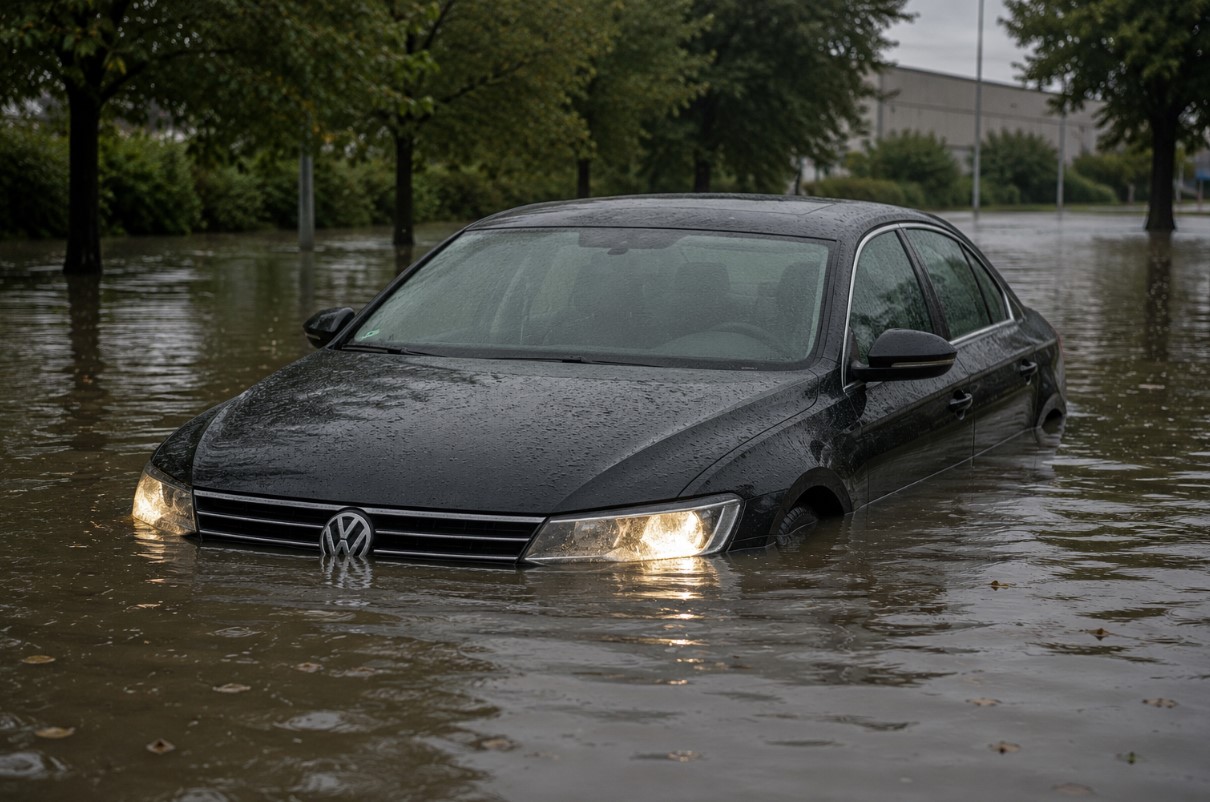
There is no single “magic sign”. A proper assessment looks for a combination of clues: unusual smells, recently replaced carpeting, moisture or contamination beneath sound insulation, corrosion on interior fasteners, oxidation inside connectors, dirt in hidden cavities, signs that the interior has been dismantled and unusual electronic faults that do not fit the seller's explanation.
The higher the water reached, the more systems may have been exposed. Particular caution is justified when water rose above the door sills and entered the passenger compartment.
💧 The key question is not:
“Is the car dry today?”
It is:
“Which components were previously in the water?”
Most buyers remember to ask whether a used car has previously been involved in an accident. Far fewer ask whether the vehicle has ever suffered significant water damage.
These are fundamentally different risks. A vehicle can still have factory paint, straight body-panel gaps and an apparently unfallfrei history, yet previously have been exposed to a serious flood.
We often look for repainting, body filler, welding and replaced body panels.
The focus shifts to moisture, hidden contamination, corrosion, oxidised connectors, wiring and low-mounted electronic modules.
Problems may be intermittent and may appear months after the car was dried and repaired.
A flooded interior can be professionally cleaned, deodorised and partially replaced.
❗ This is why a water-damaged car cannot reliably be ruled out simply because the paintwork appears original.
The actual water level is one of the most important factors when estimating possible damage. The higher the water rose, the more vehicle systems may have been directly exposed.
| Water level | Possible situation | Buyer risk | What to inspect |
|---|---|---|---|
| 💧 Below the door sill, passenger compartment remained dry | Serious damage is not inevitable, but low-mounted components may still have been exposed | Moderate | Underbody, low connectors, electrical components and drivetrain-related systems |
| 🌊 Water above the sill or entering the passenger compartment | Carpets, sound insulation, connectors and low-mounted components may have been submerged | High | Accessible floor coverings, cavities, wiring, electronics and safety systems |
| 🚨 Water approximately to the lower edge of the windows | A large number of electrical, electronic and potentially mechanical systems may have been exposed | Very high | Do not treat the vehicle like an ordinary used car without full documentation and specialist assessment |
| ❓ Water level unknown, but unusual evidence is present | The vehicle history remains unclear | High | Investigate further and require a credible explanation |
| 📄 Water damage disclosed and documented | The actual risk can be assessed more specifically | Depends on severity | Compare the repair, residual risk, purchase price and future resale value |
⚠ Water depth alone does not determine the outcome. Exposure time, the type of water, vehicle design and the location of electronic components are also important.
One of the biggest mistakes is to think of a flooded vehicle as an interior that simply needs to be cleaned and dried.
In reality, water may reach:
The visible surface may already be dry while moisture, dirt or previous water marks remain underneath.
Thick insulation mats can retain water and contamination much longer than the visible carpet.
Contact corrosion can develop gradually after the vehicle appears to have been successfully dried.
Many control units are mounted beneath seats, carpeting or low inside the body.
Connectors, sensors, seat-belt pretensioners and related electronics require particular attention.
At higher water levels, the engine, transmission and other drivetrain systems may also be exposed.
💧 Carpets can be replaced. Smells can be masked. The interior can be detailed. But the hidden consequences of water exposure are what determine the real purchasing risk.
The most obvious warning sign is a damp, musty or unusually stale smell. However, a vehicle that has been professionally prepared for sale may no longer smell damp at all.
That is why it is much more useful to assess a combination of smaller inconsistencies: recently replaced carpeting, corrosion on interior fasteners, contamination in hidden cavities, signs that the interior has been dismantled, unusual electronic faults and an interior that appears suspiciously fresh compared with the age of the car.
This deserves attention if the steering wheel, pedals and seats show much more obvious age and wear.
It may simply be part of normal detailing, but in some cases it can mask a damp or musty smell.
Rust on seat fasteners, rails or other protected interior parts requires an explanation.
This becomes more significant when it appears in several low-mounted areas.
Dirt, sand, deposits or unusual rust in the spare-wheel well should be investigated.
Random faults across different systems become more relevant when physical signs of water are also present.
⚠ None of these signs alone proves that the vehicle suffered a Hochwasserschaden. Water can also enter a car through a sunroof, blocked drains, damaged seals, incorrectly fitted glass or another local leak.
The visible surface of the carpet can be completely dry while evidence of previous water exposure remains underneath.
Particularly useful areas to inspect include:
💧 The key question is: “What is underneath the dry visible surface?”
Thick insulation mats can absorb and retain water far longer than the top layer of carpet.
That means a simple interior clean may not fully address the consequences of serious water ingress.
❗ If the seller says that “some water entered the car, but everything was simply dried out,” it is important to understand whether the floor coverings and sound insulation were removed, whether the cavities were checked and whether low-mounted electronic components were inspected.
A musty, damp or otherwise unusual smell can indeed be a sign of previous moisture.
But on a vehicle prepared for sale, smells can be temporarily reduced or removed through:
If a five-year-old car has clearly worn:
but the carpeting looks almost new, a reasonable question is: why was it replaced?
✅ There may be a completely innocent explanation. But a proper inspection should reduce uncertainty rather than rely on assumptions.
Rust on the underside of an older vehicle is not automatically suspicious. More interesting is corrosion inside protected areas of the passenger compartment.
| Area | Why it matters |
|---|---|
| 🔩 Seat mounting bolts | Normally located in a relatively protected interior area |
| 🛤 Seat rails | Unusual deposits or corrosion deserve explanation |
| 🧳 Spare-wheel well | Can retain evidence of water and contamination |
| 🚪 Lower door sections | Useful to compare left and right sides |
| 🔌 Electrical contacts | Oxidation may indicate previous moisture exposure |
| 🛡 Seat-belt mounting points | Important low-mounted areas related to occupant safety |
⚠ Corrosion must always be assessed in the context of the vehicle's age, climate, use and specific design.
An electrical connection may work normally today, while corrosion after previous water exposure continues to develop over time.
Special attention should be paid to connectors located:
❗ One oxidised connector does not prove flood damage. But widespread corrosion in several low-mounted areas, together with other warning signs, significantly increases the level of concern.
Modern cars contain dozens of electronic modules controlling almost everything: the engine, transmission, doors, seats, lighting, climate functions and safety systems.
Some of these modules are positioned low in the vehicle, sometimes directly under seats or beneath floor coverings.
Can control doors, windows and other interior functions.
Particularly important because of its role in vehicle safety.
Especially relevant in vehicles with electrically adjustable, heated or memory seats.
In hybrids and EVs, the number and complexity of electronic systems are even greater.
💧 One of the key problems with electronics after water exposure is that the fault may be intermittent. A short inspection may therefore fail to reproduce it.
A vehicle's cosmetic appearance can be restored extremely well. The electronic history, however, can sometimes reveal inconsistencies that do not fit the car's appearance.
That is why, when water damage is suspected, it is useful to scan as many accessible control units as possible, rather than checking only the engine ECU.
| What we analyse | Why it can help |
|---|---|
| ⚠ Active fault codes | Show current faults |
| 🗃 Stored fault codes | May reveal earlier problems |
| 🔄 Communication faults | Interesting when several unrelated modules show intermittent issues |
| 🛡 SRS / Airbag | Safety systems require separate attention |
| 🚪 Comfort / Door modules | Useful when interior functions behave inconsistently |
| 📡 Driver-assistance systems | Cameras, radar and electronic assistance functions |
| 🔋 Battery / Hybrid modules | Especially important for PHEV and EV vehicles |
Not one specific fault code, but a combination of:
⚠ Old stored faults do not prove flood damage. They can be caused by a weak 12V battery, previous repairs, diagnostic work or many other reasons.
Physical evidence + electronic evidence + seller history should form one coherent picture.
If water enters the passenger compartment, the risk is not limited to comfort electronics. Depending on the vehicle design, water may also reach SRS wiring, connectors, seat-belt pretensioners, impact sensors or control modules related to occupant protection.
This is one of the reasons why a flood-damaged vehicle should not be judged only by whether all warning lights are currently off.
❗ A clean SRS fault memory is useful, but it does not prove that every safety-related component was never exposed to water. Where there are strong physical signs of flooding, specialist inspection may be appropriate.
When flood water remains below the door sills, the primary concerns are usually the underbody, low-mounted electrical systems and mechanical components positioned close to the ground.
If the water rises significantly higher, the situation changes. Depending on the vehicle, water may reach:
If a running engine draws water into the combustion chambers, severe internal engine damage can occur.
A later-running engine does not automatically prove that no earlier hydrolock event occurred. If the vehicle has a documented severe flood history, the repair documentation becomes especially important.
Depending on how deeply and how long the vehicle was submerged, it may be reasonable to ask whether transmission, differential or other drivetrain fluids were inspected or replaced after the event.
⚠ The mechanical consequences of flooding depend strongly on water depth, exposure duration, whether the engine was running and the design of the specific vehicle.
Water in the passenger compartment does not automatically mean that the vehicle was submerged in a flood.
Local water ingress can be caused by:
Damage may be concentrated in one specific area, such as one footwell or the luggage compartment.
Evidence may appear across several low areas at a similar height.
✅ The purpose of the inspection is not simply to identify “water”. It is to understand where it came from, how much entered and which systems were affected.
Electric and plug-in hybrid vehicles require a separate level of caution after suspected flood exposure.
The traction battery is normally designed with extensive sealing and protection, but that does not mean that every high-voltage component, connector, module or charging-related system can be ignored after immersion.
❗ A suspected flood-damaged EV or PHEV should not be treated like a normal used combustion-engine car. High-voltage systems require manufacturer-appropriate diagnostics and, where necessary, inspection by personnel qualified for HV work.
The fact that the vehicle currently accepts a charge is useful information, but it does not by itself prove that every high-voltage or low-voltage system escaped previous water exposure.
If there is any indication that the vehicle may have suffered water or flood damage, the seller's explanation should be as specific as possible.
⚠ A statement such as “there was just a little water inside” is too vague. The buyer needs to know where the water reached and which components were exposed.
A VIN-based history report can sometimes provide additional clues about insurance events, previous damage, auctions, mileage or registration history.
However, the absence of a flood record does not prove that the vehicle was never exposed to water.
Not every incident is reported to insurance, not every country shares the same data, and private repairs may leave very little documentary trace.
Use the VIN report as one source among several: seller documents, physical inspection, OBD diagnostics, service history and the current condition of the vehicle.
Imported vehicles deserve additional attention when the earlier history is incomplete or difficult to verify.
A vehicle may have suffered flood damage abroad, been repaired, imported into Germany and later appear on the market with a clean-looking interior and limited documentation.
For vehicles imported from the United States, it may be particularly useful to search for:
Vehicles imported from the Netherlands, Belgium, France, Italy, Denmark or other European countries are not automatically suspicious.
The main issue is whether the vehicle's earlier life can be reconstructed and whether the current condition is consistent with that history.
❗ A suspiciously cheap imported vehicle with unusually fresh interior trim and incomplete history deserves a much deeper inspection before purchase.
Yes. A vehicle that has suffered water damage does not necessarily disappear from the market. Depending on the extent of the damage, it may be repaired, cleaned, dried and offered for sale again.
The difficulty for the buyer is that a professionally prepared vehicle may look completely normal during a short viewing. The interior can be clean, the engine can start immediately, there may be no warning lights and the test drive may initially reveal nothing unusual.
This is precisely why buying a used car in Germany after flood events requires a systematic inspection rather than a visual impression alone.
Carpets, trim, seats and visible surfaces can be cleaned or replaced.
Wiring, connectors and control modules may develop problems later.
A documented flood history can make future resale significantly more difficult.
A low price can make a previously water-damaged vehicle look attractive. But the purchase price is only one part of the financial equation.
The buyer should also consider:
❗ A discount of several thousand euros can disappear very quickly if the vehicle later develops intermittent electrical or electronic problems.
| Vehicle situation | Typical buyer risk | Our practical view |
|---|---|---|
| Minor local water leak, professionally repaired and documented | 🟡 Moderate | Can be considered after careful inspection |
| Water entered the interior, but repair documentation is complete | 🟠 Elevated | Requires detailed inspection and diagnostics |
| Confirmed flood exposure affecting several electronic areas | 🔴 High | Purchase only with a clear understanding of the risks |
| Suspicious signs, unclear seller explanation, no repair documentation | 🔴 Very high | In many cases, walking away is the safer decision |
| Flood-damaged EV/PHEV with unclear HV-system history | 🔴 Very high | Specialist HV inspection is essential |
💡 A low price should never be treated as compensation for an unknown risk. First estimate the risk; only then decide whether the discount is sufficient.
If you suspect Hochwasserschaden, Wasserschaden or previous water ingress, a structured inspection is more useful than randomly checking individual components.
| Step | What to check | What we are trying to establish |
|---|---|---|
| 1️⃣ History | VIN, service history, invoices, HU/AU, seller information | Whether the documented history contains inconsistencies |
| 2️⃣ Smell | Dampness, mould, strong fragrances, unusual chemical smell | Whether odours may indicate moisture or intensive detailing |
| 3️⃣ Interior | Carpets, seats, rails, fasteners, trim | Whether parts were replaced, removed or exposed to water |
| 4️⃣ Hidden low areas | Under seats, sills, spare-wheel well, lower luggage compartment | Whether contamination, corrosion or deposits remain |
| 5️⃣ Electrical system | Connectors, wiring, modules, comfort systems | Whether moisture-related damage may have affected electronics |
| 6️⃣ OBD scan | Engine, transmission, SRS, comfort, assistance and other modules | Whether electronic evidence supports the physical findings |
| 7️⃣ Test drive | Engine, transmission, steering, brakes, assistance systems | Whether the car behaves normally under real operating conditions |
| 8️⃣ Overall assessment | Compare all findings | Buy, negotiate, request further specialist checks or walk away |
Do not try to prove flood damage from one rusty screw or one stored fault code. Look for a consistent pattern of evidence.
Before signing a Kaufvertrag, use the following checklist if there is any suspicion that the vehicle may have suffered water damage.
❗ If several warning signs point in the same direction and the seller cannot provide a convincing documented explanation, the safest purchase decision may simply be to choose another vehicle.
A flood-damaged car can look excellent in an advertisement. That is why our pre-purchase inspection focuses not only on appearance, but on whether the different parts of the vehicle's story actually fit together.
Depending on the vehicle and the inspection conditions, we can assess:
📍 We provide used-car inspections in Berlin and Brandenburg and can also arrange on-site inspections across Germany.
A VIN history report can be useful before travelling to inspect a vehicle, particularly when the car is imported, has an unclear history or is being offered at an unusually attractive price.
It should not replace a physical inspection or diagnostics, but it may reveal additional information that helps you decide whether the vehicle is worth viewing at all.
Advertisement / *Affiliate link
Links and banners marked with an asterisk (*) are affiliate links. If you follow such a link and purchase a service, we may receive a commission from the provider. There is no additional cost to you: the price and conditions remain the same.
Yes. Professional cleaning, drying, replacement carpets and cosmetic preparation can remove many obvious visual signs. Hidden corrosion, connector damage or electronic problems may still remain.
No. A damp smell can also result from a leaking sunroof, blocked drains, damaged seals or another local water leak. The cause must be investigated.
Not by themselves. Diagnostic faults can support other evidence, especially when several unrelated electronic systems show communication or intermittent problems. The results must be assessed together with the physical condition and vehicle history.
It depends on the severity of the event, the water level, which components were affected, the quality of the repair and the available documentation. A minor documented local water leak is very different from a vehicle that was deeply submerged.
One of the most difficult risks is delayed corrosion in wiring, connectors and electronic components. Problems can appear intermittently long after the vehicle has been dried.
Such a purchase requires particular caution. The high-voltage battery, charging system, insulation monitoring and other HV components should be assessed using manufacturer-appropriate procedures and qualified personnel where required.
Sometimes, if the event was recorded by an insurer, auction, database or another participating source. However, no VIN report can guarantee that every previous water-damage event will be recorded.
For a used vehicle with suspected water damage, refusal to allow reasonable inspection substantially increases the buyer's uncertainty. In many cases, choosing another vehicle is the more rational decision.
Final conclusion: a flood-damaged car is not necessarily a visibly ruined car. The real danger is often hidden beneath carpets, inside connectors, wiring, control modules and low-mounted electronic systems.
If you are buying a used car in Germany and have doubts about its history, a professional pre-purchase inspection can help identify warning signs before you sign the purchase contract.
How to assess a used vehicle systematically instead of relying on the seller's description or appearance alone.

Documents, diagnostics, bodywork and technical checks that can reduce the risk of an expensive mistake.
Legal and technical disclaimer:
This article is provided for general informational purposes only.
The signs described above
do not by themselves prove
that a specific vehicle has suffered flood damage,
water damage
or improper repair.
Similar symptoms may have other causes.
The condition of a used vehicle
can only be assessed
within the scope of the inspection actually performed
and at the time of that inspection.
Hidden,
inaccessible,
intermittent
or future defects
cannot be completely excluded.
Diagnostic data,
VIN-history reports,
service records
and seller statements
should be treated as individual sources of information
and assessed together with the physical vehicle.
For electric and plug-in hybrid vehicles,
work on high-voltage systems
must be performed only by appropriately qualified personnel
and in accordance with applicable manufacturer
and safety requirements.
Sicher-Check does not provide
a guarantee of future vehicle reliability.
The final purchase decision
remains with the buyer.