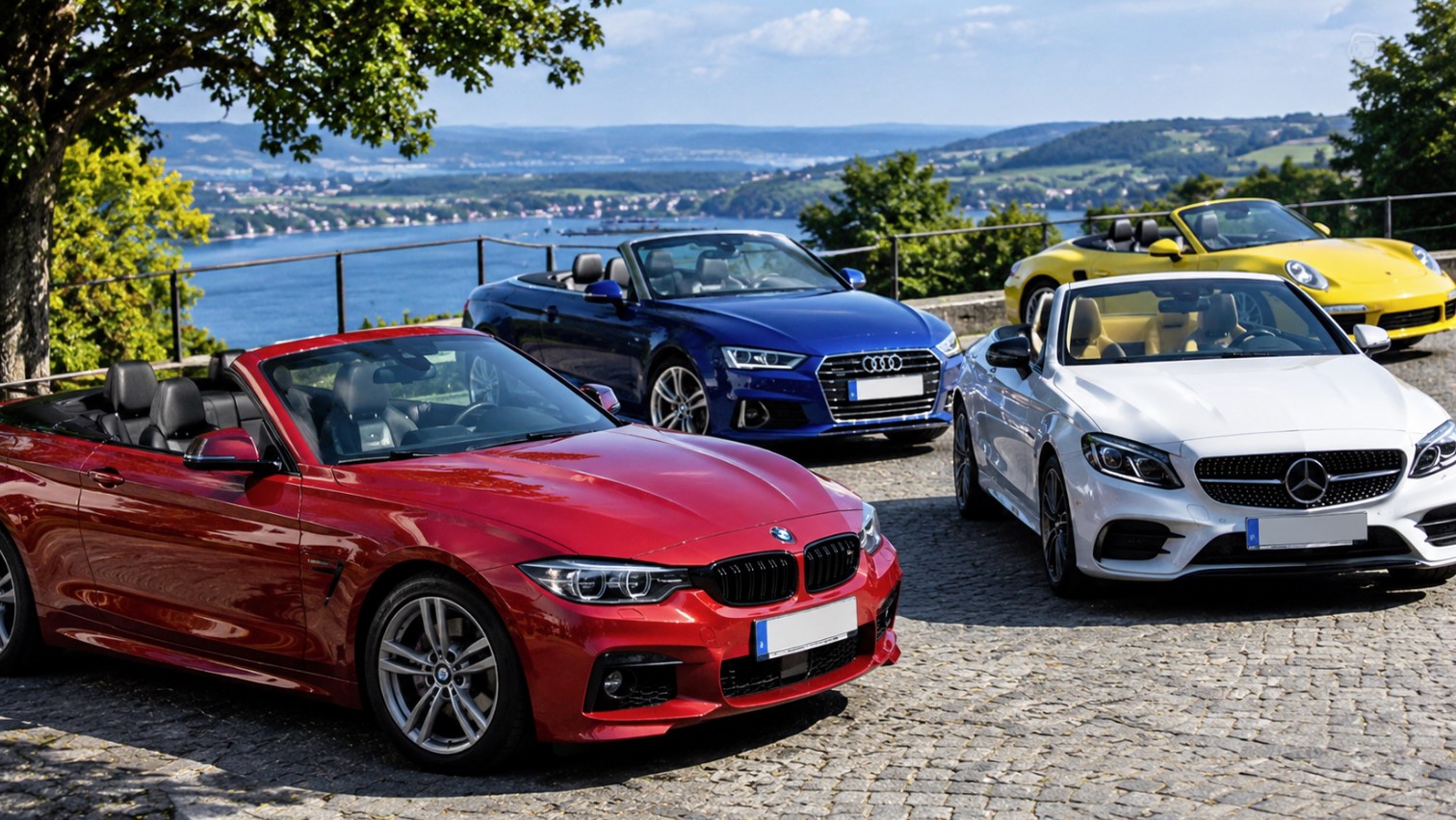
📌 Quick Answer: What Should You Check Before Buying a Used Convertible?
When buying a used convertible in Germany, the most important additional inspection area is the roof system.
Check whether the roof opens and closes smoothly, whether the seals are intact, and whether there are signs of water ingress, corrosion or previous repairs.
On vehicles with electric or hydraulic roof mechanisms, check the operation of motors, pumps, sensors, locking systems and associated electronics.
Also inspect the engine, gearbox, suspension, bodywork, maintenance history and registration documents, just as you would with any other used car.
Soft top or hardtop? Neither design is automatically more reliable. A fabric roof may be simpler and lighter, while a retractable metal roof can provide additional weather protection but often introduces more complex mechanical systems.
Is a convertible more expensive to insure or tax in Germany? Not necessarily. German vehicle tax generally depends on the vehicle's relevant tax parameters, not simply on whether it is a convertible. Insurance premiums depend on the insurer's risk assessment, vehicle classification, driver profile and coverage.
Can you save money with a Saisonkennzeichen? Seasonal registration can reduce the period for which vehicle tax and insurance are payable. However, the vehicle cannot be driven on public roads outside the registered season.
🌤️ 1. Why Buy a Used Convertible in Germany?
Driving with the roof down is a very different experience from travelling in a conventional hatchback, saloon or SUV. A convertible offers fresh air, a stronger connection to the road and the pleasure of open-top motoring on sunny days.
Germany has an established market for used convertibles, ranging from affordable compact models to premium roadsters and high-performance grand touring cars.
Buyers may encounter vehicles from manufacturers such as Volkswagen, Audi, BMW, Mercedes-Benz, Mazda, MINI, Porsche, Peugeot and Fiat.
Depending on the model, a convertible can be an enjoyable everyday car, a summer-only second vehicle or a long-term enthusiast purchase.
💶 Why Used Convertibles Can Be Attractive
Some used convertibles offer a favourable relationship between purchase price, equipment and driving enjoyment.
Seasonal demand, age, mileage, model popularity and maintenance requirements can all influence asking prices. However, a lower advertised price does not necessarily mean a lower total ownership cost.
A vehicle with an ageing roof mechanism, damaged seals or concealed moisture may require repairs that significantly change the financial calculation.
⚠️ Why a Convertible Needs Additional Checks
Compared with a conventional fixed-roof car, a convertible may have additional mechanical and electrical components associated with its roof system.
Depending on the design, these can include:
- Electric roof motors and drive mechanisms.
- Hydraulic pumps, cylinders and hoses.
- Roof-position sensors, microswitches and control units.
- Additional body reinforcements and underbody bracing.
- Window alignment systems and specialised rubber seals.
- Water drainage channels and collection trays.
- Convertible-specific trim, hinges and locking parts.
The number and complexity of these components vary considerably between models.
⚠️ Important Buying Principle
Never assume that a convertible is in good condition simply because the roof looks clean and operates once.
A proper assessment should include repeated roof operation where appropriate, inspection for moisture, visual checks of accessible mechanisms and a review of any roof-related diagnostic faults.
📍 Buying a Convertible in Berlin, Potsdam or Brandenburg
Buyers searching for a used convertible in Berlin, Potsdam, Brandenburg or elsewhere in Germany should evaluate the vehicle independently of the seller's description.
Terms such as gepflegt, top Zustand, unfallfrei or Scheckheftgepflegt may provide useful information, but they should not replace an examination of the vehicle and its available records.
A well-documented vehicle with a functioning roof and evidence of regular maintenance may be preferable to a cheaper example with unresolved technical risks.
🚘 2. Convertible, Roadster, Targa or Coupé-Cabriolet: What Is the Difference?
When searching for a used convertible in Germany, buyers will encounter several different body styles. Although these vehicles share the ability to provide open-air driving, their roof construction, practicality, driving characteristics and maintenance requirements can differ substantially.
Understanding these differences helps you select a vehicle that suits your lifestyle, budget and expectations.
🌤️ Cabriolet
A cabriolet is generally a passenger car with a fully or substantially retractable roof. It may offer two or four seats and can be based on an existing coupé, hatchback or saloon platform.
Examples include the BMW 4 Series Convertible, Audi A5 Cabriolet and Volkswagen Golf Cabriolet.
Best suited to: drivers who want open-top motoring with a reasonable level of everyday practicality.
🏎️ Roadster
A roadster is typically a two-seat sports car designed around driving enjoyment and a compact open-top body.
Well-known examples include the Mazda MX-5, BMW Z4 and Mercedes-Benz SLK/SLC.
Roadsters often have limited luggage space and may be less convenient for families or long trips with substantial baggage.
Best suited to: individuals or couples who prioritise handling, compact dimensions and driving pleasure.
🔧 Coupé-Cabriolet
A coupé-cabriolet usually features a retractable rigid roof that folds into the rear section of the vehicle.
Examples include the Peugeot 308 CC, Volkswagen Eos and certain generations of the Mercedes-Benz SLK.
The roof may provide a more enclosed coupé-like experience when closed, but its moving panels and associated mechanisms can be relatively complex.
Best suited to: buyers who prefer a rigid roof and accept the potential maintenance implications.
☀️ Targa
A Targa-style car typically retains substantial fixed body structures while offering a removable or retractable roof section.
The precise design varies by manufacturer and model generation. Some systems are manual; others use sophisticated electric mechanisms.
Porsche 911 Targa models are a well-known example of this body concept.
Best suited to: buyers seeking distinctive styling and a combination of open-air driving with fixed structural elements.
🧩 Other Roof Designs Worth Knowing
Not every vehicle marketed as an open-top car fits neatly into one of these categories.
- Manual soft tops: roofs opened and closed primarily by hand, sometimes with mechanical assistance.
- Power-operated soft tops: fabric roofs controlled by electric motors, hydraulic systems or a combination of both.
- Retractable hardtops: rigid roof panels folded and stored within the vehicle.
- Removable hardtops: separate rigid roofs that must be physically removed and stored outside the vehicle.
- Sliding fabric roofs: large retractable textile sections fitted within an otherwise fixed roof structure.
💡 Buying tip: Always identify the exact roof system fitted to the vehicle. Two generations of the same model may use completely different roof designs, with different repair costs and inspection requirements.
⚖️ 3. Soft Top vs Retractable Hardtop: Which Is Better for a Used Car?
One of the most common questions among convertible buyers is whether a fabric soft top or a retractable hardtop is the better choice.
There is no universally correct answer. The decision depends on the individual model, the condition of its roof, how frequently the car will be used and the owner's tolerance for potential repair costs.
🧵 Fabric Soft Top: Advantages and Disadvantages
A traditional soft top generally consists of a textile outer layer, supporting frame, seals and, depending on the design, additional insulation and an inner lining.
✅ Potential Advantages
- Often lighter than a multi-panel retractable metal roof.
- May require less storage space when folded.
- Can provide a traditional convertible appearance.
- Some manual systems are mechanically simple.
- Modern high-quality fabric roofs can offer good weather protection and insulation.
⚠️ Potential Disadvantages
- Fabric may fade, become worn or develop damage.
- Seams and seals can deteriorate with age.
- Incorrect cleaning can damage protective treatments.
- Noise insulation varies considerably between models.
- Replacing the complete roof covering may be expensive.
🛠️ Retractable Hardtop: Advantages and Disadvantages
A retractable hardtop uses rigid roof panels that move through a predefined sequence before being stored, usually in the rear of the vehicle.
These systems may contain electric motors, hydraulic actuators, mechanical linkages, position sensors and electronic control units.
✅ Potential Advantages
- Rigid roof panels can provide a more conventional enclosed-car feel.
- Some designs offer good acoustic and thermal insulation.
- Painted metal or composite panels do not require the same fabric care.
- The vehicle may resemble a conventional coupé when the roof is closed.
⚠️ Potential Disadvantages
- More moving parts can mean more potential failure points.
- Hydraulic repairs may require specialised expertise.
- Roof movement can consume considerable luggage space.
- Panel alignment is important for correct sealing.
- Replacement components may be expensive or difficult to source for older models.
📊 Soft Top vs Hardtop: Practical Comparison
| Criterion | Fabric Soft Top | Retractable Hardtop |
|---|---|---|
| Roof material | Textile, usually with several layers | Rigid metal or composite panels |
| Typical complexity | Varies from simple manual to complex powered systems | Often mechanically and electronically complex |
| Weight | Often lower | Often higher |
| Weather protection | Good when properly designed and maintained | Good when seals and panel alignment are correct |
| Common concerns | Fabric wear, seams, seals, drainage and mechanisms | Sensors, pumps, actuators, hinges, alignment and seals |
| Luggage space | Depends on folding design | Often significantly reduced with roof open |
| Repair costs | Can be substantial, especially for complete roof replacement | Can be substantial, particularly for complex mechanisms |
| Best buying criterion | Verified condition, documented maintenance and correct operation of the specific roof system | |
📌 Which Roof Is More Reliable?
Reliability depends more on the particular vehicle, design and maintenance history than on the label "soft top" or "hardtop".
A carefully maintained electrically operated fabric roof can still be complex, while a neglected retractable hardtop may require extensive repairs.
For a used convertible, the actual condition matters more than the roof category.
🧵 4. Common Soft-Top Problems: Fabric, Seams, Seals and Frame
A fabric roof is exposed to sunlight, rain, temperature changes, dirt and repeated folding. Over time, these factors can affect its appearance and functionality.
When inspecting a used soft-top convertible, the condition of the fabric alone is not sufficient. The roof frame, seals, attachment points and operating mechanism must also be assessed.
🔍 4.1 Fabric Wear and Damage
Examine the outer surface in good daylight. Pay particular attention to areas that fold or rub against other components.
- Faded or uneven colour.
- Frayed edges or damaged stitching.
- Abrasion marks near folding points.
- Small cuts, holes or previous patches.
- Areas where the fabric appears excessively stretched or poorly tensioned.
- Separation between roof layers or between the roof and rear window.
Minor cosmetic wear does not necessarily require replacement. However, visible deterioration can indicate that the roof has received insufficient maintenance or has reached an advanced stage of ageing.
🪟 4.2 Rear Window Problems
Depending on the model, the rear window may be made of glass or flexible transparent plastic.
Older plastic windows can become cloudy, scratched or brittle. Glass windows may suffer from damaged bonding, seals or heating elements.
Check that the rear window is securely attached and that its edges show no signs of water penetration.
⚙️ 4.3 Roof Frame and Hinges
The supporting frame must move smoothly and maintain the correct roof shape when closed.
Potential warning signs include:
- Asymmetric roof movement.
- Grinding or unusual mechanical noises.
- Visible deformation of frame elements.
- Loose or damaged hinges.
- Roof material catching on structural components.
- Difficulty engaging the front locking mechanism.
🔌 4.4 Electric Soft-Top Failures
Electrically operated soft tops can develop problems involving drive motors, cables, sensors, switches or electronic modules.
A roof that stops halfway through its cycle should not be repeatedly forced to operate. Doing so may cause further mechanical damage.
The fault should be diagnosed before any repair decision.
⚠️ Do Not Ignore a Partially Working Roof
Statements such as "the roof only needs a small adjustment" or "probably just a sensor" should be treated cautiously until the actual cause has been established.
The same symptom can arise from a relatively minor electrical issue or a much more expensive mechanical failure.
🧼 4.5 Soft-Top Maintenance
Correct maintenance can help preserve a fabric roof, but cleaning methods should follow the manufacturer's recommendations.
Aggressive chemicals, unsuitable brushes or excessive pressure may damage fabric, seams or protective coatings.
Waterproofing products should only be applied where suitable for the specific roof material.
🔧 5. Retractable Hardtop Problems: Hydraulics, Sensors and Electronics
A retractable hardtop can be one of the most technically complex systems fitted to a used convertible.
Roof movement often requires several components to operate in a precise sequence, with each stage monitored by switches or position sensors.
A failure in one component may prevent the entire opening or closing cycle from completing.
💧 5.1 Hydraulic System Faults
Some retractable roofs use hydraulic pumps, fluid reservoirs, cylinders and hoses to move the roof panels.
Typical potential problems include:
- Hydraulic fluid leaks.
- Ageing or damaged hoses.
- Leaking hydraulic cylinders.
- Pump motor or pump assembly failures.
- Insufficient pressure during roof operation.
- Intermittent operation caused by electrical or hydraulic faults.
Where safely accessible, inspect the roof mechanism and surrounding trim for signs of fluid leakage.
Avoid dismantling hydraulic components without the appropriate service information and expertise.
📡 5.2 Position Sensors and Microswitches
A modern roof control unit must know whether individual panels, locks and luggage compartment elements are in the correct positions.
This information may come from microswitches, Hall-effect sensors or other position-detection components.
If the expected signal is missing, the roof control system may interrupt operation to prevent damage.
A diagnostic scan can sometimes reveal stored faults, but the absence of fault codes does not guarantee that the roof mechanism is in perfect condition.
⚙️ 5.3 Hinges, Linkages and Locking Mechanisms
Retractable hardtops rely on accurate mechanical alignment. Wear, deformation or previous incorrect repairs may interfere with roof movement.
Inspect for:
- Uneven panel gaps.
- Scratches where panels contact one another.
- Unusual movement or vibration.
- Damaged seals around panel joints.
- Poor engagement of roof locking points.
- Evidence of improvised mechanical repairs.
🔋 5.4 Battery Voltage and Roof Operation
Many powered roof systems depend on adequate electrical supply. Some manufacturers specify that the engine must be running or particular conditions must be met before roof operation.
Low battery voltage can interfere with the process, but it should not automatically be assumed to explain every roof fault.
A proper inspection should follow the manufacturer's operating requirements.
🧪 5.5 How to Test a Retractable Hardtop
- Check the roof and luggage compartment for visible damage before operation.
- Confirm that the vehicle meets the manufacturer's operating conditions.
- Open the roof while observing the complete movement sequence.
- Listen for unusual noises and watch for irregular movement.
- Check whether the roof reaches its fully open position.
- Close the roof and verify correct locking and panel alignment.
- Repeat the cycle where appropriate and safe to do so.
- Inspect accessible seals, mechanisms and surrounding areas.
- Where supported, perform electronic diagnostics of the roof control system.
⚠️ Important Safety Warning
Never place hands, tools or other objects inside moving roof mechanisms.
If the roof jams, stop the operation. Emergency manual closing procedures differ between vehicles and should only be performed according to the relevant manufacturer instructions.
💦 6. Water Leaks, Blocked Drains and Hidden Moisture Damage
Water ingress is among the most important risks when purchasing an older convertible.
Even a roof that appears undamaged can allow water to enter if its seals, drainage system or panel alignment are defective.
In some vehicles, moisture may accumulate beneath carpets, behind interior trim or in the luggage compartment without being immediately visible.
🌧️ 6.1 Where Can Water Enter?
- Along the upper windscreen seal.
- At the junction between the roof and side windows.
- Around rear-window seals or bonding.
- Through deteriorated roof-panel seals.
- Via blocked drainage channels.
- Around damaged luggage compartment seals.
- Through incorrectly repaired body joints.
🔍 6.2 Signs of Previous Water Ingress
During a pre-purchase inspection, pay attention to the following indicators:
- Damp carpets or underlay.
- A persistent musty smell.
- Condensation inside the vehicle.
- Water marks on interior trim.
- Corrosion on accessible metal parts.
- Oxidation on electrical connectors.
- Unexplained electrical malfunctions.
- Moisture in the spare-wheel well or luggage compartment.
🧠 6.3 Why Hidden Moisture Can Become Expensive
Water entering the passenger compartment may affect wiring harnesses, connectors, control modules, insulation materials and metal components.
Depending on the vehicle, electronic modules may be installed in areas vulnerable to accumulated moisture.
The consequences can range from unpleasant odours to intermittent electrical faults and corrosion.
📌 Can a Convertible Be Completely Waterproof?
A properly functioning convertible roof should provide the weather protection intended by its manufacturer.
However, effective sealing depends on the condition of the roof, windows, rubber seals and drainage system.
A visible leak should not be dismissed as normal simply because the car is a convertible.
🚿 6.4 Should You Perform a Water Test?
A controlled water test may help identify certain leaks, but it should only be carried out with the seller's permission and using a method suitable for the vehicle.
High-pressure washing directly against seals is not a reliable substitute for a proper inspection and may force water into areas that are not designed to withstand such pressure.
Even if no leak appears during a short test, this does not rule out intermittent water ingress during prolonged rain or particular parking conditions.
🏗️ 7. Body Rigidity, Accident Repairs and Structural Condition
Removing a conventional fixed roof changes the structural design of a passenger car.
Convertible manufacturers compensate through model-specific reinforcements, strengthened sills, underbody structures and other engineering solutions.
These features make the condition of the body structure particularly important when assessing a used convertible.
🔩 7.1 Areas Worth Inspecting
- Sills and their accessible inner and outer sections.
- Underbody reinforcements and crossmembers.
- Floor panels and visible structural joints.
- Windscreen frame and surrounding body elements.
- Door openings and hinge areas.
- Suspension mounting points.
- Roof attachment and locking locations.
🚗 7.2 Accident Damage and Previous Repairs
A convertible that has undergone significant structural repairs deserves careful examination.
Incorrect repair work may affect body geometry, door alignment, roof sealing or the operation of roof mechanisms.
Paint-thickness measurements, visual examination of accessible joints, inspection of fasteners and comparison of panel gaps can help identify possible previous repairs.
These checks alone cannot conclusively establish the complete accident history of a vehicle.
🔊 7.3 Unusual Noises During a Test Drive
Some convertibles may exhibit different levels of body vibration or interior noise compared with fixed-roof vehicles.
However, pronounced rattling, abnormal movement or unusual noises should be investigated rather than automatically attributed to the convertible design.
During a test drive, pay attention to:
- Knocking sounds over uneven roads.
- Excessive movement of interior trim.
- Unusual wind noise around the roof and windows.
- Door closing and alignment.
- Changes in noise between roof-open and roof-closed driving, where permitted and safe.
🔍 Professional inspection tip: A roof that opens and closes correctly does not automatically prove that the body is free from structural damage.
Roof operation, body condition and evidence of previous repairs should be assessed as separate but related aspects of the inspection.
🚘 8. Popular Used Convertibles in Germany: Which Models Are Worth Considering?
The German second-hand car market offers a wide selection of convertibles, from affordable city cars to premium roadsters and high-performance sports cars.
However, a model's popularity does not guarantee that every individual example is reliable. Roof construction, engine generation, transmission type, service history and previous repairs must all be considered.
🚗 Compact and Affordable Convertibles
Volkswagen Golf Cabriolet
The Golf Cabriolet combines familiar Volkswagen technology with a fabric convertible roof. It can be a practical choice for buyers who want an open-top car without moving into the premium segment.
Inspection priorities: roof operation, water drainage, engine-specific maintenance, DSG operation where fitted, suspension and body repairs.
MINI Convertible
The MINI Convertible offers compact dimensions, distinctive styling and an engaging driving experience.
Inspection priorities: roof movement, seals, drainage, engine generation, cooling system, oil leaks and maintenance history.
Fiat 500C
The Fiat 500C features a retractable fabric roof section rather than the complete open-body construction of a traditional cabriolet.
Inspection priorities: sliding roof mechanism, fabric condition, guides, water ingress, transmission and general mechanical condition.
Peugeot 207 CC / 308 CC
These coupé-cabriolets use retractable rigid roofs and can offer attractive purchase prices on the used-car market.
Inspection priorities: roof hydraulics or drives, sensors, seals, drainage, engine-specific problems and evidence of previous repairs.
🏎️ Roadsters for Driving Enthusiasts
Mazda MX-5
The Mazda MX-5 is a compact, lightweight roadster available across several generations with different roof configurations.
Some versions use a manual fabric roof, while others feature a retractable rigid roof design.
Inspection priorities: corrosion, underbody condition, roof operation, water drainage, suspension, engine condition and previous accident repairs.
BMW Z4
Depending on generation, the BMW Z4 may have a fabric soft top or a retractable hardtop.
The driving experience and maintenance requirements differ significantly between engine versions and model generations.
Inspection priorities: roof system, engine oil leaks, cooling system, suspension, electronic diagnostics and service records.
Mercedes-Benz SLK / SLC
The Mercedes-Benz SLK, later renamed SLC, is known for its retractable rigid roof.
It offers a combination of compact roadster dimensions and a coupé-like enclosed roof.
Inspection priorities: roof hydraulics, locking mechanisms, water ingress, engine and transmission, corrosion and electronics.
Porsche Boxster
The Porsche Boxster offers a mid-engine sports-car layout and open-top driving. Different generations have different engines, transmissions and technical characteristics.
Inspection priorities: engine-generation-specific risks, cooling, oil leaks, roof condition, suspension, brakes and documented servicing.
⭐ Premium Four-Seat Convertibles
Buyers seeking greater comfort and everyday practicality may consider models such as:
- Audi A3 Cabriolet.
- Audi A5 Cabriolet.
- BMW 2 Series Convertible.
- BMW 4 Series Convertible.
- Mercedes-Benz C-Class Cabriolet.
- Mercedes-Benz E-Class Cabriolet.
These vehicles can offer sophisticated equipment, comfortable interiors and strong performance. However, optional equipment, complex electronics, powerful engines and premium replacement parts may increase ownership costs.
| Model | Roof Type | Key Buying Consideration |
|---|---|---|
| Mazda MX-5 | Fabric or retractable rigid roof, depending on version | Corrosion, roof, suspension and accident history |
| BMW Z4 | Depends on generation | Roof mechanism, engine generation and maintenance |
| Mercedes-Benz SLK/SLC | Retractable hardtop | Roof hydraulics, seals and electronics |
| Volkswagen Eos | Multi-section retractable rigid roof | Roof mechanism, drainage and leaks |
| Audi A5 Cabriolet | Fabric soft top | Roof operation, engine, gearbox and electronics |
| Peugeot 308 CC | Retractable hardtop | Roof operation, seals and engine-specific risks |
| Porsche Boxster | Primarily fabric powered roof | Engine generation, service history and roof condition |
💡 Important Model Selection Advice
When comparing used convertibles, identify the exact model year, engine code, transmission, roof design and equipment.
A vehicle with the same commercial model name may have significantly different technical risks depending on its generation.
⚙️ 9. Engines and Transmissions: What Should You Check in a Used Convertible?
Although the roof is a major distinguishing feature, a convertible remains a conventional motor vehicle in many other respects.
Engine reliability, gearbox condition, cooling performance, suspension wear and maintenance history can have a greater financial impact than minor cosmetic roof imperfections.
⛽ Petrol Engines
Petrol engines are common in used convertibles, particularly in compact and sports-oriented models.
Before buying, check:
- Cold-start behaviour.
- Unusual engine noises.
- Oil consumption history.
- Timing chain or belt maintenance.
- Cooling-system condition.
- Turbocharger operation, if fitted.
- Misfires and stored fault codes.
- Evidence of overheating or fluid leaks.
🛣️ Diesel Engines
Diesel-powered convertibles can be suitable for drivers who regularly travel longer distances.
However, diesel vehicles used mainly for short summer journeys may experience operating conditions that are unfavourable for certain exhaust aftertreatment systems.
Particular attention should be paid to:
- Diesel particulate filter (DPF).
- Exhaust gas recirculation (EGR).
- Turbocharger operation.
- Fuel injection system.
- SCR/AdBlue system, where fitted.
- Maintenance and regeneration history.
🔄 Manual and Automatic Transmissions
A manual gearbox may appeal to buyers who prefer direct control and a traditional driving experience.
Automatic transmissions, including dual-clutch and torque-converter systems, can provide greater convenience. Their maintenance requirements and potential weaknesses depend on the exact design.
Manual Gearbox
- Clutch operation.
- Gear engagement.
- Unusual transmission noises.
- Clutch slipping under load.
- Dual-mass flywheel, where fitted.
Automatic Gearbox
- Smooth gear changes.
- Response during acceleration.
- Unusual vibrations or slipping.
- Transmission fault codes.
- Required oil-service history.
🧪 Why a Test Drive Matters
A stationary inspection cannot fully reproduce real driving conditions. A test drive, where permitted and practically possible, can help assess:
- Acceleration and engine response.
- Transmission operation.
- Steering and suspension.
- Brake performance.
- Vibrations at different speeds.
- Wind noise around the closed roof.
- Unusual rattles from roof components.
⚠️ No Fault Codes Does Not Mean No Problems
Electronic diagnostics can reveal valuable information, but not every mechanical defect generates a fault code.
A proper pre-purchase assessment combines diagnostic information with visual inspection, available service records and driving behaviour.
💶 10. Convertible Road Tax in Germany: How Does Kfz-Steuer Work?
Buyers frequently ask whether a convertible is more expensive to tax than an ordinary hatchback, saloon or coupé.
In Germany, a convertible does not automatically attract higher motor vehicle tax simply because it has an opening roof.
German motor vehicle tax (Kraftfahrzeugsteuer or Kfz-Steuer) depends on the vehicle's legally relevant characteristics and the rules applicable to its registration.
📋 Factors Affecting Kfz-Steuer
For many passenger cars with combustion engines, relevant factors include:
- First registration date.
- Petrol or diesel engine.
- Engine displacement.
- Applicable CO₂ emissions figure.
- Relevant emissions classification.
- Any applicable exemptions or special rules.
The precise calculation depends on the statutory regime applicable to the vehicle. Different first-registration dates can result in different tax calculation methods.
🧮 Illustrative Tax Calculation
Consider a hypothetical petrol convertible first registered under the tax regime applicable to passenger cars initially registered from 2021.
Assume the following values:
- Petrol engine: 1,998 cm³.
- Official relevant CO₂ value: 150 g/km.
- No special exemption.
Under the relevant tariff, the engine-displacement component would be calculated using 20 units of 100 cm³ at €2 per unit:
20 × €2 = €40.
The progressive CO₂ component would then be added according to the applicable statutory brackets.
For these assumed values, the resulting illustrative annual tax would be €134.
💡 Verify the Exact Vehicle
This example is not a quotation for any particular vehicle. Older registration dates, different CO₂ values or special circumstances can change the result.
Before purchasing, verify the exact tax using the vehicle's registration information and the official German customs (Zoll) tax calculator.
🚗 Does Roof Type Affect Road Tax?
The distinction between a fabric roof and a retractable hardtop is not itself a separate tax category.
However, two vehicles with different roof designs may have different homologated CO₂ values, weights, engines or registrations. Their tax amounts may therefore differ.
📆 What About Seasonal Registration?
A convertible registered for only part of the year under a valid Saisonkennzeichen is generally taxed for its registered operating period.
This can reduce annual vehicle tax compared with continuous registration. The practical restrictions are explained in Section 12.
🛡️ 11. Convertible Insurance in Germany: Haftpflicht, Teilkasko or Vollkasko?
Insurance is another important ownership cost when purchasing a used convertible in Germany.
The premium is not determined solely by whether the vehicle has a fabric or retractable metal roof.
Insurers consider several risk-related factors, including the vehicle model, driver profile, insurance history and selected coverage.
🚘 11.1 Kfz-Haftpflicht: Mandatory Liability Insurance
Motor vehicle liability insurance is mandatory for vehicles registered for road use in Germany.
It generally covers insured third-party claims arising from the operation of the vehicle, subject to policy terms and applicable law.
It does not normally cover accidental damage to your own vehicle.
🌧️ 11.2 Teilkasko: Partial Comprehensive Insurance
Teilkasko may provide protection against specified risks, depending on the policy.
Common insured events can include theft, glass damage, certain natural hazards, fire and other contractually defined risks.
For convertible owners, the exact treatment of roof damage deserves special attention.
⚠️ Is a Damaged Soft Top Covered by Teilkasko?
Do not assume that every torn or damaged convertible roof is automatically covered.
Coverage depends on the insured event, policy wording, exclusions and the circumstances of the damage.
Normal wear, ageing and deterioration are generally not insured accidental events.
Before purchasing a convertible, ask the insurer how the policy treats vandalism, theft-related damage and damage to the roof mechanism.
🏎️ 11.3 Vollkasko: Comprehensive Insurance
Vollkasko typically includes Teilkasko protection and additional coverage for specified damage to the insured vehicle, including certain self-caused accidents and vandalism, subject to the contract.
It may be particularly relevant for newer or higher-value convertibles.
However, Vollkasko does not replace a mechanical warranty and does not normally cover ordinary wear or mechanical breakdown simply because a component fails.
📊 Insurance Comparison
| Coverage | Typical Purpose | Important Limitation |
|---|---|---|
| Haftpflicht | Third-party liability | Generally does not insure damage to your own car |
| Teilkasko | Selected risks such as theft, glass damage and specified natural hazards | Only events included in the policy are covered |
| Vollkasko | Broader protection, potentially including certain self-caused accidents and vandalism | Wear, mechanical failure and exclusions remain relevant |
💰 What Determines the Insurance Premium?
- Vehicle type classification (Typklasse).
- Regional classification (Regionalklasse).
- No-claims class (Schadenfreiheitsklasse), where applicable.
- Driver age and driving history.
- Annual mileage.
- Registered drivers.
- Parking arrangements.
- Deductible (Selbstbeteiligung).
- Selected insurance coverage.
- Seasonal or year-round registration.
Two owners of the same convertible may therefore receive significantly different insurance quotations.
📌 Is Convertible Insurance Always More Expensive?
No. Insurance costs depend on the particular vehicle and policyholder.
Before buying, request quotations for the exact model and intended registration period rather than relying on general assumptions.
📅 12. Saisonkennzeichen: Seasonal Registration for Convertibles in Germany
Many convertible owners in Germany use their vehicles mainly during spring, summer and early autumn.
A Saisonkennzeichen allows a vehicle to be registered for a specified recurring period each calendar year.
This can be attractive for owners who do not intend to drive their convertible throughout the winter.
🗓️ How Seasonal Plates Work
The permitted operating period is displayed on the registration plate.
For example, a plate marked 04–10 indicates a season from April through October, inclusive.
Under the usual rules, the selected period must comprise at least two and no more than eleven consecutive months.
☀️ Example: April–October
Registration period: 7 months
The vehicle may be operated on public roads during the registered season, provided the other legal requirements are satisfied.
❄️ November–March
Outside the registered season
The vehicle must not be driven or parked on public roads or public traffic areas outside the permitted period.
Suitable private storage must therefore be arranged.
💶 Potential Tax Savings
With seasonal registration, Kfz-Steuer is generally calculated for the registered period rather than for twelve full months.
As an illustrative example, consider a convertible with an annual vehicle tax of €240.
If registered for seven months, the proportional tax calculation would be:
€240 × 7 ÷ 12 = €140.
This example demonstrates the basic principle. The actual tax assessment is determined by the competent authority.
🛡️ What Happens to Insurance Outside the Season?
Seasonal motor insurance may include limited off-season protection under a so-called Ruheversicherung arrangement.
However, the scope and conditions depend on the insurer and the policy.
Owners should verify:
- Whether off-season insurance protection applies.
- Which risks remain insured.
- Where the vehicle must be stored.
- Whether special security conditions apply.
- How the premium is calculated.
⚠️ Important Restrictions
A vehicle with seasonal registration cannot legally be driven outside its registered operating period simply because the weather is favourable.
Public-road parking outside the registered season is also prohibited.
If the vehicle needs to be moved for repairs, inspection or transport, an appropriate lawful arrangement must be made.
🔍 Is Seasonal Registration Worth It?
It may be worthwhile when the convertible is genuinely used only during a limited part of the year.
However, buyers should compare potential tax and insurance savings with the cost of secure storage, battery maintenance and winter preparation.
🎯 Seasonal Registration: Our Recommendation
A Saisonkennzeichen can be practical for a summer-only convertible, particularly when suitable private storage is available.
For buyers who want year-round flexibility, continuous registration may be more convenient.
💶 13. Used Convertible Ownership Costs: Maintenance, Roof Repairs and Unexpected Expenses
The purchase price of a used convertible is only one part of its total cost of ownership. Buyers should also consider routine servicing, insurance, vehicle tax, depreciation, tyre replacement and potential repairs to the roof mechanism.
A convertible may share many mechanical components with a conventional coupé, hatchback or saloon. However, its roof system, additional seals, drainage components and model-specific body parts can introduce additional maintenance risks.
📌 Is a Convertible More Expensive to Maintain Than a Normal Car?
Not necessarily, but it has additional components that may require maintenance or repair.
A well-maintained convertible with a simple manual roof may have relatively modest roof-related expenses. A neglected vehicle with a complex hydraulic hardtop may require considerably more expensive repairs.
🔧 13.1 Routine Maintenance Costs
Regardless of roof type, regular vehicle maintenance remains essential.
- Engine oil and filter changes.
- Brake inspection and replacement.
- Tyre replacement and alignment.
- Suspension and steering repairs.
- Transmission servicing where required.
- Cooling-system maintenance.
- Battery and electrical-system checks.
- Scheduled inspections and HU.
Maintenance costs depend primarily on the model, engine, transmission, vehicle age and condition. A premium sports convertible may be considerably more expensive to maintain than a small city cabriolet.
🧵 13.2 Soft-Top Maintenance and Replacement
Fabric convertible roofs require appropriate cleaning, periodic inspection and attention to seals and drainage channels.
Typical repair requirements may include:
- Repairing damaged stitching.
- Replacing worn rubber seals.
- Repairing or replacing the rear window.
- Correcting roof tension or alignment.
- Repairing electric roof drives.
- Replacing damaged roof fabric.
The cost of a complete fabric roof replacement depends on the vehicle, roof construction, replacement-part availability and labour requirements.
Before buying a car with visible roof damage, request a written estimate from a workshop experienced in convertible roofs.
⚙️ 13.3 Retractable Hardtop Repair Costs
Retractable hardtops may contain electric motors, hydraulic pumps, cylinders, sensors, control units and mechanical linkages.
Repair costs can vary substantially depending on the actual fault. Replacing a sensor is not equivalent to repairing multiple hydraulic components or damaged roof structures.
In some older models, original replacement parts may be difficult to obtain. This can increase repair time and cost.
📊 13.4 Potential Convertible Expenses
| Expense | Typical Cause | Buying Consideration |
|---|---|---|
| Roof seals | Ageing, deformation, incorrect alignment | Check for leaks and verify part availability |
| Fabric roof | Wear, cuts, damaged seams | Obtain a repair or replacement quotation |
| Roof motor | Electrical or mechanical failure | Diagnose before purchase |
| Hydraulic system | Pump, cylinder or hose problems | Specialist assessment may be necessary |
| Drainage system | Blocked or damaged drains | Inspect for hidden moisture damage |
| Interior electronics | Moisture, corrosion or component failure | Check accessible modules and electrical functions |
| Body repairs | Accident damage, corrosion or wear | Evaluate structural and cosmetic condition |
🧮 13.5 Calculate the Real Cost of Ownership
A realistic ownership budget should include more than fuel and annual insurance.
Total ownership cost =
Depreciation + vehicle tax + insurance + fuel + regular maintenance + repairs + tyres + parking or storage + other applicable expenses.
For a seasonal convertible, secure winter storage may also represent a meaningful expense.
A relatively inexpensive vehicle with a defective roof and neglected servicing may ultimately cost more than a better-maintained example with a higher purchase price.
⚠️ Beware of Unverified Repair Promises
Sellers may describe a roof malfunction as a minor electrical problem or an inexpensive adjustment.
Such explanations should not be treated as confirmed diagnoses without appropriate evidence.
If the roof is defective, obtain a specialist repair estimate or account for the unresolved risk when deciding whether to purchase the vehicle.
❄️ 14. Driving a Convertible in Winter: Storage, Roof Protection and Maintenance
A convertible is often associated with warm weather, sunshine and summer journeys. Nevertheless, many modern convertibles are designed for year-round use.
Whether winter driving is practical depends on the model, roof construction, heating system, tyres and general condition.
🌨️ 14.1 Can You Drive a Soft-Top Convertible in Winter?
Many modern fabric-roof convertibles provide sufficient weather protection for winter driving when their roofs and seals are in good condition.
However, owners should pay attention to:
- Roof seals and water tightness.
- Heating and ventilation performance.
- Rear-window visibility.
- Roof fabric condition.
- Frozen seals and moving components.
- Tyres suitable for road conditions.
In Germany, winter tyres are required under the applicable situational winter-tyre rules when relevant winter road conditions occur.
A convertible is not exempt from these requirements.
🧊 14.2 Avoid Operating a Frozen Roof
A roof mechanism should not be forced when its seals, fabric or moving parts are frozen.
Ice can interfere with roof movement and may damage seals or mechanisms.
Follow the manufacturer's temperature restrictions and operating instructions.
🏠 14.3 Storing a Convertible During Winter
Buyers planning to use a Saisonkennzeichen should consider where the vehicle will be stored outside the registered season.
A dry, ventilated and secure location is generally preferable to prolonged exposure to harsh weather.
Good storage practices may include:
- Cleaning and drying the vehicle before storage.
- Removing leaves and dirt from accessible drains.
- Checking tyre pressures.
- Maintaining the battery using a suitable method.
- Checking for moisture inside the cabin.
- Following the manufacturer's recommendations for long-term storage.
- Ensuring that insurance and storage arrangements meet policy conditions.
🔋 14.4 Battery Maintenance During Storage
Modern vehicles may continue consuming small amounts of electrical energy while parked.
Prolonged inactivity can therefore result in a discharged battery.
Depending on the vehicle and battery technology, a suitable maintenance charger may help preserve battery condition.
Battery disconnection is not always advisable because some vehicles require specific procedures or may lose stored settings.
Follow the manufacturer's instructions before disconnecting or charging the battery.
💧 14.5 Moisture and Ventilation
Moisture trapped inside a stored convertible can encourage condensation, unpleasant odours and deterioration of interior materials.
Before storage, check the carpets, luggage compartment and accessible interior cavities for signs of dampness.
If water ingress is suspected, identify and repair the cause rather than merely attempting to dry the interior.
📌 Is a Garage Necessary for a Convertible?
A garage is not mandatory for every convertible.
However, protected storage can reduce exposure to weather, contamination and certain forms of deterioration.
If you use seasonal plates, remember that the vehicle must not be parked on public roads outside its registered season.
🔍 15. Used Convertible Pre-Purchase Inspection Checklist: 30 Essential Checks
A thorough used convertible inspection should combine conventional vehicle checks with additional examination of the roof system, seals, drainage channels and convertible-specific body structures.
The following checklist can help buyers organise an inspection before making a purchase decision.
📑 A. Documents and History
- Vehicle identification: Compare the VIN on the vehicle with the registration documents.
- Registration documents: Review Zulassungsbescheinigung Teil I and Teil II, as applicable.
- Seller identity: Clarify the seller's authority to sell the vehicle.
- HU documentation: Check the latest Hauptuntersuchung report and recorded observations.
- Service history: Review available maintenance invoices, records and repair documents.
- Roof repair history: Ask whether roof fabric, motors, hydraulic parts, seals or sensors have previously been replaced.
🧵 B. Roof and Weather Protection
- Roof fabric or panels: Examine visible damage, ageing and alignment.
- Roof opening: Check the complete opening sequence under permitted conditions.
- Roof closing: Confirm correct closure and locking.
- Movement symmetry: Watch for irregular or asymmetric movement.
- Unusual noises: Listen for grinding, clicking or excessive mechanical strain.
- Rubber seals: Inspect accessible seals for damage, deformation or incorrect positioning.
- Drainage channels: Check accessible areas for blockage or contamination.
- Water ingress: Look for moisture, stains and musty smells.
- Rear window: Examine attachment, visibility and sealing.
- Roof diagnostics: Read relevant control-unit information where supported.
🎨 C. Body and Interior
- Paintwork: Check for repainting, uneven colour and visible repair indications.
- Body structure: Inspect accessible sills, underbody reinforcements and structural areas.
- Panel alignment: Compare door, bonnet and boot gaps.
- Corrosion: Inspect vulnerable body and underbody areas.
- Interior moisture: Check carpets, footwells and luggage compartment.
- Electrical equipment: Test windows, lighting, climate control and other accessible functions.
⚙️ D. Mechanical Condition
- Cold start: Observe engine starting and unusual noises where a cold start is possible.
- Engine compartment: Check accessible areas for leaks, damage and unusual modifications.
- Transmission: Assess gear selection and operating behaviour.
- Suspension: Check for unusual noises, wear and visible defects.
- Brakes: Inspect accessible components and assess performance during a permitted test drive.
- Tyres: Check age, condition, size and wear pattern.
- Computer diagnostics: Read accessible control units and evaluate relevant faults.
- Test drive: Assess engine, gearbox, steering, braking, vibrations and roof-related noises.
💡 Inspection Conditions Matter
Not every inspection item can be completed in every situation.
Test drives, computer diagnostics, roof operation and access to particular components may depend on seller permission, vehicle condition, equipment compatibility and practical circumstances.
Any checks that could not be performed should be clearly identified when assessing the remaining purchase risk.
📋 Documents to Request Before Buying in Germany
Where applicable, ask the seller to provide:
- Zulassungsbescheinigung Teil I.
- Zulassungsbescheinigung Teil II.
- Latest HU inspection report.
- Service records and repair invoices.
- Available roof repair documentation.
- Vehicle keys and relevant accessories.
- CoC or other approval documents where needed.
- Written purchase contract with agreed vehicle details.
The precise documents required depend on the vehicle and transaction. A registration certificate alone is not conclusive proof of legal ownership.
🚩 16. Used Convertible Red Flags: When Should You Walk Away?
Certain warning signs deserve particular attention when evaluating a second-hand convertible.
A single defect does not automatically mean that a vehicle should be rejected. However, unresolved problems can significantly increase financial uncertainty.
🚩 Roof Does Not Work
The roof cannot complete its opening or closing cycle, or the seller refuses to demonstrate its operation.
Risk: unknown mechanical, electrical or hydraulic repair costs.
🚩 Signs of Water Damage
Damp carpets, water stains, mould-like odours or corrosion around electrical components.
Risk: hidden corrosion, damaged wiring and intermittent electrical faults.
🚩 Poor Roof Alignment
Uneven panel gaps, damaged seals or unusual contact between moving parts.
Risk: wear, incorrect repairs or possible structural misalignment.
🚩 Unexplained Body Repairs
Significant repainting, unusual panel alignment or signs of repairs without supporting documentation.
Risk: uncertain accident history or repair quality.
🚩 Missing Service Records
The seller cannot provide meaningful information about maintenance or major repairs.
Risk: uncertain technical condition and future expenses.
🚩 Pressure to Buy Quickly
The seller discourages reasonable checks, refuses important questions or demands immediate payment.
Risk: insufficient opportunity to verify vehicle condition and documents.
⚖️ 16.1 Evaluate the Severity of Each Problem
Not all defects carry the same level of technical or financial risk.
| Finding | Potential Significance | Recommended Action |
|---|---|---|
| Minor cosmetic fabric wear | May be primarily cosmetic | Assess condition and future maintenance |
| Damaged roof seal | Possible water ingress | Obtain repair estimate and check for moisture |
| Intermittent roof operation | Uncertain electrical or mechanical fault | Specialist diagnosis before purchase |
| Persistent interior moisture | Possible hidden damage | Investigate the cause and affected areas |
| Suspected structural damage | Potentially serious safety and repair concerns | Specialist assessment; reconsider purchase |
| Incomplete vehicle documents | Potential legal and registration complications | Resolve before payment |
💬 16.2 Can Defects Be Used in Price Negotiations?
Identified defects may provide a factual basis for discussing the asking price.
However, a price reduction does not eliminate the underlying technical risk.
Before negotiating, consider:
- Whether the cause of the defect is known.
- Whether suitable replacement parts are available.
- Whether a qualified workshop can perform the repair.
- Whether the repair cost is reasonably predictable.
- Whether the vehicle remains suitable for your intended use.
🎯 When Is It Better Not to Buy?
Consider walking away when serious defects cannot be investigated, important documents remain unresolved, structural damage is suspected or the financial risk exceeds your budget.
A low purchase price is not sufficient compensation for an unknown and potentially expensive technical problem.
🔍 17. Independent Used Convertible Inspection in Berlin, Potsdam and Brandenburg
Buying a second-hand convertible can be an enjoyable experience. However, the combination of conventional vehicle systems, roof mechanisms, seals, drainage channels and model-specific components makes a careful inspection particularly important.
Sicher-Check provides independent pre-purchase vehicle inspection services for buyers in Berlin, Potsdam, Brandenburg and surrounding areas. Inspections at other locations in Germany may be arranged individually.
Our objective is to help buyers understand the observable condition of a vehicle, identify potential risks and make a more informed purchase decision.
🚗 17.1 What Can Be Included in a Convertible Inspection?
🎨 Bodywork and Paint
Visual examination of accessible body panels, paint-thickness measurements, indications of previous repairs, panel alignment and visible corrosion.
🧵 Roof and Seals
Examination of accessible roof materials, seals, locking points, drainage areas and roof operation, where safe and permitted.
💻 Computer Diagnostics
Electronic fault-code checks using compatible diagnostic equipment, including relevant vehicle systems where supported.
⚙️ Engine and Transmission
Assessment of accessible mechanical components, starting behaviour, visible fluid leaks, operating characteristics and available diagnostic information.
🛞 Suspension and Brakes
Visual checks of accessible components, tyre condition, visible wear and driving behaviour where a test drive is possible.
📑 Documents and History
Review of available registration documents, service records, repair invoices and seller-provided information.
📸 17.2 Photos, Findings and Inspection Report
Inspection findings can be documented with photographs, relevant diagnostic information and a written assessment of the vehicle's observed condition.
This information can help buyers distinguish between ordinary signs of use, potential maintenance needs and defects requiring further investigation.
Identified issues may also provide a factual basis for discussing the purchase price with the seller.
⚖️ 17.3 What an Inspection Can and Cannot Establish
A pre-purchase inspection is an assessment of the vehicle under the conditions available at the time.
It does not automatically include dismantling components, laboratory testing, specialist hydraulic pressure measurements or a complete investigation of concealed structural areas.
The absence of visible defects or diagnostic fault codes cannot guarantee that no hidden problems exist.
If a roof mechanism shows signs of a serious or intermittent fault, additional diagnosis by a specialist workshop may be recommended.
Important distinction: A Sicher-Check pre-purchase inspection is not a statutory Hauptuntersuchung (HU) and does not replace an officially recognised technical inspection or specialist certification.
The scope of the inspection depends on the agreed service, vehicle accessibility, available equipment, seller permission and practical circumstances.
📍 17.4 Where Do We Work?
Our main service area includes:
- Berlin: independent used-car inspections across the city by arrangement.
- Potsdam: vehicle inspections before purchase.
- Brandenburg: inspections in surrounding towns and districts, subject to availability.
- Other German locations: individual arrangements may be possible, including applicable travel costs.
💬 17.5 How to Request an Inspection
To enquire about an independent inspection, send us the vehicle listing and the following information:
- Vehicle make, model and year of registration.
- Engine and transmission, if known.
- Advertised mileage and asking price.
- Vehicle location in Germany.
- Preferred inspection date.
- Any particular concerns about the roof, engine or vehicle history.
❓ 18. Frequently Asked Questions About Buying Used Convertibles in Germany
1. Is buying a used convertible in Germany a good idea?
A used convertible can be a good purchase when its technical condition, roof operation, maintenance history and ownership costs suit the buyer's needs. The individual vehicle should be inspected before purchase.
2. Which is better: a soft top or a hardtop?
Neither roof type is universally better. A fabric soft top may be lighter and mechanically simpler, while a retractable hardtop can offer a more enclosed-car feel. Reliability depends on the specific design, condition and maintenance.
3. Are used convertibles expensive to maintain?
Maintenance costs depend on the model, engine, age and condition. Convertibles also have roof-related components that may require servicing or repair. Complex hydraulic roof systems can be expensive to repair.
4. Can a soft-top convertible be driven in winter?
Many modern soft-top convertibles can be driven in winter if the roof, seals, heating system and tyres are suitable. The manufacturer's operating instructions and German winter-tyre requirements must be observed.
5. Is a convertible more expensive to tax in Germany?
Not automatically. German Kfz-Steuer depends on the vehicle's applicable tax parameters, such as first registration, engine characteristics and relevant CO₂ emissions. Convertible body style alone does not determine the tax amount.
6. Is convertible insurance more expensive?
Not necessarily. Insurance premiums depend on the vehicle model, driver profile, insurance history, regional and type classifications, selected coverage and other factors. Obtain a quotation for the exact vehicle.
7. What is a Saisonkennzeichen for a convertible?
A Saisonkennzeichen is a seasonal German registration plate that permits road use during a specified recurring period of two to eleven consecutive months. The vehicle cannot be driven or parked on public roads outside that period.
8. How can I check whether a convertible roof leaks?
Inspect roof seals, drainage areas, carpets, interior trim and the luggage compartment for signs of moisture. A controlled water test may help when permitted, but a short test cannot rule out every possible leak.
9. What should I do if the retractable roof does not work?
Do not force the mechanism. The cause may involve sensors, electrical components, hydraulic parts or mechanical linkages. Obtain an appropriate diagnosis and repair estimate before deciding whether to buy.
10. Does a valid TÜV guarantee that a convertible has no defects?
No. A valid HU indicates that the vehicle passed the statutory inspection at the relevant time. It does not guarantee freedom from hidden defects, roof mechanism problems or future mechanical failures.
11. Which used convertible is the most reliable?
There is no universally most reliable model. Reliability depends on the generation, engine, roof design, maintenance history and actual condition. Compare individual vehicles rather than relying only on model reputation.
12. Can I arrange a used convertible inspection in Berlin or Potsdam?
Yes. Sicher-Check offers independent pre-purchase vehicle inspections in Berlin, Potsdam and surrounding Brandenburg by arrangement. The inspection scope and appointment availability should be confirmed before booking.
🎯 19. Final Recommendations: How to Choose the Right Used Convertible in Germany
A convertible can offer a distinctive driving experience, but choosing the right second-hand vehicle requires more than comparing design, engine performance and asking prices.
The roof system, seals, drainage, structural condition and maintenance history deserve particular attention.
🚗 Which Convertible Fits Your Needs?
| Buyer Profile | Possible Choice | Main Consideration |
|---|---|---|
| Budget-conscious buyer | Compact convertible | Overall condition, roof and maintenance costs |
| Driving enthusiast | Two-seat roadster | Handling, corrosion, engine and suspension |
| Everyday driver | Four-seat cabriolet | Practicality, comfort, roof insulation |
| Hardtop preference | Coupé-cabriolet | Roof mechanism complexity and repair history |
| Summer-only driver | Seasonal convertible | Saisonkennzeichen, storage and insurance |
| Premium sports-car buyer | Premium roadster or sports convertible | Specialist maintenance and potential repair costs |
✅ Our Five Key Recommendations
- Choose the right vehicle, not just the right model. A well-maintained example is often preferable to a cheaper vehicle with unresolved defects.
- Test the complete roof system. Check operation, seals, drainage and visible signs of damage.
- Investigate moisture. Water ingress can lead to hidden corrosion and electrical problems.
- Calculate total ownership costs. Include insurance, vehicle tax, maintenance, storage and possible roof repairs.
- Arrange an independent pre-purchase inspection. An additional assessment can help identify risks before the purchase becomes final.
📌 The Bottom Line
The best used convertible is not necessarily the cheapest or the most powerful.
It is the vehicle whose technical condition, documented history, roof reliability, running costs and intended use make sense for you.
A careful inspection before purchase can help reduce the risk of unexpected expenses and unpleasant surprises.
⚖️ Legal and Technical Disclaimer
This article is provided for general information and educational purposes. It does not constitute legal, tax, insurance or binding technical advice.
Vehicle specifications, maintenance requirements, tax rules, insurance conditions and registration regulations may change over time and can differ between individual vehicles.
The technical issues discussed in this article are potential inspection considerations and do not establish that any particular vehicle has a defect.
Information about specific manufacturers and models is general and should be verified against the exact vehicle and relevant documentation.
Any inspection performed by Sicher-Check is subject to the agreed service scope, access conditions, equipment capabilities and seller permission.
A pre-purchase inspection cannot guarantee the absence of hidden or future defects.
Before making a purchase, verify important information with the seller, relevant authorities, insurers or appropriately qualified specialists.
Published: 10 November 2026.