Used Car Buying Guide · Germany · Article 120
Audi vs Volkswagen vs Škoda: Which Used Car Should You Buy in Germany?
Same Volkswagen Group, shared engines and transmissions, but different prices, equipment and ownership costs. Is a used Audi really worth more than a comparable Volkswagen or Škoda? Discover what actually matters when choosing between these popular German-market cars.
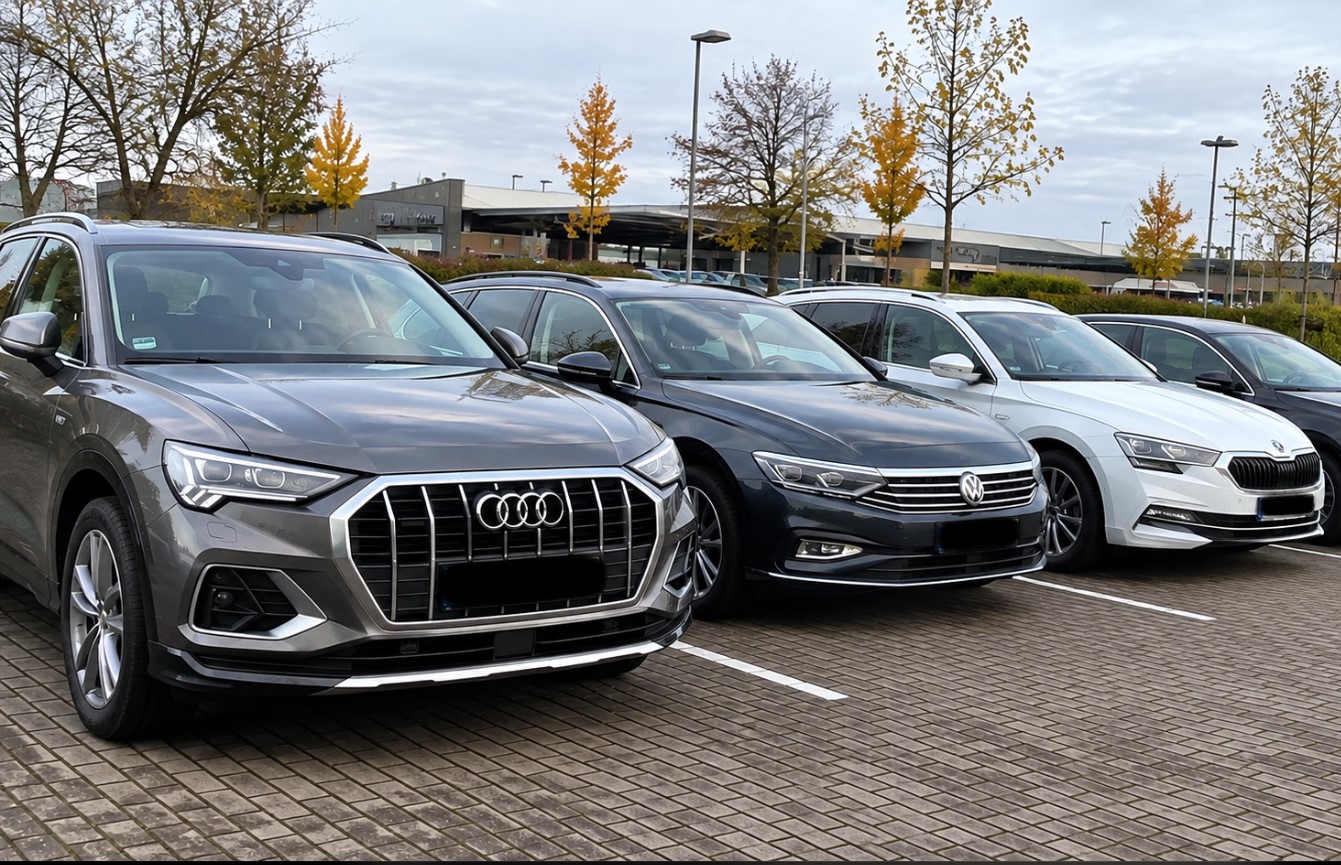
🚗 1. Why Are Audi, Volkswagen and Škoda So Popular on the German Used-Car Market?
Anyone searching for a used car in Germany will quickly encounter vehicles from the Volkswagen Group.
Audi, Volkswagen and Škoda offer a wide selection of hatchbacks, estates, family cars, SUVs, diesel motorway cruisers, plug-in hybrids and electric vehicles.
Their popularity is supported by a broad model range, an established service and repair infrastructure, and the availability of numerous replacement parts.
However, one question frequently arises when comparing second-hand vehicles:
💡 Quick Answer: Are Audi, VW and Škoda Basically the Same Cars?
No. Audi, Volkswagen and Škoda may share platforms, engines, transmissions and electronic components, but they are not necessarily identical cars.
Differences can include body construction, sound insulation, suspension configuration, steering calibration, braking systems, interior materials, electronic features, equipment and repair costs.
For a used-car buyer, the decisive factors are the exact model generation, engine and gearbox versions, maintenance history, equipment and actual technical condition.
🧩 Shared Technology: An Advantage or a Risk?
Volkswagen Group uses modular vehicle architectures to develop several models around related technical foundations.
For example, certain generations of the Audi A3, Volkswagen Golf and Škoda Octavia share the MQB architecture and may use related engine and transmission families.
This can offer practical advantages to buyers, including broad parts availability and a substantial body of workshop experience.
At the same time, shared components can mean that particular technical weaknesses occur across more than one brand or model.
A problem associated with a specific engine or transmission variant should therefore be investigated across all relevant Volkswagen Group models, rather than viewed as an issue affecting only one badge.
💶 Why Does a Used Audi Often Cost More?
Audi is generally positioned as a premium brand, Volkswagen as a mainstream brand with a broad product range, and Škoda as a brand emphasising practicality and value.
These positions can influence original purchase prices, equipment packages, interior design, brand perception and used-car prices.
However, a higher asking price does not automatically indicate better mechanical condition or lower future repair costs.
Practical buying principle: A well-maintained Škoda Octavia with a documented service history may be a better purchase than a poorly maintained Audi A3 with uncertain mileage and unresolved faults.
The reverse can also be true. Individual vehicle condition matters more than brand stereotypes.
🇩🇪 What Makes the German Used-Car Market Different?
Germany offers buyers a large variety of Volkswagen Group vehicles, including cars previously used by private owners, companies, leasing operators and commercial fleets.
A vehicle advertised as Scheckheftgepflegt may have a documented service history, but the actual records should still be examined.
Similarly, a valid HU (Hauptuntersuchung), often informally called TÜV, does not guarantee that the engine, gearbox, electronics or other components are free from defects.
When buying a used Audi, Volkswagen or Škoda, it is important to consider not only the advertised mileage and price, but also the vehicle's technical configuration, maintenance records and inspection findings.
🧩 2. Shared Volkswagen Group Platforms: Why Audi, VW and Škoda Are Not Identical
One of the most common arguments when comparing used Audi, Volkswagen and Škoda cars is that they are built using the same technology.
There is some truth to this statement. Volkswagen Group develops modular architectures that allow different brands to share engineering solutions, production methods and certain components.
However, a shared platform does not mean that every vehicle has the same suspension, interior, equipment, engine calibration or driving characteristics.
💡 What Does "Same Platform" Mean?
A shared vehicle platform is a common engineering architecture that can support multiple models. It may define important installation points, powertrain layouts, electronic systems and structural principles.
It does not mean that two cars are mechanically identical or that all their parts are interchangeable.
⚙️ MQB: The Foundation of Many Popular Used Cars
MQB (Modularer Querbaukasten) is Volkswagen Group's modular architecture developed primarily for vehicles with transversely mounted engines.
Depending on model generation, MQB-based vehicles include:
🚗 Audi
Various generations of the Audi A3 and Audi Q2 use MQB-based engineering.
Audi may differentiate these models through interior presentation, equipment, styling, sound insulation and chassis tuning.
🚙 Volkswagen
Examples include the Golf VII and VIII, certain Passat generations, Tiguan and Touran models.
These vehicles serve different purposes, despite sharing aspects of their technical architecture.
🚘 Škoda
MQB-based models include various generations of the Octavia, Superb, Karoq and Kodiaq.
Škoda frequently emphasises passenger space, boot capacity and practical features.
🔧 What Can Be Shared?
Depending on the exact model and version: engine families, transmission families, electronic modules, sensors and selected chassis components.
Compatibility must always be verified using the vehicle's VIN and correct part numbers.
Consider the Audi A3, VW Golf and Škoda Octavia. Certain generations are closely related technically, but the Octavia may offer substantially more luggage space, while the Audi may provide a different interior environment and equipment selection.
The Golf often occupies a middle position between compact dimensions, everyday usability and a wide choice of engines and trims.
Important: The comparison only makes sense when model generations and production years are taken into account.
An older Audi A3, a newer Golf and a different-generation Octavia may use different platforms and significantly different powertrains.
🏗️ MLB and MLB Evo: Longitudinal-Engine Audi Models
Another important Volkswagen Group architecture is MLB (Modularer Längsbaukasten), developed for vehicles with longitudinally mounted engines.
MLB and its later developments are used in various Audi models, including certain generations of the A4, A5, A6, Q5 and other vehicles.
This is why it would be incorrect to assume that every Audi is simply a Volkswagen or Škoda with a premium badge.
For example, a longitudinal-engine Audi A4 and a transverse-engine Volkswagen Passat can have fundamentally different layouts, transmissions, suspension components and all-wheel-drive systems.
The distinction matters when evaluating repair costs, mechanical complexity and long-term reliability.
🔋 MEB: Shared Electric Vehicle Technology
MEB is Volkswagen Group's modular electric vehicle architecture.
It is used in models such as the Volkswagen ID.3, ID.4, Škoda Enyaq and Audi Q4 e-tron.
These vehicles may share major elements of their electric drivetrain architecture, but differ in body design, interior, equipment, software configurations and pricing.
When purchasing a used electric vehicle, the inspection priorities also change.
- 🔋 High-voltage battery condition and available diagnostic information.
- ⚡ AC and DC charging functionality.
- 💻 Software versions, system warnings and documented updates.
- 🌡️ Battery thermal management and cooling.
- 🚗 Suspension, brakes, tyres and accident history.
Shared EV architecture does not guarantee identical battery condition, charging performance or ownership costs between individual used vehicles.
📊 Platform Comparison
| Architecture | Typical Layout | Example Models | Buying Considerations |
|---|---|---|---|
| MQB | Transverse-engine architecture | Golf, A3, Octavia, Tiguan | Verify exact engine, DSG variant, electronics and maintenance history. |
| MLB / MLB Evo | Longitudinal-engine architecture | Certain Audi A4, A5, A6 and Q5 generations | Check drivetrain configuration, transmission type, suspension complexity and repair costs. |
| MEB | Dedicated electric vehicle architecture | VW ID.3, ID.4, Škoda Enyaq, Audi Q4 e-tron | Assess battery, charging systems, software and vehicle condition. |
Key takeaway: Compare the exact technical architecture and model generation, not just the manufacturer's name or exterior design.
🏷️ 3. Audi vs Volkswagen vs Škoda: What Are the Real Differences?
Although all three brands belong to Volkswagen Group, their vehicles are positioned differently in the market.
This affects not only the original list price, but potentially the driving experience, equipment, repair costs and resale value.
⭐ Audi: Premium Positioning
Audi generally places greater emphasis on premium presentation, design, technology and perceived quality.
Depending on the model and equipment package, buyers may find sophisticated lighting, advanced infotainment, high-quality materials and additional driver-assistance systems.
Potential disadvantage: premium equipment and model-specific components may be expensive to repair or replace.
⚖️ Volkswagen: Balanced Everyday Use
Volkswagen typically offers a balance between comfort, equipment, practicality and brand recognition.
Models such as the Golf, Passat and Tiguan cover a wide range of everyday needs.
Potential disadvantage: some well-equipped used Volkswagens may cost considerably more than technically related Škoda models.
📦 Škoda: Space and Practicality
Škoda often focuses on generous interior space, practical storage solutions and competitive value.
Models such as the Octavia, Superb and Kodiaq are especially interesting for families and drivers who need luggage space.
Potential disadvantage: lower-trim vehicles may have fewer comfort features, although equipment varies significantly.
🔍 What Matters on the Used Market?
Brand positioning is only a starting point for comparison.
A highly equipped Škoda can offer features missing from a basic Audi.
Likewise, a carefully maintained Volkswagen may be more attractive than a cheaper but neglected alternative.
📊 Practical Brand Comparison
| Criterion | Audi | Volkswagen | Škoda |
|---|---|---|---|
| Market Position | Premium | Mainstream | Practical, value-oriented |
| Interior Approach | Premium design and materials | Balanced comfort and usability | Space and practicality |
| Equipment | Wide premium options list | Broad range of trims | Practical features, generous equipment in some trims |
| Parts and Repairs | Potentially higher costs for premium and unique parts | Broad parts availability | Often shares components with VW |
| Typical Buyer Priorities | Design, technology, premium feel | Balanced everyday ownership | Practicality, space, value |
Important distinction: These are general brand-positioning tendencies, not guaranteed characteristics of every model.
Actual equipment, comfort and maintenance costs depend on the specific vehicle, model year, trim and options.
🔇 Is Audi Always Quieter Than Volkswagen or Škoda?
Not necessarily.
Premium models may use additional sound insulation, different glazing or suspension settings, but the actual noise level depends on many factors.
- 🛞 Tyre brand, size and condition.
- 🛣️ Road surface and driving speed.
- 🚪 Door seals and body condition.
- ⚙️ Engine type and transmission.
- 🧰 Suspension wear and previous repairs.
A test drive under comparable conditions is more informative than assuming that a particular badge guarantees better sound insulation.
🛠️ Does Shared Technology Mean Equal Repair Costs?
No.
Even when two vehicles use related engines, repair costs can differ because of component accessibility, parts specifications, labour requirements and workshop pricing.
Lighting systems, bumpers, body panels, interior electronics and optional equipment may be specific to one model.
Therefore, a buyer comparing a used Audi A3 with a VW Golf should investigate not only engine maintenance costs, but also model-specific components and potential accident repairs.
🚘 4. Audi A3 vs VW Golf vs Škoda Octavia: Which Used Car Is Better?
This is one of the most useful comparisons for buyers looking for a compact used car in Germany.
The Audi A3, Volkswagen Golf and Škoda Octavia can share related technology within comparable generations, yet they offer different approaches to everyday driving.
⭐ Audi A3: Compact Premium Car
The Audi A3 is often chosen by buyers who value premium styling, interior presentation and a compact exterior size.
Depending on generation and configuration, the A3 may be available with petrol or diesel engines, manual or automatic transmissions, and various driver-assistance features.
Advantages:
- Attractive interior design and premium brand positioning.
- Wide range of engines and equipment.
- Compact dimensions suitable for urban driving.
- Potentially appealing resale market, depending on specification.
What to check:
- Exact engine generation and maintenance history.
- S tronic operation where fitted.
- Electronic systems and optional equipment.
- Accident history, paintwork and previous body repairs.
⚖️ Volkswagen Golf: The All-Rounder
The Volkswagen Golf is a popular choice for buyers seeking a practical, well-balanced compact car.
It is available in numerous versions, from economical everyday models to powerful performance variants.
The Golf's broad model range also means that two apparently similar vehicles may differ greatly in engine technology, gearbox type and equipment.
Advantages:
- Balanced combination of comfort, handling and everyday practicality.
- Broad availability on the German used-car market.
- Extensive service and parts infrastructure.
- Wide choice of engine and trim versions.
What to check:
- TSI or TDI engine condition and maintenance records.
- DSG behaviour, if equipped.
- Cooling system, emissions equipment and diagnostic faults.
- Suspension wear, electronics and accident repairs.
📦 Škoda Octavia: Practicality and Space
The Škoda Octavia is particularly attractive to families, commuters and drivers who need a larger luggage compartment without moving to a large SUV.
Although closely related to the Golf in certain generations, the Octavia typically offers a different body concept and more emphasis on interior and boot space.
Advantages:
- Generous luggage capacity.
- Practical body styles, including the Combi estate.
- Suitable for family use and long-distance travel.
- Access to related Volkswagen Group engine and gearbox technology.
What to check:
- Engine and transmission configuration.
- Service records and actual vehicle usage.
- Rear suspension, brakes and tyres.
- Tailgate, boot, interior wear and signs of intensive commercial use.
📊 Audi A3 vs Golf vs Octavia: Comparison
| Criterion | Audi A3 | VW Golf | Škoda Octavia |
|---|---|---|---|
| Main Strength | Premium presentation | Balanced everyday use | Space and practicality |
| Body Concept | Compact hatchback or saloon, depending on version | Compact hatchback or estate, depending on generation | Liftback or Combi estate |
| Boot Practicality | Depends on body and drivetrain | Practical compact-car layout | Often particularly spacious |
| Powertrains | Related VAG engine families | Related VAG engine families | Related VAG engine families |
| Used-Car Focus | Equipment, transmission, repair costs | Engine, DSG, electronics | Service history, drivetrain, usage-related wear |
| Best Suited For | Buyers prioritising premium design | Buyers seeking an all-rounder | Families and space-conscious buyers |
🏆 Which One Should You Choose?
Choose the Audi A3 if premium presentation and specific comfort features matter more than maximum luggage space.
Consider the VW Golf if you want a balanced compact car with broad model availability.
Consider the Škoda Octavia if passenger space, luggage capacity and everyday practicality are priorities.
In every case, a well-maintained individual vehicle is preferable to a poorly maintained example with a more prestigious badge.
🚙 5. Audi A4, VW Passat, Škoda Superb and SUVs: Are They Really Comparable?
Buyers searching for a larger family or business vehicle often compare the Audi A4, Volkswagen Passat and Škoda Superb.
All three can be attractive used-car options for long-distance travel in Germany, but their engineering and market positioning are not identical.
🚘 Audi A4: Premium Mid-Size Car
Certain Audi A4 generations use a longitudinal-engine architecture, unlike comparable transverse-engine Passat and Superb models.
This can result in differences in drivetrain layout, gearbox configuration, suspension design and repair requirements.
The A4 is worth considering if premium interior presentation, driving characteristics and specific Audi features are priorities.
However, buyers should examine the exact engine, transmission and suspension configuration before estimating ownership costs.
🚗 VW Passat: Comfort and Long-Distance Use
The Volkswagen Passat, particularly in Variant estate form, is popular with families, commuters and business users.
Depending on generation, it can offer a spacious interior, practical luggage area, economical diesel options and comfortable motorway driving.
Used Passat buyers should pay particular attention to service records, high-mileage wear, DSG maintenance where applicable, emissions systems and previous fleet usage.
📦 Škoda Superb: Maximum Practical Space
The Škoda Superb is particularly interesting for buyers who value rear passenger legroom and a large boot.
It may offer an attractive alternative to more expensive premium models when space and practicality are more important than brand image.
However, an inexpensive high-mileage Superb is not automatically a low-risk purchase.
The condition of the engine, transmission, suspension, electronics and maintenance history remains essential.
⚠️ Why Comparing Only Engine Power Is Misleading
Two vehicles may both be advertised with a 2.0-litre diesel engine producing similar power.
This does not guarantee that the engines, transmissions or drivetrains are identical.
Differences may include:
- ⚙️ Engine generation and engine code.
- 🔧 Installation layout and associated components.
- 🔄 Gearbox type, gear ratios and service requirements.
- 🛞 Front-wheel drive or all-wheel drive.
- 🌱 Emissions equipment, including EGR, DPF and SCR/AdBlue where fitted.
- 💻 Software calibration and control systems.
Buyer warning: Never assume that two vehicles with the same engine displacement and advertised power have the same maintenance requirements or technical weaknesses.
Engine codes, gearbox identification and the exact model generation are essential for a meaningful comparison.
🚙 SUV Comparison: Audi Q3, VW Tiguan and Škoda Karoq
The SUV market provides another useful example of shared Volkswagen Group technology.
Depending on generation, the Audi Q3, Volkswagen Tiguan and Škoda Karoq may share related architecture and powertrain families.
Nevertheless, differences in vehicle dimensions, wheelbase, suspension setup, equipment and interior layout can be significant.
⭐ Audi Q3
Often considered by buyers seeking a compact SUV with premium design and equipment options.
Inspect electronics, drivetrain configuration, suspension and model-specific repair costs.
⚖️ VW Tiguan
Offers a broad range of engines, equipment levels and family-oriented configurations.
Check the exact engine and gearbox, service history, all-wheel-drive maintenance and electronic systems.
📦 Škoda Karoq
Focuses on practical packaging, everyday usability and family needs.
Inspect drivetrain condition, suspension, electronic equipment and signs of intensive use.
🔍 Comparison Rule
Compare actual dimensions, boot capacity, engine code, gearbox, driven axles and equipment.
The SUV label alone says little about reliability or future repair costs.
📊 Larger Used VAG Cars: Which Priorities Matter?
| Buyer Priority | Models Worth Comparing | Inspection Focus |
|---|---|---|
| Premium mid-size car | Audi A4 / A5 | Drivetrain layout, transmission, suspension, electronics |
| Practical motorway estate | VW Passat Variant | Service history, DSG, emissions systems, fleet wear |
| Maximum family space | Škoda Superb Combi | Engine, transmission, suspension, interior wear |
| Premium compact SUV | Audi Q3 | Electronics, drivetrain, body condition |
| Family-oriented SUV | VW Tiguan, Škoda Karoq | AWD system where fitted, gearbox, maintenance |
The practical conclusion: Comparing Volkswagen Group vehicles requires more than matching engine size, horsepower and model year.
The correct choice depends on your driving needs, expected annual mileage, equipment preferences, maintenance budget and the condition of the individual car.
⚙️ 6. TSI, TFSI and TDI Engines: Are Audi, Volkswagen and Škoda Engines the Same?
When comparing used Audi, Volkswagen and Škoda cars in Germany, buyers often discover similar engine capacities, power outputs and technical specifications.
For example, a Volkswagen Golf, Škoda Octavia and Audi A3 may all be advertised with a 1.5-litre turbocharged petrol engine or a 2.0-litre diesel.
Does this mean they have exactly the same engine?
💡 Quick Answer: Are VAG Engines Identical?
Sometimes closely related, but not necessarily identical.
Volkswagen Group brands share engine families, manufacturing technology and numerous components. However, differences may exist in engine codes, software calibration, emissions equipment, cooling systems, installation layouts and auxiliary components.
The correct comparison requires the exact engine code, production year, vehicle configuration and maintenance history.
⛽ 6.1 What Is the Difference Between TSI and TFSI?
TSI is commonly used by Volkswagen and Škoda for turbocharged petrol engines.
TFSI is Audi's familiar designation for many turbocharged petrol engines with direct fuel injection.
The names alone do not establish whether two engines have identical internal components or technical specifications.
Depending on the generation, both designations can refer to engines from related Volkswagen Group engine families.
🔧 6.2 EA111, EA211 and EA888: Why Engine Generation Matters
A major mistake when evaluating a used VAG petrol car is assuming that all engines with the same displacement have the same reliability.
In reality, engine generation can be more important than the badge on the vehicle.
🔩 EA111 Family
Earlier Volkswagen Group small petrol engines include several EA111 variants.
Some chain-driven TSI versions became associated with timing-chain and tensioner concerns.
However, the risk depends on the exact engine variant and production period.
Inspection focus: timing-drive history, cold-start noises, diagnostic information and maintenance records.
⚙️ EA211 Family
The EA211 family includes numerous small-displacement petrol engines used across Volkswagen Group brands.
Many EA211 variants use a timing belt rather than the chain arrangement found in certain earlier engines.
Inspection focus: cooling-system condition, timing-belt requirements, engine operation, fluid leaks and service history.
🚀 EA888 Family
The EA888 family includes various 1.8- and 2.0-litre turbocharged petrol engines used in Audi, Volkswagen and Škoda models.
Earlier generations of certain variants have known histories involving oil consumption or timing-drive concerns.
Later versions feature substantial engineering changes.
Inspection focus: exact generation, oil consumption, cooling system, timing drive and maintenance.
📋 Engine Code Before Brand
An engine-family designation is not sufficient to identify every technical detail.
Different engine codes may indicate changes in power output, emissions equipment or construction.
Buying principle: identify the exact engine code before assessing known maintenance requirements.
🛢️ 6.3 Oil Consumption: What Should Buyers Check?
Excessive engine oil consumption can become an expensive problem, particularly when the underlying cause involves internal engine components.
However, not every TSI or TFSI engine has an oil-consumption problem, and an engine-family reputation does not establish the condition of an individual car.
During a pre-purchase inspection, consider:
- 🛢️ The seller's information about oil top-ups between services.
- 📑 Available invoices for engine repairs or oil-consumption investigations.
- 🔍 Visible oil leaks around accessible engine components.
- 🌫️ Unusual exhaust smoke under appropriate conditions.
- 💻 Relevant diagnostic information and operating abnormalities.
Technical limitation: A short inspection or test drive cannot reliably measure long-term oil consumption.
Where concerns exist, documented consumption measurements or specialist diagnosis may be necessary.
🌱 6.4 TDI Diesel Engines: Shared Technology, Different Risks
Volkswagen Group's TDI diesel engines are widely represented on the German used-car market.
A 2.0 TDI may be found in a Volkswagen Passat, Škoda Octavia, Audi A3 or other vehicles.
Yet different generations and installation layouts can have different components, service requirements and emissions systems.
When inspecting a modern diesel, pay attention to the following systems.
| System | Purpose | Inspection Focus |
|---|---|---|
| DPF | Traps particulate matter in diesel exhaust | Regeneration history, differential pressure, soot/ash information where supported |
| EGR | Exhaust gas recirculation for emissions control | Fault codes, operating behaviour, leaks and relevant symptoms |
| SCR / AdBlue | Reduces nitrogen oxide emissions | Warning messages, dosing system, NOx sensor faults and relevant diagnostics |
| Turbocharger | Increases intake air pressure | Unusual noises, boost behaviour, leaks and fault information |
| Fuel Injection | Controls diesel fuel delivery | Starting behaviour, smooth running, correction data where meaningful |
🚦 6.5 Diesel or Petrol for Driving in Germany?
A diesel engine may be attractive for drivers covering substantial annual motorway mileage.
However, repeated short journeys and unsuitable operating conditions can complicate particulate-filter regeneration.
A petrol engine may be more suitable for some urban driving patterns, but this does not automatically make it cheaper or more reliable.
Buyers should compare:
- Annual mileage and journey length.
- Fuel consumption under realistic conditions.
- Kfz-Steuer and insurance.
- Emissions equipment and maintenance history.
- Environmental-zone requirements and applicable local driving restrictions.
- Potential future repair costs.
Buying warning: A low advertised fuel consumption does not compensate for a neglected DPF, faulty AdBlue system or unresolved engine problems.
🔄 7. DSG vs S tronic: Are Volkswagen and Audi Automatic Gearboxes the Same?
The transmission is one of the most important technical factors when buying a used Volkswagen Group vehicle.
Volkswagen and Škoda commonly use the designation DSG, while Audi uses S tronic for various dual-clutch transmissions.
These names describe a transmission concept, but they do not identify one universal gearbox.
💡 Is Audi S tronic the Same as VW DSG?
Both names can refer to dual-clutch transmissions, and some variants are closely related. However, not all DSG and S tronic gearboxes are identical.
Gearbox design depends on factors including engine layout, torque requirements, number of gears, clutch technology and drivetrain configuration.
⚙️ 7.1 How Does a Dual-Clutch Transmission Work?
A dual-clutch transmission uses separate clutch arrangements for different gear groups.
This allows the transmission to prepare the next gear and perform relatively quick gear changes.
Depending on the specific gearbox, clutches may be designed to operate dry or in oil.
These constructions have different operating characteristics and maintenance requirements.
🛠️ 7.2 Dry-Clutch and Wet-Clutch DSG
🔧 Dry-Clutch DSG
Certain lower-torque DSG variants, including the DQ200, use dry clutches.
Potential concerns may involve clutch wear, mechatronic faults or irregular engagement behaviour.
Inspection focus: smooth engagement, low-speed operation, reverse gear, diagnostic faults and service history.
🛢️ Wet-Clutch DSG
Other DSG variants, such as certain DQ250, DQ381 and DQ500 versions, use wet-clutch technology.
These gearboxes have specific fluid requirements and maintenance procedures.
Inspection focus: documented servicing, shift quality, clutch behaviour, leaks and diagnostic information.
📋 7.3 Why Gearbox Identification Matters
A buyer should not assume that every seven-speed DSG has the same construction.
Seven-speed transmissions can differ substantially in clutch design, torque capacity and maintenance.
Similarly, an Audi S tronic used with a longitudinally mounted engine may differ significantly from a transverse-engine DSG installation.
| Transmission | General Characteristics | Buying Focus |
|---|---|---|
| DQ200 | Seven-speed, dry-clutch DSG family | Clutch engagement, mechatronics, low-speed behaviour |
| DQ250 | Six-speed, wet-clutch DSG family | Service records, shift quality, fluid maintenance |
| DQ381 | Seven-speed, wet-clutch DSG family | Correct service requirements, operating behaviour |
| DL382 | Longitudinal-layout dual-clutch transmission family | Variant identification, maintenance, diagnostic findings |
| Tiptronic | Audi designation used for certain conventional automatic transmissions | Identify exact gearbox, servicing, shift behaviour |
Important: These are transmission families rather than a complete list of all variants. The correct gearbox must be identified for the individual car.
🚗 7.4 DSG Test Drive: What Should You Check?
A proper DSG assessment should consider behaviour under several operating conditions.
- Initial engagement: Observe how the transmission engages Drive and Reverse.
- Low-speed driving: Check for excessive shuddering, unexpected hesitation or abnormal noises.
- Normal acceleration: Assess gear changes under moderate load.
- Deceleration: Observe downshifts and vehicle behaviour when approaching a stop.
- Warm operation: Where possible, assess behaviour after the transmission reaches normal operating conditions.
- Computer diagnostics: Check relevant control-unit faults and available operating information.
Diagnostic limitation: Not every gearbox defect produces a stored fault code.
Likewise, a fault code does not automatically prove that an entire transmission requires replacement.
Diagnosis should consider symptoms, maintenance history, measured data and the exact gearbox variant.
💶 7.5 Is a Manual Gearbox Safer to Buy?
A manual gearbox may have a simpler control system than a dual-clutch automatic transmission.
However, manual transmissions also have components that can wear, including clutches, synchronisers and dual-mass flywheels where fitted.
The better choice depends on the individual vehicle's condition, driving requirements and maintenance budget.
🛞 8. quattro vs 4Motion vs Škoda 4x4: Is Volkswagen Group All-Wheel Drive the Same?
Audi, Volkswagen and Škoda offer various all-wheel-drive configurations.
Their marketing names are familiar:
- Audi quattro
- Volkswagen 4Motion
- Škoda 4x4
However, these designations do not represent one identical mechanical system.
⚙️ 8.1 Different AWD Architectures
Depending on model and generation, Volkswagen Group vehicles may use different methods of distributing drive torque between the axles.
Some transverse-engine models use electronically controlled multi-plate clutch systems to engage the rear axle when required.
Certain longitudinal-engine Audi models use other AWD designs, including mechanical centre differentials or alternative electronically controlled systems.
Electric vehicles may achieve all-wheel drive using separate electric motors for different axles.
💡 Is quattro Better Than 4Motion?
The badge alone is not enough to determine which system is better.
quattro and 4Motion are umbrella marketing designations covering different AWD architectures.
The correct comparison requires the exact vehicle model, generation, drivetrain layout and intended use.
🔧 8.2 What to Check on a Used AWD Car
- 📑 Documented AWD-system maintenance, where required.
- 🛢️ Fluid changes according to the specific drivetrain requirements.
- 🔊 Unusual noises during acceleration or cornering.
- 🛞 Tyre size, condition and compatibility across axles.
- 💻 Relevant diagnostic faults and control-unit data.
- 🔍 Visible leaks and mechanical damage in accessible areas.
🌨️ 8.3 Is AWD Necessary in Germany?
All-wheel drive can improve traction in certain conditions, particularly when accelerating on slippery surfaces.
However, it does not eliminate the need for appropriate tyres or safe driving.
AWD does not inherently shorten braking distances on slippery roads.
For many drivers in Berlin, Potsdam and surrounding areas, front-wheel drive may be sufficient.
Buyers should weigh the benefits of AWD against additional components, maintenance requirements and potential repair costs.
Buying warning: An AWD system should not be considered maintenance-free merely because it operates without obvious dashboard warnings.
🛠️ 9. Suspension, Brakes and Driving Comfort: Where VAG Models Differ
Shared vehicle architecture does not mean identical handling or suspension design.
Even technically related cars may use different springs, dampers, anti-roll bars, bushings, wheel sizes and steering settings.
🛞 9.1 Why an Audi May Feel Different From a Golf or Octavia
Driving characteristics depend on many factors, including:
- Vehicle weight and weight distribution.
- Wheelbase and suspension geometry.
- Spring and damper calibration.
- Tyre size and construction.
- Steering calibration.
- Optional sports or adaptive suspension.
An Audi equipped with sports suspension and large wheels may feel firmer than a Volkswagen or Škoda with comfort-oriented suspension.
Conversely, a vehicle with worn dampers or incorrect tyres may behave worse regardless of its original engineering specification.
🔩 9.2 Rear Suspension: Not Every Golf or Octavia Is Built the Same
Certain Volkswagen Group compact-car generations use different rear suspension configurations depending on engine output, drivetrain and model specification.
Some versions have a torsion-beam rear axle, while others use independent multi-link suspension.
These designs differ in construction, service requirements and potential repair costs.
However, it would be incorrect to assume that one configuration is always more reliable or comfortable in every vehicle.
The actual condition of bushings, dampers, wheel bearings and suspension components is more important when evaluating an individual used car.
⚙️ 9.3 Adaptive Suspension and DCC
Some Volkswagen Group models offer electronically controlled adaptive damping, including systems marketed as DCC.
Such equipment can provide different driving characteristics, depending on the selected mode and system design.
However, adaptive dampers and related components may be more expensive than conventional suspension parts.
During an inspection, check for:
- Suspension warning messages.
- Damper leaks and visible damage.
- Unusual suspension noises.
- Differences between driving modes, where supported.
- Relevant diagnostic fault information.
🛑 9.4 Braking Systems: Why Similar Cars May Have Different Costs
Braking systems can differ between vehicles using the same platform.
Disc diameter, brake calipers, pad specifications and electronic parking-brake configurations may vary according to engine power, weight and equipment.
A high-performance Audi or Volkswagen may require more expensive brake components than a lower-powered related model.
Before purchasing, examine:
- Brake disc and pad condition.
- Uneven wear and visible corrosion.
- Brake fluid service history.
- Electronic parking-brake operation, where fitted.
- Braking behaviour during a permitted test drive.
📊 Suspension and Brake Comparison
| Component | Possible Differences | Buying Priority |
|---|---|---|
| Front Suspension | Geometry, materials, bushings, tuning | Wear, noises, alignment, repair history |
| Rear Suspension | Torsion beam or multi-link, depending on version | Identify design, inspect wear and damage |
| Dampers | Conventional, sports or adaptive systems | Leaks, operation, replacement costs |
| Brakes | Disc size, calipers, electronic systems | Wear, corrosion, correct parts |
| Wheels and Tyres | Diameter, width, load and speed ratings | Condition, compatibility, replacement cost |
🚗 9.5 Why the Test Drive Is Essential
A static inspection can identify certain visible suspension defects, but it cannot fully reproduce driving conditions.
A permitted test drive can help assess:
- Steering response and straight-line stability.
- Unusual noises over road irregularities.
- Vibration at different speeds.
- Braking behaviour and directional stability.
- Transmission operation under load.
- General comfort and noise levels.
Sicher-Check inspection principle: A test drive is performed only when permitted by the seller and when practical and safe.
If a test drive is not possible, that limitation should be considered when evaluating the remaining purchase risk.
💻 10. Electronics, Infotainment and Driver Assistance: Are Audi, VW and Škoda Equally Equipped?
Modern Volkswagen Group vehicles increasingly rely on complex electronic control systems.
Even when an Audi, Volkswagen and Škoda share a platform, their electronic equipment can differ considerably.
The differences may include infotainment systems, digital instrument clusters, lighting technology, parking assistance, adaptive cruise control and other driver-assistance functions.
💡 Does a Used Audi Always Have Better Equipment?
No. Equipment depends on the exact model, trim level, optional packages and production year.
A well-equipped Volkswagen or Škoda may have more practical features than an Audi with a basic specification.
Always compare the actual equipment installed in the vehicle, not just the brand.
📱 10.1 Infotainment and Digital Cockpits
Volkswagen Group brands use different versions of infotainment and digital instrument systems.
Depending on generation, equipment may include touchscreen navigation, smartphone integration, digital instruments, voice control and connected services.
During a used-car inspection, check whether the functions advertised by the seller are actually present and operational.
- 📱 Apple CarPlay and Android Auto, where fitted or activated.
- 🗺️ Navigation, GPS reception and map functionality.
- 🔊 Audio system, speakers and controls.
- 📷 Reversing camera and parking sensors.
- 💻 Digital instruments and warning messages.
- 🔌 USB ports, charging functions and connectivity.
Important for buyers: A function displayed in the infotainment menu is not necessarily activated or available.
Some services depend on software versions, licences, subscriptions or vehicle configuration.
🚦 10.2 Driver-Assistance Systems: ACC, Lane Assist and Emergency Braking
Modern Audi, Volkswagen and Škoda vehicles may offer a wide range of assistance systems.
Common examples include:
🚗 Adaptive Cruise Control (ACC)
Helps maintain a selected speed and distance from vehicles ahead, within system limits.
Check warning messages, activation and operation where a safe test is possible.
🛣️ Lane Assist
Can provide steering assistance or warnings related to lane markings.
Operation depends on road conditions, system configuration and sensor visibility.
🛑 Emergency Braking
Certain systems can warn the driver or apply braking in specific collision scenarios.
Functionality should be assessed through warnings, diagnostics and appropriate specialist procedures.
📷 Parking Assistance
May include parking sensors, reversing cameras or automated parking assistance.
Check available functions and visible sensor damage.
Safety warning: Do not deliberately create dangerous situations to test automatic emergency braking or other safety systems.
Advanced driver-assistance systems may require professional calibration after certain repairs, windscreen replacements or collision damage.
💡 10.3 LED, Matrix LED and Advanced Headlights
Lighting equipment can significantly affect the cost of repairing a used vehicle.
Depending on specification, Audi, Volkswagen and Škoda models may use conventional LED headlights, adaptive systems or matrix-based lighting technology.
Advanced headlights can offer additional functionality, but replacement assemblies and electronic modules may be expensive.
Before purchasing, inspect:
- Headlight housings for cracks and moisture.
- Mounting points and evidence of previous repairs.
- Warning messages and diagnostic faults.
- Available lighting functions under suitable conditions.
- Evidence of correct calibration after relevant repairs.
🔍 10.4 Why Electronic Diagnostics Matter
Computer diagnostics can help identify stored faults in accessible vehicle control units.
However, diagnostic coverage depends on the vehicle, software and equipment used.
A fault-free scan does not guarantee that every electronic system is operating correctly.
Physical inspection, functional testing and available service documentation remain important.
🔧 11. Audi vs Volkswagen vs Škoda Reliability: Which Brand Has Fewer Problems?
Reliability is one of the most frequently discussed subjects among buyers of used Volkswagen Group vehicles.
Unfortunately, there is no universally correct answer to the question:
"Is Audi more reliable than Volkswagen or Škoda?"
A meaningful comparison requires the exact model generation, engine, gearbox, maintenance history and vehicle condition.
💡 Which VAG Brand Is the Most Reliable?
No single brand is automatically the most reliable across every model and generation.
Related vehicles may share technical weaknesses, while differences in equipment, drivetrain design and maintenance can produce different ownership experiences.
For a used-car buyer, documented maintenance and actual condition are generally more useful than brand reputation alone.
⚠️ 11.1 Common Areas Requiring Attention
The following table summarises potential inspection priorities found in various Volkswagen Group vehicles.
These are not defects present in every car. Their relevance depends on the exact technical configuration.
| Component | Potential Concern | What to Check |
|---|---|---|
| TSI / TFSI Engine | Timing drive, oil consumption, cooling system | Engine generation, service history, leaks and operating behaviour |
| TDI Diesel | DPF, EGR, SCR/AdBlue, turbocharger | Diagnostic data, warning messages, maintenance records |
| DSG / S tronic | Clutch wear, mechatronics, shift irregularities | Gearbox variant, service history, test-drive behaviour |
| AWD System | Maintenance-related wear or faults | Fluid service, leaks, noises, diagnostics |
| Electronics | Sensor faults, infotainment and assistance systems | Functional tests, fault codes, repair history |
| Suspension | Bushings, dampers, wheel bearings | Visual inspection, noises, driving behaviour |
| Bodywork | Accident repairs, corrosion, paint defects | Paint measurements, panel alignment, visible structure |
📑 11.2 Scheckheftgepflegt: Does It Mean Perfect Maintenance?
The German term Scheckheftgepflegt generally indicates that a vehicle has a recorded service history.
However, the term alone does not prove that every required maintenance operation was completed correctly or on time.
Buyers should examine the available records and compare them with the requirements for the exact engine and transmission.
- 📅 Service dates and mileage entries.
- 🛢️ Engine oil specifications and service intervals.
- 🔄 Gearbox maintenance, where applicable.
- ⚙️ Timing-belt or timing-chain service information.
- 🧾 Repair invoices and replaced parts.
- 🔍 Consistency between documents, mileage and vehicle condition.
Practical recommendation: A digital service record or stamped service book is useful evidence, but supporting invoices can provide additional details about the work actually performed.
🚕 11.3 Company Cars, Leasing Vehicles and High Mileage
The German used-car market includes many vehicles previously operated by companies, leasing customers and commercial users.
Such vehicles should not automatically be considered inferior to privately owned cars.
A company vehicle may have received regular servicing and accumulated substantial motorway mileage.
Conversely, intensive use, frequent short trips or neglected maintenance can increase wear.
The important questions are:
- How was the vehicle used?
- Are the mileage and service records consistent?
- What maintenance and repairs were performed?
- What is the current condition of the engine, gearbox and chassis?
🧠 11.4 The Most Important Reliability Principle
A used car should not be selected solely because a particular engine or model has a good reputation.
Likewise, a model associated with certain technical concerns should not be rejected automatically without examining the exact version and individual vehicle.
The objective is to identify the actual risks of the car you intend to buy.
💶 12. Audi vs VW vs Škoda: Maintenance and Ownership Costs in Germany
The purchase price is only one part of the total cost of owning a used vehicle.
A relatively inexpensive premium car can become expensive if it requires major repairs or specialised replacement parts.
Conversely, a carefully maintained mainstream vehicle may offer predictable running costs over time.
🧾 12.1 What Should Be Included in the Ownership Budget?
⛽ Fuel or Electricity
Calculate expected consumption based on realistic driving conditions, not only official figures.
🛡️ Insurance
Obtain quotations for the exact vehicle and driver profile.
Premiums depend on several factors, including coverage and insurance classifications.
🇩🇪 Kfz-Steuer
German vehicle tax depends on the applicable statutory rules and vehicle data.
Check the amount for the exact registration details.
🔧 Maintenance
Include scheduled servicing, fluids, filters, timing-drive work where required, and gearbox maintenance.
🛞 Wear Components
Tyres, brakes, suspension parts, batteries and other wear-related items require budgeting.
⚠️ Unexpected Repairs
Allow a financial reserve for unplanned repairs, especially on older or higher-mileage cars.
📊 12.2 Are Audi Repairs Always More Expensive?
Audi's premium positioning can result in higher costs for certain model-specific parts, electronic equipment and repair procedures.
However, shared mechanical components may sometimes reduce differences between related vehicles.
The exact repair cost depends on the component, parts availability, workshop labour and vehicle design.
| Cost Category | Audi | Volkswagen | Škoda |
|---|---|---|---|
| Routine Service | Depends on engine and workshop | Depends on engine and workshop | Depends on engine and workshop |
| Engine Repairs | Related components possible; layout matters | Engine generation matters | Engine generation matters |
| Body Parts | Premium model-specific components | Model-specific pricing | Model-specific pricing |
| Electronics | Advanced options may increase repair costs | Depends on equipment | Depends on equipment |
| Tyres and Brakes | Wheel and performance specification matter | Wheel and performance specification matter | Wheel and performance specification matter |
🧮 12.3 Example: Calculate Your Annual Running Costs
Consider a hypothetical used car driven 15,000 km per year, consuming an average of 6.5 litres per 100 km.
Annual fuel consumption would be approximately 975 litres.
At an illustrative fuel price of €1.75 per litre, the annual fuel cost would be approximately €1,706.
This is an example, not a current fuel-price quotation.
Insurance, vehicle tax, servicing, tyres, repairs and depreciation must be added separately.
Useful principle: Compare the total expected ownership cost of two specific vehicles, rather than assuming that the cheaper purchase price means lower overall expenditure.
🛠️ 12.4 Independent Workshops vs Authorised Dealers
Many Volkswagen Group vehicles can be maintained by appropriately qualified independent workshops.
However, certain repairs, software functions and calibration procedures may require manufacturer-specific access, equipment or authorisation.
Before purchasing a technically complex used vehicle, consider whether suitable repair facilities are available locally.
For vehicles still covered by a manufacturer warranty or additional service agreement, review the applicable conditions.
📉 13. Depreciation and Resale Value: Audi, Volkswagen or Škoda?
Resale value is an important consideration when choosing a used car in Germany.
However, it is misleading to assume that one Volkswagen Group brand always retains its value better than the others.
Depreciation depends on numerous factors.
- 📅 Vehicle age and first registration.
- 🛣️ Mileage and usage history.
- 🔧 Technical and cosmetic condition.
- ⚙️ Engine and transmission.
- 🎨 Body style, colour and equipment.
- 📑 Service history and accident records.
- 📊 Market supply and demand.
⭐ 13.1 Audi: Premium Image and Resale
Audi's premium positioning can support buyer interest in certain models and specifications.
However, a higher original purchase price does not guarantee lower depreciation in absolute euro terms.
Older premium cars with complex equipment and expensive potential repairs may also become less attractive to budget-conscious buyers.
⚖️ 13.2 Volkswagen: Broad Market Appeal
Models such as the Golf, Passat and Tiguan are familiar to many buyers in Germany.
Their broad market presence can make it easier to find comparable listings.
However, the same availability also creates competition between sellers.
A vehicle's specification, condition and asking price remain decisive.
📦 13.3 Škoda: Practical Value
Škoda models can appeal to buyers seeking practical transport, interior space and competitive purchase prices.
A well-maintained Octavia or Superb with suitable equipment can be attractive on the used market.
Nevertheless, resale performance depends on the exact model, drivetrain, condition and market situation.
💶 13.4 The Real Cost of Depreciation
Consider two hypothetical vehicles:
| Example | Purchase Price | Later Sale Price | Depreciation |
|---|---|---|---|
| Vehicle A | €18,000 | €13,000 | €5,000 |
| Vehicle B | €14,000 | €10,500 | €3,500 |
Although Vehicle A has a higher resale price, it loses more money in absolute terms.
These figures are illustrative and are not forecasts for any particular Audi, Volkswagen or Škoda model.
💡 Resale Value: What Matters Most?
Buy at a realistic market price, choose a suitable specification and maintain the vehicle properly.
Paying too much for a vehicle can be more financially significant than small differences in brand depreciation.
🎯 14. Audi, Volkswagen or Škoda: Which Brand Fits Your Needs?
The best used Volkswagen Group vehicle depends on how you intend to use it.
Rather than choosing a brand first, begin with your actual requirements.
👨👩👧👦 14.1 Family Car
If passenger and luggage space are priorities, models such as the Škoda Octavia Combi, Superb Combi and VW Passat Variant deserve consideration.
Compare:
- Rear-seat space and child-seat access.
- Boot dimensions and loading height.
- Comfort on longer journeys.
- Maintenance and insurance costs.
🏙️ 14.2 City Driving in Berlin or Potsdam
For predominantly urban driving, a compact model may be more practical than a large SUV or executive car.
Consider vehicles such as the Audi A3, VW Golf or suitable compact Škoda models.
Pay attention to parking dimensions, fuel consumption, transmission behaviour in traffic and maintenance costs.
If journeys are mostly short, carefully evaluate whether a modern diesel is suitable for your driving pattern.
🛣️ 14.3 Long-Distance Motorway Driving
Drivers covering substantial motorway mileage may prioritise comfort, stability, fuel economy and luggage capacity.
Possible candidates include the Audi A4, VW Passat and Škoda Superb.
The correct engine and transmission combination depends on annual mileage, route profile and maintenance budget.
⭐ 14.4 Premium Driving Experience
Buyers who value interior design, premium features and particular driving characteristics may prefer Audi.
However, premium equipment should be evaluated alongside potential repair and replacement costs.
💰 14.5 Maximum Value for Money
If practical space and equipment matter more than brand image, a Škoda may offer an attractive combination.
A Volkswagen can also provide strong everyday usability, depending on the exact model and market price.
The final decision should be based on comparable individual vehicles.
📊 Buyer Profile Comparison
| Buyer Priority | Models to Consider | Main Inspection Focus |
|---|---|---|
| Family practicality | Octavia Combi, Superb Combi, Passat Variant | Space, suspension, service history |
| Urban driving | Golf, A3, compact Škoda | Transmission, electronics, short-trip wear |
| Motorway travel | A4, Passat, Superb | Engine, gearbox, emissions systems |
| Premium features | Audi models | Equipment, electronics, repair costs |
| Practical value | Škoda and Volkswagen models | Condition, maintenance, purchase price |
| SUV requirements | Q3, Tiguan, Karoq, Kodiaq | Drivetrain, AWD, suspension, tyres |
🔍 15. Used Audi, Volkswagen and Škoda Inspection Checklist Before Buying in Germany
A structured pre-purchase inspection helps buyers identify potential problems before signing a contract.
The following checklist covers important areas relevant to many used Volkswagen Group vehicles.
📑 15.1 Documents and Vehicle Identity
- Verify the vehicle identification number (VIN) against available documents and accessible markings.
- Examine Zulassungsbescheinigung Teil I and Teil II, where available.
- Review the available service history and invoices.
- Check the latest HU report and any recorded deficiencies.
- Compare mileage information across available records.
- Clarify the seller's statements about accidents and previous repairs.
🎨 15.2 Bodywork and Accident Repairs
- Examine body panels for visible paint differences and irregularities.
- Perform paint-thickness measurements on suitable accessible surfaces.
- Inspect panel gaps and alignment.
- Look for visible corrosion, damaged seals and repair traces.
- Inspect accessible structural areas for indications of damage or previous repair.
⚙️ 15.3 Engine and Cooling System
- Identify the exact engine and relevant maintenance requirements.
- Observe starting behaviour, ideally before the engine has been warmed.
- Listen for unusual mechanical noises.
- Check accessible areas for oil and coolant leaks.
- Review timing-drive maintenance where applicable.
- Assess engine operation and relevant diagnostic information.
🔄 15.4 Transmission and Drivetrain
- Identify the exact gearbox variant.
- Review gearbox service records where required.
- Assess engagement, shifting and abnormal noises during a permitted test drive.
- Check relevant diagnostic information.
- For AWD vehicles, examine available maintenance records and visible drivetrain condition.
💻 15.5 Electronics and Equipment
- Scan accessible control units using compatible diagnostic equipment.
- Check warning messages and dashboard indicators.
- Test climate control, windows, mirrors and central locking.
- Check infotainment and advertised equipment.
- Examine lighting and accessible assistance-system functions.
- Check for signs of low battery voltage or electrical problems.
🛞 15.6 Suspension, Tyres and Brakes
- Inspect tyre dimensions, condition, age and visible wear.
- Examine accessible suspension components.
- Check visible brake condition.
- Assess steering and braking behaviour during a permitted test drive.
- Note unusual vibration, noises or directional instability.
🧾 15.7 Before Signing the Contract
- Clarify unresolved technical concerns with the seller.
- Request documentation for significant repairs where available.
- Consider independent specialist diagnosis for serious suspected defects.
- Estimate foreseeable maintenance and repair expenses.
- Ensure important seller representations and agreed terms are documented appropriately.
Important: This checklist is not a guarantee that all defects will be detected.
Some faults are intermittent, concealed or only identifiable through dismantling, extended testing or specialist workshop procedures.
🚩 15.8 Warning Signs That Deserve Further Investigation
- 🚩 Inconsistent mileage records.
- 🚩 Significant undocumented body repairs.
- 🚩 Persistent engine or transmission faults.
- 🚩 DSG engagement problems or abnormal noises.
- 🚩 Unresolved DPF or AdBlue system warnings.
- 🚩 Multiple electronic faults without a clear explanation.
- 🚩 Missing maintenance records for critical scheduled work.
- 🚩 Seller pressure to complete the purchase without reasonable inspection opportunities.
A warning sign does not automatically prove that the vehicle should be rejected.
However, significant unresolved concerns should be investigated before committing to the purchase.
🔍 16. Independent Audi, Volkswagen and Škoda Pre-Purchase Inspection in Germany
Choosing between a used Audi, Volkswagen and Škoda is not simply a question of brand preference.
Two vehicles built on related platforms can have very different maintenance histories, technical conditions and future repair risks.
An independent pre-purchase vehicle inspection can help buyers identify observable defects, understand potential maintenance requirements and make a more informed purchasing decision.
Sicher-Check provides used-car inspection services in Berlin, Potsdam, Brandenburg and surrounding areas. Other locations in Germany may be considered by individual arrangement.
🚗 16.1 What Can Sicher-Check Inspect?
🎨 Bodywork and Paint
Visual examination of accessible body panels, paint-thickness measurements, panel alignment, visible corrosion and indications of previous repairs.
💻 Electronic Diagnostics
Diagnostic checks using compatible equipment, including Launch X-431, to examine accessible control units and relevant fault information where supported.
⚙️ Engine and Transmission
Assessment of starting behaviour, engine operation, visible fluid leaks, transmission behaviour and available diagnostic information.
🛞 Suspension and Brakes
Visual checks of accessible components, tyres, brakes and suspension condition, supplemented by driving observations when possible.
📑 Documents and History
Review of available vehicle documents, maintenance records, repair invoices and seller-provided information.
📸 Photos and Report
Documentation of relevant observations through photographs and an inspection report, according to the agreed service scope.
🧠 16.2 Why VAG-Specific Technical Knowledge Matters
A useful inspection should consider the exact engine, gearbox and drivetrain configuration.
For example, the same general Volkswagen Group engine family may appear in several brands, but maintenance requirements and associated components can differ.
Similarly, identifying whether a vehicle has a dry-clutch DSG, wet-clutch DSG, longitudinal S tronic or another automatic transmission is important when assessing potential repair risks.
The aim is not to assume that a particular engine or gearbox is defective, but to focus the inspection on relevant technical characteristics and observable symptoms.
🛣️ 16.3 Test Drive and Diagnostic Limitations
A test drive can provide useful information about engine performance, transmission operation, steering, suspension and braking behaviour.
However, test drives are carried out only when permitted by the seller and when practical and safe.
If a test drive cannot be performed, the limitations should be considered when evaluating the vehicle.
Important: A pre-purchase inspection is a condition assessment performed under the available circumstances.
It does not automatically include dismantling, laboratory analysis, specialist workshop testing or examination of inaccessible components.
The absence of visible defects or stored diagnostic fault codes cannot guarantee that a vehicle has no hidden or future problems.
📍 16.4 Service Area: Berlin, Potsdam and Brandenburg
Sicher-Check's main operating area includes Berlin, Potsdam and surrounding locations in Brandenburg.
Vehicle inspections elsewhere in Germany may be arranged individually, subject to availability and applicable travel costs.
To enquire about an inspection, send the vehicle advertisement and the following details:
- Vehicle make, model and year.
- Engine and transmission, if known.
- Advertised mileage and asking price.
- Vehicle location.
- Preferred inspection date.
- Any particular concerns or questions.
❓ 17. Frequently Asked Questions: Audi vs VW vs Škoda Used Cars in Germany
1. Are Audi, Volkswagen and Škoda made by the same company?
Audi, Volkswagen and Škoda are brands within Volkswagen Group. They may share platforms, engines, transmissions and other components, but individual models can differ significantly in design, equipment and engineering.
2. Is an Audi A3 basically a VW Golf?
Certain generations of the Audi A3 and Volkswagen Golf share the MQB architecture and related powertrain technology. However, they are not identical vehicles. Differences may include bodywork, interior, equipment, suspension tuning and repair costs.
3. Is Škoda less reliable than Volkswagen?
Not automatically. Reliability depends on the specific model, engine, gearbox, production year, maintenance history and vehicle condition. Related Škoda and Volkswagen models may share some technical strengths and weaknesses.
4. Are TSI and TFSI engines the same?
TSI and TFSI are brand-specific designations used for various petrol engine technologies. Some engines belong to related Volkswagen Group families, but the names alone do not establish identical construction. Check the exact engine code.
5. Is Audi S tronic the same as VW DSG?
DSG and S tronic can both describe dual-clutch transmissions. Some variants are technically related, but they are not all identical. Gearbox construction depends on the exact model, drivetrain and transmission type.
6. Is quattro better than 4Motion?
Neither designation identifies one universal AWD system. Audi quattro and Volkswagen 4Motion cover different drivetrain architectures. Compare the specific systems fitted to the vehicles under consideration.
7. Is a used Audi more expensive to maintain?
Some Audi models may have higher costs for premium equipment, specialised components and certain repairs. However, shared mechanical technology can reduce differences in some maintenance areas. Costs depend on the exact vehicle.
8. Which is better: Audi A3, VW Golf or Škoda Octavia?
The Audi A3 may appeal to buyers seeking premium presentation. The VW Golf offers balanced everyday practicality, while the Škoda Octavia is especially attractive for interior and luggage space. The best choice depends on condition, specification and needs.
9. Is a 2.0 TDI a good engine for a used car?
A 2.0 TDI can be suitable for drivers covering substantial distances. However, reliability and maintenance needs vary by engine generation and vehicle configuration. DPF, EGR, SCR/AdBlue and service history should be evaluated where applicable.
10. Does Scheckheftgepflegt guarantee a reliable car?
No. Scheckheftgepflegt indicates a recorded service history, but buyers should examine the actual entries and invoices. It does not guarantee that every maintenance operation was completed or that the vehicle has no defects.
11. Is a valid TÜV enough when buying a used Volkswagen Group car?
No. A valid Hauptuntersuchung (HU) indicates that the vehicle passed the statutory inspection at the relevant time. It does not guarantee freedom from hidden engine, gearbox, electronic or other defects.
12. Where can I book a used Audi, VW or Škoda inspection in Berlin or Potsdam?
Sicher-Check offers independent pre-purchase vehicle inspections in Berlin, Potsdam and surrounding Brandenburg by arrangement. Inspection scope, availability and travel conditions should be confirmed before booking.
🎯 19. Final Verdict: Should You Buy a Used Audi, Volkswagen or Škoda?
Audi, Volkswagen and Škoda offer many attractive used-car options on the German market.
Their shared technology can provide advantages in parts availability, workshop familiarity and model choice.
However, common platforms and related powertrains do not make every model identical.
The most important differences may involve drivetrain layout, equipment, suspension, interior practicality and repair costs.
🏆 Which Brand Should You Choose?
| Your Priority | Brand or Models Worth Considering | Key Consideration |
|---|---|---|
| Premium presentation | Audi A3, A4, Q3 and other suitable models | Equipment, technical condition, repair budget |
| Balanced everyday use | VW Golf, Passat, Tiguan | Engine, gearbox, maintenance history |
| Maximum practicality | Škoda Octavia, Superb, Kodiaq | Space, equipment, condition |
| Compact urban car | Audi A3, VW Golf, suitable Škoda models | Dimensions, running costs, transmission |
| Long-distance travel | Audi A4, VW Passat, Škoda Superb | Comfort, engine choice, service history |
| Electric driving | VW ID.3 / ID.4, Škoda Enyaq, Audi Q4 e-tron | Battery condition, charging, software |
✅ Five Rules for Buying a Used Volkswagen Group Car
- Compare exact generations. Cars with similar names or engines may use different technology.
- Identify the engine and gearbox. Technical codes are more informative than marketing names.
- Examine maintenance records. A service-history claim should be supported by available evidence.
- Calculate ownership costs. Include maintenance, insurance, tax, repairs and depreciation.
- Inspect the individual car. Its actual condition matters more than the badge on the bonnet.
📌 The Bottom Line
A used Audi is not automatically better than a Volkswagen, and a Škoda is not automatically a cheaper version of the same car.
Each brand offers different strengths. Shared components can make some technical comparisons easier, but the vehicle's exact specification, maintenance history and condition determine whether it is a sensible purchase.
A carefully inspected and appropriately priced vehicle is generally a better starting point than a decision based solely on brand prestige.
⚖️ Legal and Technical Disclaimer
This article provides general information about Volkswagen Group vehicles and the German used-car market.
It does not constitute binding legal, tax, insurance or technical advice.
Vehicle specifications, engine and gearbox configurations, maintenance requirements and available equipment vary by model, generation, production year and market.
References to potential technical weaknesses do not establish that a particular vehicle has a defect.
Any inspection performed by Sicher-Check is subject to the agreed service scope, vehicle accessibility, available equipment, seller permission and practical conditions.
A pre-purchase inspection cannot guarantee the absence of hidden, intermittent or future defects.
The brand names Audi, Volkswagen and Škoda belong to their respective rights holders. This article is an independent informational comparison and does not imply affiliation with or endorsement by the manufacturers.
Publication date: 15 November 2026.