
 Car sourcing in Germany: computer turbo diagnostics (article 46)
Diagnostics of cars with two turbos (Bi-Turbo)
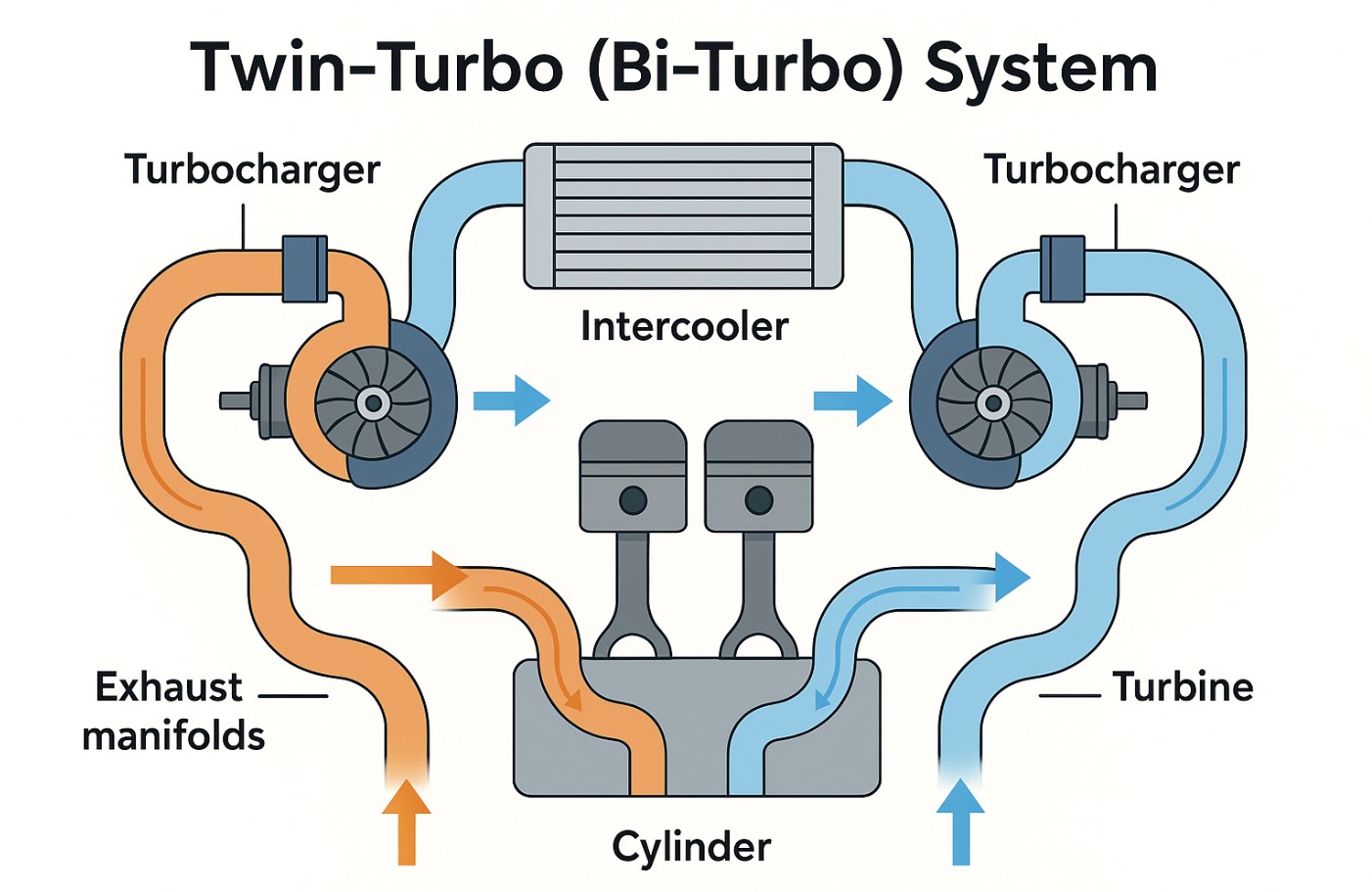
Engines with two turbos deserve special attention. You’ll find these systems on both petrol and diesel engines in the premium segment – for example certain BMW models with TwinPower Turbo technology, bi-turbo V-engines from Audi and Mercedes, as well as sequential bi-turbo diesels like the 3.0 BiTDI and similar setups. Two turbos can be arranged in different ways:
👓 Parallel twin-turbo
In a parallel configuration each turbocharger serves its own group of cylinders – usually one turbo per bank on a V-engine. Both turbos are the same size and work at the same time, sharing the airflow. Diagnostics in this case means checking the operation of each turbo separately.
In the scanner you can see parameters per cylinder bank (Bank 1 / Bank 2). The ECU may monitor boost pressure separately for each bank. If one turbo performs worse, you’ll often see a mismatch: the engine may log faults for boost pressure differences between banks or mixture problems on one side. A specialist will compare the figures – if both turbos are healthy, boost and mixture parameters for both banks will be very similar.
The LAUNCH scanner can also read specific fault codes for each turbo (for example “Turbocharger B Underboost”), which immediately points to the “second” turbo. For car sourcing in Germany that level of detail is crucial: repairing a bi-turbo setup is usually much more expensive than working on a single-turbo engine.
👓 Sequential (two-stage) turbocharging
Sequential two-stage turbocharging is common on diesels (for example certain Audi and BMW bi-turbo diesels or Mazda’s 2.2 bi-turbo). Here the turbos are different sizes: a small one for low revs and a big one for high revs. At low rpm only the small turbo works to give quick response; at higher rpm the large turbo joins in to provide strong boost. Between them there is a network of valves and a fairly complex control system.
Diagnostics of sequential systems is more complex, but a LAUNCH scanner makes it manageable. First we look for typical faults – for example codes indicating incorrect switching between boost stages or insufficient boost at higher rpm (a common sign that the big turbo is not doing its job).
Then we examine live boost graphs relative to engine speed. On a healthy bi-turbo diesel the boost curve is “two-step”: first you see boost from the small turbo, then at a certain rpm the large turbo comes in and boost climbs further. If this “second step” is missing, the large turbo is not contributing. The opposite is also possible: a weak low-end response suggests that the small turbo isn’t building enough boost at low rpm.
The scanner can also show us the status of the control valves that redirect exhaust and intake flow between turbos – both commanded and actual positions. Any discrepancy is an important clue for further checks.
In short, with two turbos you must ensure that both stages of boost work together smoothly. Computer diagnostics lets you see which stage is misbehaving. In some cases the data directly points to the cause – for example a stuck actuator on one turbo, a leak in a specific intercooler circuit or a sticky valve that switches between turbos. From our experience, even though bi-turbo systems are more complex, modern diagnostics tools are very effective at checking them – as long as you carefully analyse all available data and, where needed, complement it with a test drive while logging live boost in real driving conditions.
Turbo fault symptoms on a test drive
Besides direct diagnostics with a scanner, a lot of useful information comes from a proper test drive. An experienced inspector – or even a careful buyer – can spot a number of symptoms that point to boost problems, even before connecting any tools. Still, to confirm the diagnosis you should always run computer diagnostics, because many symptoms can have more than one cause. Here are the main turbo-related warning signs you should watch for during a test drive or first inspection:
⚠️ Noticeable loss of power and pull
The car feels flat and sluggish. You press the accelerator and it just doesn’t “go” the way a turbo engine should. A turbo engine that has lost its boost will feel lazy, especially on motorway slip roads, uphill or when overtaking – you push the pedal but there is no real surge of power.
⚠️ Flat spots at higher rpm
Sudden loss of pull at higher revs. On two-stage or high-rev-biased turbos the problem can show up as a flat spot after a certain rpm. For example, up to around 3,000 rpm the car feels acceptable, but above that the acceleration hardly increases. That usually means there is no effective boost in the higher range (possibly the second turbo isn’t working or the intercooler is restricted). This “plateau” in performance is a red flag.
⚠️ Strange noises from under the bonnet
A healthy turbo is almost inaudible, aside from a slight whistle under heavy load – which is normal. But if you hear strong foreign noises during acceleration – grinding, metallic screeching, a loud siren-like whistle or howling – the turbo is likely in trouble. Grinding and droning can indicate bearing damage, while a very sharp whistle may point to a boost leak or a hole in the intercooler. At idle a turbo is usually quiet, so it’s worth opening a window or asking a helper to listen carefully while you accelerate.
⚠️ Smoke from the exhaust
Exhaust colour is another important indicator. Turbo problems often show up as increased smoke under acceleration. Thick bluish (blue-grey) smoke means the engine is burning oil – quite possibly because oil is getting past worn turbo seals into the intake or exhaust. Heavy black smoke suggests an over-rich mixture – the turbo is not supplying enough air, so fuel doesn’t burn completely (often a sign of underboost or big leaks in the charge-air pipes). Dense white smoke or steam may be coolant, but a light white haze can also accompany serious oil burning. In any case, unusual heavy smoke during acceleration is a reason to suspect turbo or related system issues.
⚠️ High oil consumption
If you can check the oil level or ask the owner, always clarify oil consumption. A failing turbo often leads to the engine “drinking” oil. Some of the oil escapes through worn turbo seals into the intake or exhaust. You can’t measure this directly on a short test drive, but blue smoke and oil traces inside the intake pipes are strong hints. If you remove the hose after the turbo and find a lot of oil pooled there, that’s a bad sign. A light oil “mist” is acceptable; puddles are not. Leaks can also be visible outside – around the turbo housing and connections. If oil is seeping from the turbo body, it’s a sign that a rebuild or replacement will be needed.
⚠️ Unstable boost and “on-off” power delivery
Unstable boost or “surging” can also be felt. When cruising at steady speed, boost should be relatively stable. If you feel frequent surges or drops in power – as if someone is briefly lifting off and reapplying the throttle – boost may be fluctuating. You can sometimes see this on a boost gauge if the car has one. Common causes include a sticky boost control valve or electronic control issues. In any case, consistency is important: random boost swings without a clear reason are a symptom that needs investigation.
If you notice one or more of these symptoms on a test drive, follow up quickly with professional diagnostics. Sometimes the root cause lies not in the turbo itself but in related systems – for example variable-geometry control, EGR, fuel system or even a heavily blocked DPF or catalytic converter. Computer diagnostics helps sort this out: fault codes and live data will usually point in the right direction. For example, black smoke and loss of power might come from a clogged catalyst rather than a weak turbo – and the scanner will show corresponding DTCs. But very often these symptoms are directly linked to turbocharger wear, so ignoring them is risky. It’s better to check the turbo before it fails catastrophically and sends debris into the engine.
Equipment and experience – the key to accurate diagnostics
Proper turbo diagnostics requires both good equipment and a qualified approach. Boost control is a complex system tied into the entire engine management, and mistakes in judgement can be very expensive. That’s why it’s important to trust this job to professionals who have both the tools and the know-how.
💯 Specialised equipment
In “backyard” conditions turbo checks are very limited. Yes, you can do a basic visual inspection – wiggle the shaft for play, look at exhaust smoke, maybe measure pressure with a mechanical gauge. But this doesn’t give you the full picture. We use a modern LAUNCH scanner that talks to all electronic systems of the car. Only computer diagnostics can show you how the turbo works in all modes by reading data from dozens of sensors.
On top of that, a professional toolkit includes other useful devices: mechanical boost gauges for independent pressure checks, smoke machines to find leaks in the boost system, borescopes to inspect compressor wheels and housings from the inside, and more. In complex cases we may do a borescope inspection of the turbo – looking at the blades and housing without removing the unit. But the first and most important step is always OBD-II diagnostics: it’s fast, non-invasive and extremely informative.
💯 Expertise and brand knowledge
Even the best scanner is useless without someone who knows how to interpret the data. Reading a turbo report correctly requires solid understanding of how turbochargers work, which faults are typical and how they show up in live data and fault codes. For example, an experienced technician knows that a P0234 (Overboost) code often points to a stuck wastegate or actuator, while a P0299 (Underboost) code means you should check the intercooler and hoses for leaks, as well as overall turbo wear.
They also know which values are “normal” for each engine type. Experience helps avoid false alarms – for instance, recognising that a slight whistle is normal on this particular turbo engine, whereas a metallic howling noise is not. We work with a wide range of brands and models – Audi, VW, BMW, Mercedes and others – each with its own turbo characteristics. Our experts are familiar with these nuances and continually update their skills and diagnostic software.
💯 A systematic diagnostic approach
Professional turbo diagnostics follows a clear algorithm. We don’t stop at reading fault codes: we go through the full cycle, from listening to the client’s complaints to final repair recommendations. Imagine a typical scenario: the client complains about loss of power. We scan for codes – nothing critical shows up. Then we log live data on the road and see that the boost pressure sensor is under-reporting. We test the sensor and find that it is faulty. Replacing the sensor solves the problem. Without a structured process, it would be easy to blame the turbo and recommend an expensive replacement for no reason.
By combining electronic diagnostics with engineering thinking, we can localise the true cause. Statistics show that in many cases strange turbo behaviour is actually caused by sensors or valves, not by mechanical destruction of the turbo itself. That’s why we always start with a full scan and analysis of all related systems before saying “this turbo needs rebuilding”.
Turbo diagnostics before buying a used car
When buying a used car with a turbo engine, the condition of the turbocharger becomes one of the key topics. Repairing or replacing a turbo is not cheap, so spotting problems before you pay for the car is extremely valuable. Our company offers a comprehensive pre-purchase inspection service across Germany, with a strong focus on the boost system.
What does your turbo diagnostics service include❓
On-site inspection with computer diagnostics. We travel to the car – the seller can be almost anywhere in Germany. Our base is near Berlin, which allows us to react very quickly in Berlin and Brandenburg, but we also cover more distant regions by appointment. The inspector brings all necessary tools, first of all a LAUNCH scanner, and carries out full engine and turbo diagnostics on site.
Test drive and expert report. In addition to talking to the ECU we always take the car on a proper test drive to see how the turbo behaves in real conditions. This combination – scanner + road test – gives the most reliable result. In the end you receive a detailed report: DTCs (if any), turbo condition, whether the engine develops correct boost, and whether there are suspicious noises, smoke, unstable power delivery and so on. If we find issues, we explain the likely cause and rough repair costs. Sometimes the scan looks fine but we hear a worrying noise on the road – in that case we recommend a deeper workshop check, because a scanner cannot “hear” mechanical problems.
Brands and engine types. We diagnose cars of all brands. In practice most of our clients ask us to check Audi, Volkswagen, BMW and Mercedes-Benz – these are very common on the German market, and many of their models are turbocharged (diesel TDI/CDI and petrol TSI/TFSI, Turbo etc.). Our LAUNCH scanner supports all of them, so reading and logging data is straightforward. We apply the same thorough approach to both diesel and petrol turbos. Each has its specifics: on diesels we pay close attention to the DPF and EGR system (they directly affect turbo life), while on petrol engines we look carefully at boost control, ignition and misfire counters, because misfires can also stress the turbo and catalyst.
We have experience with a wide range of engines – from simple 4-cylinder turbos to complex V8 Bi-Turbo units. By booking a pre-purchase inspection with us you greatly reduce the risk of buying a car with a “dying” turbo. Our specialists check the turbo and all related systems quickly and properly. Our location near Berlin makes it easy to support deals in that region, but we also travel to other German cities where needed.
Conclusion: computer turbo diagnostics when car sourcing in Germany
Computer turbo diagnostics is an irreplaceable tool for assessing the health of a modern engine. Using a professional LAUNCH scanner and a structured interpretation of the results, we can detect even early stages of turbocharger problems. Live data shows how boost is built and controlled and allows us to compare it with what the engine is supposed to do – including on engines with two turbos.
A proper test drive with a specialist then closes the loop and shows how these problems manifest in real life. If you need a turbo check or a complete pre-purchase inspection of a used car in Germany, we’re here to help. We have the equipment and the experience to give you a clear expert verdict. By catching boost issues in time you save money and nerves – and avoid sudden big bills right after buying the car.
For anyone planning car sourcing in Germany this is especially important: buying a powerful Bi-Turbo car without proper turbo diagnostics is pure roulette. Let your turbos spool up as they should – and let the car bring only positive emotions on the road, not unpleasant surprises at the workshop.
Werbung / *Affiliate-Link
Links and banners marked with an asterisk (*) are affiliate links/banners. If you use such a link and subsequently request an offer, sign a contract or make a purchase, we receive a commission from the respective provider. For you, there are no disadvantages: the price and conditions remain the same.
FAQ – Bi-Turbo diagnostics and turbo checks when car sourcing in Germany
Is Bi-Turbo repair always much more expensive than a single turbo?
There is no fixed percentage, but the logic is simple: a Bi-Turbo system has more components, actuators and valves, access is often more difficult and sometimes both turbos need attention. That’s why Bi-Turbo repairs are usually more expensive – and why during car sourcing we pay extra attention to such engines.
Should I still buy a car if the turbo is “on the edge” but the price is very attractive?
It’s a question of risk and budget. Sometimes it makes sense to buy if the seller offers a substantial discount and the rest of the car is in great condition – provided you are ready to invest in a turbo rebuild. In other situations it’s cheaper and less stressful to walk away and find a car with a healthy boost system. In our report we outline possible scenarios so you can decide calmly.
If there are no turbo-related fault codes, does that mean the turbo is definitely healthy?
No, the absence of codes is a good sign but not a 100% guarantee. Sometimes the turbo is already working at its limit but the ECU has not yet logged a DTC. That is why we always look at live data and do a test drive. Only the combination of codes, parameters and driving impressions gives a reliable picture.
Do you check only the turbo or the whole car?
In our standard car sourcing service in Germany we inspect the whole car: engine, turbo, gearbox, suspension, brakes, body, interior, electronics and of course legal status and VIN history. You can ask us to focus on the engine and turbo, but in most cases a full inspection provides better protection against hidden problems.
Related posts
Car sourcing in Germany: computer turbo diagnostics (article 46)
 5 signs you’re looking at a flood-damaged car – how not to buy a “swimmer”