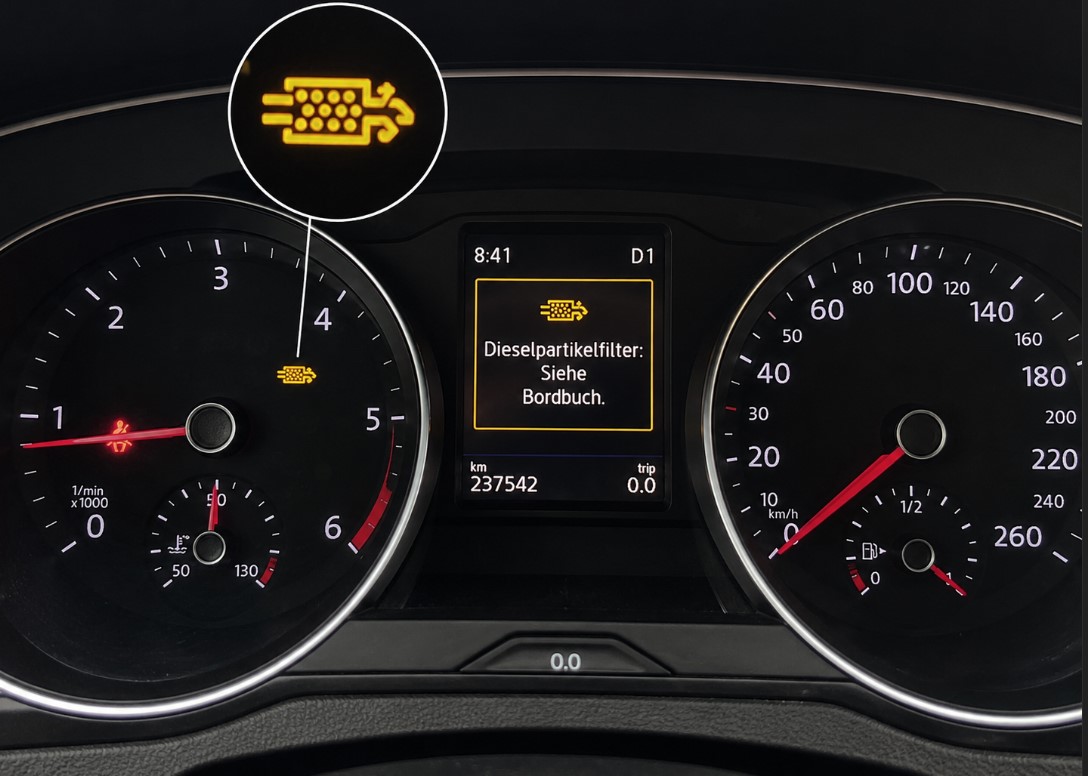
DPF or catalytic converter fault: symptoms, repair and costs
Why even a relatively young car may hide expensive risks in the exhaust aftertreatment system.
 Sicher-Check
You have found a car, the price looks attractive and the seller shows some paperwork — but the listing says: Import aus Frankreich, EU-Fahrzeug, Erstzulassung Belgien or Reimport. For a buyer, this is not automatically a bad sign. But it does mean the documents deserve extra attention.
A car from France, the Netherlands, Belgium, Italy, Austria or another EU country can be used and registered in Germany without problems. The decisive question is whether the CoC is available, the purchase contract or invoice is correct, the TÜV status is clear, the VAT situation is understandable and registration through Zulassungsstelle Berlin can be completed without delays.
In this article, we explain which documents are needed for a car from another EU country, how the eVB works, when a CoC is important, how buying from a private seller differs from buying from a company, and why document checking should be done together with a technical inspection of the vehicle.
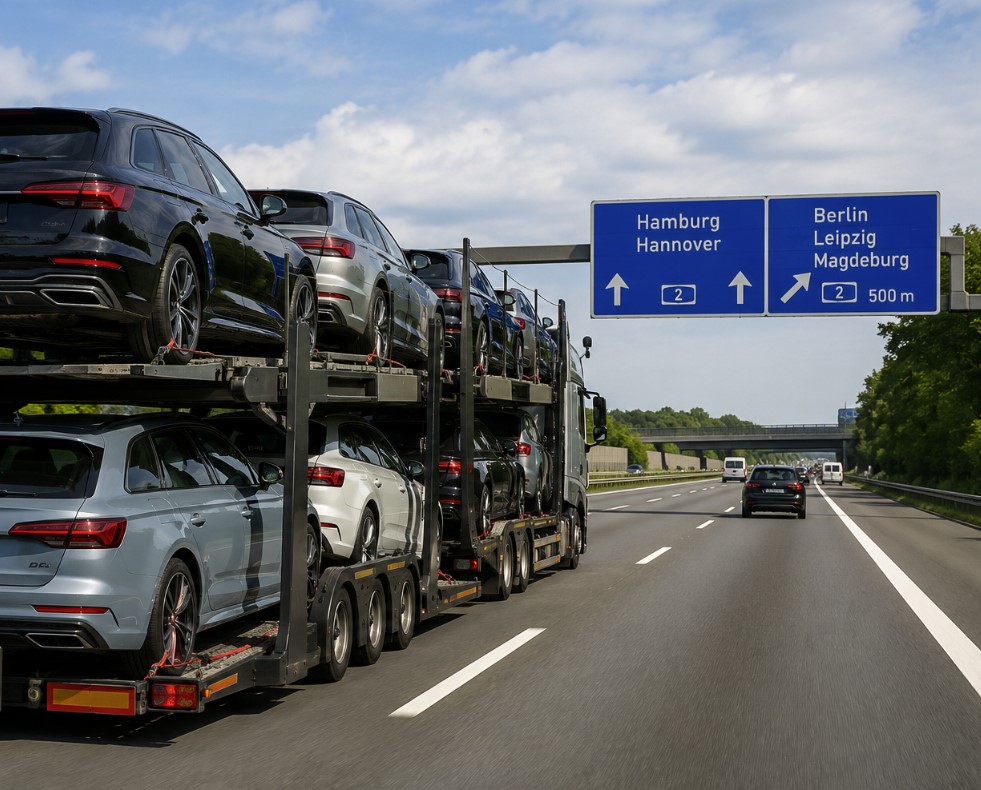
The German used-car market has long been part of a wider European market. Dealers, exporters, leasing companies and private buyers regularly bring vehicles from France, the Netherlands, Belgium, Italy, Austria, Spain, Luxembourg, Denmark and Sweden.
Therefore, terms like EU-Fahrzeug, Importfahrzeug or Reimport in a listing do not automatically mean that the car is bad. They simply mean that the vehicle’s history began outside Germany or that it was brought into Germany from another EU country.
✅ What matters is not the import itself, but three points: transparent vehicle history, a correct document package and a clear tax setup for the sale.
Vehicles from other EU countries can be cheaper than comparable German-market cars for straightforward market reasons: local pricing, leasing returns, large company fleets, quick fleet renewal and strong competition between dealers.
In some EU countries, certain models lose value faster, and German dealers buy them for resale.
A car from France or Belgium may have an unusual specification that is rare on the German market.
The Netherlands, Belgium and France often provide leasing returns with relatively clear service history.
Some countries offer useful documents for mileage and history checks, such as the Belgian Car-Pass.
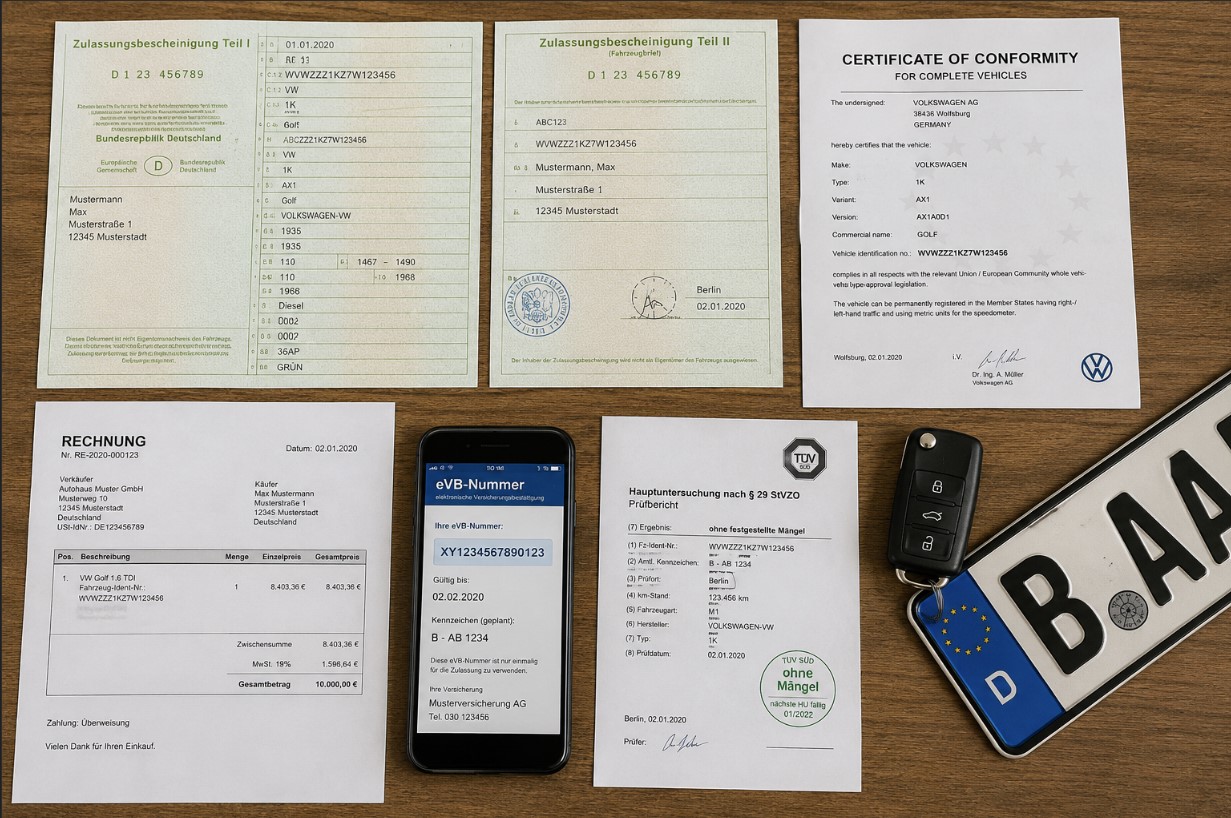
The simplest situation is when the vehicle has already been imported into Germany by a previous owner or dealer and now has German documents: Zulassungsbescheinigung Teil I and Zulassungsbescheinigung Teil II.
In that case, the purchase is usually similar to buying a standard German-market used car. Still, the vehicle’s origin should not be ignored. It is useful to ask for old foreign documents, CoC, the first invoice or contract, service history and mileage confirmations.
⚠ German documents reduce registration risk, but they do not replace checks of history, VAT, mileage, bodywork and technical condition.
Before buying a car from another EU country, you should check not only the vehicle itself, but also its complete paper trail. You need to understand who is selling the car, where it was previously registered, whether the sale is correctly documented, whether the CoC is available, whether the car can be registered in Berlin and whether there are any VAT issues.
Even if the car already has German plates, the documents still deserve a careful look. Sometimes the seller shows only German Teil I and Teil II, but cannot explain where the vehicle came from, when it was imported, who the first seller was or which tax scheme was used.
❗ Do not transfer money if the seller does not show original documents, avoids questions about the vehicle’s origin or offers to write a lower price in the contract than the amount actually paid.
| Document | What it is | What to check |
|---|---|---|
| Zulassungsbescheinigung Teil I | German registration certificate, part I | VIN, registration number, technical data, owner |
| Zulassungsbescheinigung Teil II | German registration certificate, part II | Original document, number of owners, VIN match |
| Kaufvertrag | Purchase contract | Seller and buyer data, VIN, price, date, signatures |
| Rechnung | Invoice from a business or dealer | VAT, margin scheme, company data, VIN |
| CoC | Certificate of Conformity | European certificate confirming type conformity |
| TÜV report | Technical inspection report | Validity, defects, mileage at inspection |
| Foreign documents | Documents from the country of first registration | VIN, first registration date, ownership history, export status |
This is the smaller German registration document. It confirms that the vehicle is registered and contains key technical data: VIN, plate number, power, emission class, weight, tire dimensions and other parameters.
When buying, compare the VIN in Teil I with the VIN on the vehicle body, in the service history, in the TÜV report and in the purchase contract. Any mismatch must be explained before signing.
This is the larger German registration document. For the buyer it is especially important, because a normal transfer or registration is not possible without the original Teil II.
If the seller says that Teil II is held by a bank, leasing company or will be handed over later, the legal situation must be clear. This can be normal for financed cars, but before payment there must be a clear procedure for releasing the original document and removing any encumbrance.
When buying from a private person, the usual document is a Kaufvertrag. When buying from a dealership, trader, exporter or company, there should be a Rechnung.
This document proves who sold the vehicle, to whom, for which price, on which date and under which conditions. For EU cars, it is especially important that the contract or invoice makes the tax scheme clear: normal sale, margin scheme or intra-community supply.
⚠ Wording in the invoice matters. Terms like Differenzbesteuerung, Margin Scheme, Régime de la marge or Margehandel indicate a margin scheme, where VAT is usually not shown separately.
CoC means Certificate of Conformity. In German searches, buyers often see terms like CoC Papiere Auto or CoC Dokumente Auto. In simple terms, the CoC confirms that the vehicle conforms to an EU type approval and can be registered in EU countries without a complex individual approval procedure.
✅ A CoC is especially useful when a vehicle has recently been imported from France, the Netherlands, Belgium, Italy, Spain, Austria or another EU country and does not yet have a complete German registration package.
A missing CoC does not always mean that you cannot buy the car. In many cases, a duplicate can be ordered from the manufacturer or through an official dealer of the brand. However, this means extra cost, time and possible registration delays.
If the vehicle already has German documents and was previously registered in Germany, the missing CoC may be less critical. But for a fresh EU import, it is much better to have the CoC before buying.
eVB means elektronische Versicherungsbestätigung, or electronic confirmation of insurance. Without an eVB number, you cannot register a car in Germany, obtain license plates or complete the registration process.
The buyer arranges insurance, receives an eVB code and provides this code to the registration office. For Berlin this is especially important because appointments are often planned in advance, and one missing document can break the entire process.
❌ Without an eVB number, the vehicle cannot be registered. That is why “eVB Berlin Gebrauchtwagen” is one of the key practical topics for buyers who have already found a car and are preparing registration.
The table below gives an orientation for documents often encountered when buying cars from different EU countries. Document names may vary depending on the vehicle age, seller type, registration form and whether the car has already been imported into Germany.
| Country | Documents | What to check | Special risks |
|---|---|---|---|
| 🇫🇷 France | Carte Grise, Certificat de Cession, Facture, Contrôle Technique | French registration document, transfer document, invoice, technical inspection | Check TVA / TVA sur marge, VIN and first-registration date |
| 🇳🇱 Netherlands | Kentekencard, Factuur, export documents | Plastic registration card, invoice, export confirmation | Check export deregistration and BPM/tax history |
| 🇧🇪 Belgium | Certificat d'Immatriculation, Car-Pass, Contrôle Technique, Facture | Registration document, mileage-history Car-Pass, inspection report | Missing Car-Pass means mileage needs extra verification |
| 🇮🇹 Italy | Carta di Circolazione, Certificato di Proprietà, Fattura | Italian registration document, proof of ownership, invoice | Check body repairs and service history carefully |
| 🇪🇸 Spain | Permiso de Circulación, ITV, Factura | Registration document, ITV inspection, invoice | Check ITV validity, tax status and VIN |
| 🇦🇹 Austria | Zulassungsschein, Kaufvertrag, CoC | Similar document logic, often easier for German buyers | Check NoVA/tax history if the vehicle is nearly new |
| 🇩🇰 Denmark | Registreringsattest, invoice, export documents | Danish registration papers and invoice | Understand the tax part and usage history |
| 🇸🇪 Sweden | Registreringsbevis, invoice, service history | Swedish registration documents, often clear service records | Check corrosion, climate-related use and VIN |
French cars often attract buyers with price and equipment. But it is important to check how the sale is documented: private seller, dealership, company or exporter. Documents may contain terms such as TVA or TVA sur marge.
The Netherlands is an important source of vehicles for the German market. Many are leasing returns or former company-fleet vehicles. Check export deregistration, invoice and VIN consistency.
The Belgian Car-Pass can help verify mileage history. It does not replace a technical inspection, but it is a useful document. If the seller claims Belgian origin and no Car-Pass is available, ask additional questions.
Tax treatment is one of the most sensitive areas when buying a car from another EU country. A buyer may see an attractive price and assume it is final. But if the sale scheme is misunderstood, VAT questions can arise — especially for almost new cars or business-to-business transactions.
If the seller is a private person, VAT is usually not charged or shown separately. The key document is a proper purchase contract with seller and buyer details, VIN, mileage, price, date, signatures and vehicle description.
If the seller is a dealership, company, leasing structure or exporter, read the invoice carefully. It must be clear whether VAT is included, shown separately or whether the sale uses the margin scheme.
| Scheme | What you see in the documents | What matters to the buyer |
|---|---|---|
| Standard sale with VAT | VAT shown as a separate line | Check rate, amount and seller data |
| Differenzbesteuerung / margin scheme | VAT is not shown separately | Understand that VAT is included in the seller’s margin |
| Intra-community supply | May be used between businesses | Correct VAT ID and formal handling are required |
⚠ If a company from France, the Netherlands, Belgium or another EU country sells the car and the invoice is unclear, clarify it before payment. Tax mistakes are much harder to fix after the deal.
For a normal used car from the EU, double VAT payment normally does not arise if the documents are correct. But there is a sensitive area: almost new vehicles.
In EU practice, a vehicle can be treated as new for tax purposes if it is very fresh by first-registration date or has very low mileage. Be especially careful with vehicles younger than six months or with less than 6,000 km.
🚩 If an EU car is almost new, do not buy it only because the price looks attractive. First check how VAT is documented and who the seller is: private person, dealer, company or exporter.
Such vehicles can be very good deals — but only when the paperwork is correct. Otherwise, the buyer may face unpleasant questions during registration or later resale.
If the documents are prepared correctly, registering a vehicle from another EU country in Berlin is usually manageable. The buyer’s main task is to collect the full document set in advance and not arrive at the registration office with an incomplete folder.
Registration usually requires identity documents, proof of address, eVB, German registration documents or foreign documents for a fresh import, purchase contract or invoice, valid TÜV, CoC and a SEPA mandate for vehicle tax.
| Required item | Purpose |
|---|---|
| ID / residence permit | Identification of the applicant |
| Registration address / Anmeldung | Proof of residence address |
| eVB | Insurance confirmation |
| Teil I / Teil II or foreign documents | Vehicle registration documents |
| Purchase contract / invoice | Proof of purchase |
| CoC | Technical data and EU conformity |
| TÜV | Technical roadworthiness approval |
| SEPA mandate | Direct debit for vehicle tax |
✅ For the search intent “EU car registration in Berlin”, the decisive factor is not the country of origin, but whether the documents are ready for registration.
If the documents are prepared in advance, registering a car from another EU country becomes much calmer. The following workflow shows the typical path from finding a car to obtaining German license plates.
From EU car to German registration
💡 Practical advice: even if the vehicle is already registered in Germany by the previous owner, it is still useful to check its origin, CoC, old documents, invoice/purchase contract and mileage history.
Before transferring money to the seller, check the car in two directions: technical condition and document readiness. A clean exterior alone does not make the purchase safe.
| What to check | Why it matters |
|---|---|
| VIN on the body and in documents | It must match in all documents |
| Teil I and Teil II | Without originals, normal registration or transfer is not possible |
| CoC | Simplifies registration for a vehicle from another EU country |
| Purchase contract / invoice | Confirms the deal and the tax scheme |
| VAT / margin scheme | Helps avoid tax mistakes |
| TÜV report | Check validity, defects and mileage |
| OBD diagnostics | Reveals control-unit errors |
| Paint and bodywork | Helps find accident damage and repainting |
| Test drive | Checks engine, gearbox, suspension and brakes |
❗ Do not agree to a contract with an artificially reduced price. It weakens your position in disputes, returns, defects and future resale.
For a buyer, the key question is not only whether the car can be registered. It is whether this specific car is worth buying at all. A complete document set does not protect you from hidden accident damage, a problematic gearbox, manipulated mileage or expensive repairs after purchase.
We inspect the body, interior, engine bay, suspension, brakes, tires, glass, repair traces and overall condition.
We check OBD faults, electronic control units, mileage indicators, system status and hidden signs of defects.
We review Teil I, Teil II, purchase contract, invoice, CoC, TÜV, foreign documents and registration readiness.
We look at seller type, invoice wording, margin scheme, Differenzbesteuerung and possible VAT warning signs.
⚠ We do not replace a tax advisor or lawyer, but we help the buyer identify practical risks before signing the contract and transferring money.
Yes. French origin is not a problem by itself. You should check the documents, history, VAT status, mileage and technical condition.
Not always, especially if the car already has German documents. But for a fresh EU import, the CoC makes registration much easier.
No. The eVB is mandatory electronic insurance confirmation for vehicle registration in Germany.
In most normal used-car purchases, no. But you must check the seller type, invoice, margin scheme and vehicle status.
Both are important. A missing CoC usually causes registration delays, while incorrect VAT handling can create financial and legal risks.
Not always for registration, but they are useful for checking origin, mileage history and previous ownership.
Yes. We can inspect the vehicle on site, check the documents, prepare photo and video documentation and send the conclusion to the client.
A car from France, the Netherlands, Belgium, Italy or another EU country can be a good purchase in Germany. The mistake is looking only at the price and photos. You need to check documents, history, VAT, CoC, eVB, registration readiness in Berlin and the real technical condition of the car.
If you have already found a vehicle, it is smarter to check it before signing the contract. That is cheaper than dealing later with registration problems, repair costs, tax questions or trying to return the car to the seller.
Why even a relatively young car may hide expensive risks in the exhaust aftertreatment system.
What to check at new-car handover, which documents are needed and how to avoid registration mistakes.
Disclaimer / Haftungsausschluss:
The content on this page is for general information only and does not replace an individual vehicle inspection,
tax advice, legal advice or a document check by the responsible registration authority.
Despite careful preparation, we do not guarantee the accuracy, completeness or current validity of the information.
Registration rules, tax treatment, document requirements and legal interpretation may differ depending on the case.
You use this information at your own responsibility.