Scheckheftgepflegt Without Illusions: How to Compare a Car’s Service History with Its Actual Condition
The word Scheckheftgepflegt is commonly interpreted as a quality signal in German used-car advertisements. Buyers often assume that the vehicle has been serviced regularly, its mileage has been verified and no serious technical problems should be expected.
In practice, the term means only that the seller claims that a service history exists. It does not guarantee genuine mileage, correct maintenance intervals, accident-free history or the good condition of the engine, transmission, suspension and other expensive components.
Genuine transparency begins when the service book, digital service records, workshop invoices, HU/TÜV inspection reports, oil-change stickers, mileage progression and the vehicle’s actual wear all support the same story.
❗ The key point: a neatly stamped service book does not prove that the mileage is genuine, every required maintenance operation has been completed or the vehicle’s actual condition matches its documents.
🧭 Article Contents
- 📘 What Does Scheckheftgepflegt Mean?
- 🔍 Service Book vs Transparent Vehicle History
- 📚 Which Service-History Sources Should Be Collected?
- 🧾 How to Check Paper and Digital Service Records
- 🛠 Why Invoices Matter More Than a Workshop Stamp
- 📄 How to Use HU/TÜV Inspection Reports
- 📈 How to Check Whether the Mileage Is Plausible
- 🚗 How to Compare the Records with the Car’s Wear
- 🛣 What Diagnostics and a Test Drive Can Reveal
- ✅ Service-History Verification Checklist
- ⚖️ How to Assess the Purchase Risk
- 🔎 Independent Vehicle Inspection in Berlin and Germany
- ❓ Frequently Asked Questions
- 🏁 Conclusion
📘 What Does Scheckheftgepflegt Mean?
The German term Scheckheftgepflegt literally refers to a vehicle that has been maintained with entries recorded in a service book. When sellers use this description in an advertisement, they are stating that the vehicle’s maintenance was documented in a paper or digital service record.
However, the quality and completeness of that documentation can vary considerably. One vehicle may have a complete digital history from an authorised dealership, accompanied by a folder containing detailed invoices. Another may have only a few stamps in an old service book, with no records at all for the most recent years.
📘 Paper Service Book
Entries, workshop stamps, dates, mileage readings and the stated type of maintenance performed.
💻 Digital Service History
Electronic maintenance records retrieved from a manufacturer’s system or dealership network.
🧾 Individual Invoices
Workshop invoices and repair orders confirming the actual work performed and the parts used.
🗣 Seller’s Statement
In some advertisements, the term Scheckheftgepflegt is used even though a complete service history is not actually available.
⚠️ Scheckheftgepflegt does not automatically mean that the vehicle has never been involved in an accident, that its mileage could not have been altered, that every service was carried out correctly or that the car will not require expensive repairs after purchase.
The description Scheckheftgepflegt should therefore be treated as a starting point for further verification—not as a guarantee of quality.
🔍 A Service Book and a Transparent Vehicle History Are Not the Same Thing
The mere existence of a service book does not make a vehicle’s history transparent. The book is only one source of information, while a credible Wartungshistorie—maintenance history—is built from several independent forms of evidence.
The more documents agree with one another, the easier it is to determine whether the vehicle was serviced regularly, whether its stated mileage is plausible and which costs may await the next owner.
| Verification Area | Weak Evidence | Credible, Transparent History |
|---|---|---|
| 📘 Service records | Several stamps without a clear description of the work performed. | Service entries are supported by invoices, repair orders or digital records. |
| 📈 Mileage | Mileage appears only in the service book. | Mileage progression is confirmed by service records, invoices and HU/TÜV inspection reports. |
| 📅 Chronology | Long gaps and inconsistent service intervals remain unexplained. | Most years of the vehicle’s operation can be traced through dated documents. |
| 🚗 Vehicle condition | The documents look convincing, but the actual car has not been inspected. | The wear of the interior, engine, brakes, tyres, suspension and body is consistent with the records. |
| 💶 Future costs | The seller simply states that the car has always been serviced. | It is clear which major maintenance items have already been completed and which are approaching. |
✅ A complete service history is not merely a tidy folder of documents. It is a logical and verifiable chronology that matches the vehicle standing in front of you.
📚 Which Sources Should Be Used to Verify a Car’s Service History?
A reliable assessment should never be based on only one document. A stamp in a service book may look convincing but often provides little practical information about the work that was actually completed.
When buying a used vehicle in Germany, try to collect and compare as many of the following sources as possible.
📘 Serviceheft
The traditional paper service book containing dates, mileage readings, workshop stamps and brief notes about completed maintenance.
💻 Digitale Servicehistorie
A digital service-history printout from the vehicle manufacturer’s system or an authorised dealer network.
🧾 Rechnungen
Workshop invoices showing the vehicle, date, mileage, individual operations, labour time, spare parts and fluids used.
🔧 HU/TÜV Reports
Periodic technical-inspection reports that usually contain the inspection date, recorded mileage and any defects identified at that time.
🏷️ Service Stickers
Stickers in the engine compartment or door area relating to oil changes, timing-belt replacement, air-conditioning service or other maintenance.
📄 Additional Documents
Diagnostic reports, warranty work, recall campaigns, component-replacement documents and workshop repair orders.
🔗 Why Cross-Checking the Sources Matters
Every individual document has limitations. A service-book entry may be incomplete, an invoice may have been lost and a digital manufacturer history may not include maintenance performed by an independent workshop.
The goal is therefore not to find one “perfect” document, but to build a coherent chain of evidence.
| Source | What It Can Confirm | What It Usually Cannot Confirm |
|---|---|---|
| 📘 Paper service book | Dates, stated mileage, servicing workshop and the general sequence of maintenance. | The precise scope and quality of every completed operation. |
| 💻 Digital history | Entries made within the manufacturer or authorised dealership system. | Work performed by workshops that do not participate in that system. |
| 🧾 Workshop invoice | Specific operations, parts, fluids, date, mileage and the invoicing workshop. | Whether the rest of the vehicle is currently in good technical condition. |
| 🔧 HU/TÜV report | Mileage recorded on the inspection date and defects relevant to the periodic inspection. | A complete diagnosis of the engine, transmission, electronics or future repair requirements. |
| 🏷️ Service sticker | A possible date or mileage for a particular maintenance operation. | That the information is genuine or that the operation was performed correctly. |
💡 Missing invoices do not automatically mean that the vehicle was not serviced. However, the more unexplained gaps there are, the greater the uncertainty—and the more important the actual vehicle inspection becomes.
🧾 How to Check a Paper Service Book
A typical service-book entry may include the date, mileage, type of service, workshop stamp and mechanic’s signature. Some entries also show the oil specification, additional work and the date or mileage at which the next service is due.
Do not assess the entries only by their appearance. Their sequence, content and consistency with other documents are considerably more important than a neat stamp.
✅ What a Useful Service Entry Should Contain
- 📅 the date on which the maintenance was performed;
- 📈 the vehicle’s mileage at the time of the service;
- 🔧 the type and scope of the maintenance;
- 🏢 the name and identifiable details of the workshop;
- ✍️ a stamp, signature or digital confirmation;
- 🛢️ the engine-oil specification, where recorded;
- 🧾 any additional repairs or replacements;
- ⏭️ the date or mileage for the next scheduled service.
🚩 What May Look Suspicious?
- 📄 missing, torn or damaged pages;
- 🖊️ numerous entries apparently completed using the same pen and handwriting;
- 🏷️ identical-looking stamps covering many years;
- 📉 mileage values that do not increase logically;
- 📅 maintenance dates with highly irregular or implausible intervals;
- 🧾 major service entries without any supporting invoice;
- 🆕 a virtually unused replacement service book for an older vehicle;
- 🏢 a workshop whose existence or contact details cannot be verified;
- 🔀 entries made in a different order from the vehicle’s apparent chronology;
- 🚗 a VIN or registration number that does not match the vehicle being sold.
⚠️ A workshop stamp by itself does not prove that the stated maintenance was actually completed. The strongest evidence combines a plausible date, mileage, identifiable workshop and supporting invoice.
🔎 Can the Workshop Be Verified?
If the service book contains the name of a workshop, it may be useful to check whether that business existed at the stated time and whether its address and contact details are plausible.
A buyer can also ask the seller to provide the corresponding invoice or clarify whether the workshop can confirm the service. Due to data-protection rules, a workshop may refuse to disclose customer information, but it may still be possible to establish whether a document or invoice format is plausible.
💡 The purpose is not to investigate every stamp in isolation. The objective is to assess the consistency and credibility of the complete history.
💻 How to Check a Digital Service History
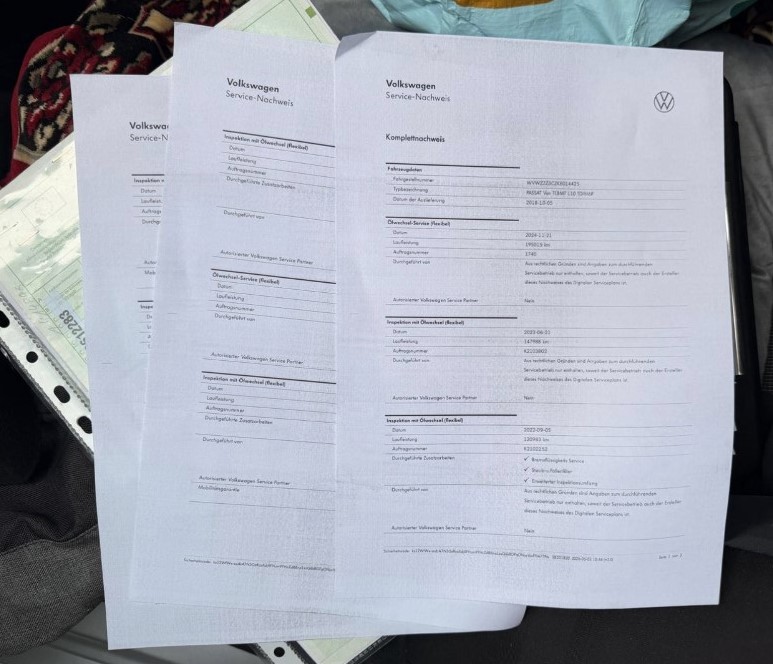
Many newer vehicles no longer use a traditional paper service book. Maintenance records are stored in the vehicle manufacturer’s digital system and may be accessible through an authorised dealer or manufacturer portal.
In this situation, the seller should ideally provide a recent printout or electronic document containing the relevant vehicle identification and service entries.
| What to Check | Why It Matters |
|---|---|
| 🚗 VIN | Confirms that the digital service history belongs to the vehicle being offered. |
| 📅 Service dates | Helps reconstruct the chronology of the vehicle’s use and maintenance. |
| 📈 Mileage readings | Shows whether the mileage increased consistently between service visits. |
| 🔧 Type of service | Helps determine whether only routine oil changes or more extensive scheduled maintenance was completed. |
| 🏢 Servicing workshop | Shows where the work was recorded and whether it was completed within the manufacturer network. |
| ⏳ Gaps in the history | Missing periods may require invoices from independent workshops or further explanation from the seller. |
⚠️ The Limitations of Digital Records
A manufacturer’s digital history is useful, but it may not contain every maintenance operation performed during the vehicle’s life. Work completed by an independent workshop, a tyre specialist or the owner may not appear in the manufacturer’s database.
⚠️ A digital service history from an authorised dealer is strong evidence for the entries it contains. However, a gap in the digital system does not necessarily prove that the car was not serviced—it means that additional evidence should be requested.
🛠️ Why Workshop Invoices Matter More Than a Service-Book Stamp
A workshop invoice normally contains far more useful information than a short entry in a service book. It can show which vehicle was serviced, when the work was carried out, what mileage was recorded and which parts, fluids and labour operations were invoiced.
Detailed invoices help a buyer understand not only whether the car visited a workshop, but also what was actually done.
🚗 Vehicle Identification
VIN, registration number, model, engine specification or the workshop’s internal vehicle reference.
📅 Date and Mileage
Useful for reconstructing the vehicle’s chronology and assessing whether the mileage progression is plausible.
🔧 List of Operations
Shows what was inspected, serviced, repaired or replaced during the workshop visit.
🧩 Spare Parts
Part numbers, quantities and sometimes the manufacturer or quality category of the installed parts.
🛢️ Oil and Fluids
Specification, viscosity, quantity and type of engine oil, transmission oil, brake fluid or coolant used.
📝 Mechanic’s Remarks
Identified defects, measurements, recommendations and repairs suggested for a later date.
📋 Why the Word “Inspektion” Is Not Enough
An invoice may state that an Inspektion was performed. However, that wording alone does not always confirm that all manufacturer-required items were replaced.
Depending on the vehicle, workshop and selected package, an inspection may or may not include:
- 🛢️ engine oil and oil-filter replacement;
- 🌬️ engine air-filter replacement;
- 🫁 cabin or pollen-filter replacement;
- ⛽ fuel-filter replacement;
- 💧 brake-fluid replacement;
- ⚙️ transmission-oil and transmission-filter service;
- ⏱️ timing-belt, tensioner and water-pump replacement;
- 🔥 spark-plug replacement on a petrol engine;
- 🧪 coolant, AdBlue or other operating fluids;
- 🔍 additional inspections required by the manufacturer.
⚠️ An invoice for an “inspection” should not automatically be treated as proof that every required filter, fluid or wear component was replaced. The individual invoice lines must be checked.
🗂️ A Practical Way to Analyse the Documents
Arrange all available documents in chronological order and create a simple timeline. This makes gaps, contradictory mileage readings and missed maintenance intervals easier to identify.
-
① Identify the vehicle.
Check whether the VIN, registration number or model details correspond to the car being offered. -
② Record every date and mileage value.
Add service-book entries, invoices, HU/TÜV reports and other dated documents to one timeline. -
③ Check mandatory maintenance intervals.
Compare the documented work with the requirements for the specific engine, transmission and model. -
④ Mark major replacements.
Timing belt, gearbox service, brakes, battery, clutch, DPF work and other costly items should be clearly identified. -
⑤ Note unexplained gaps.
A gap does not automatically prove fraud, but it increases uncertainty and should influence the inspection and price assessment. -
⑥ Compare the history with the actual car.
Documents are useful only when the vehicle’s technical condition and visible wear do not contradict them.
💡 Pay particular attention to invoices marked Kostenvoranschlag, Empfehlung, Hinweis or nicht durchgeführt. These may describe recommended repairs that were never completed.
📄 How to Use HU/TÜV Inspection Reports
During Germany’s periodic roadworthiness inspection (Hauptuntersuchung or HU), the vehicle’s mileage is normally recorded. The report may also list technical defects identified on the inspection date.
HU reports are therefore useful as independent chronological reference points. They can help confirm where the mileage stood at a particular time and whether the vehicle had previously recorded defects.
🔎 What Should Be Checked in an HU Report?
- 📅 the date of the technical inspection;
- 📈 the recorded odometer reading;
- 🚗 the VIN and registration details;
- 🟢 whether the inspection was passed;
- ⚠️ any minor defects (geringe Mängel);
- 🔴 any major defects (erhebliche Mängel);
- ⛔ dangerous defects or an immediate road-safety concern;
- 🔁 whether a repeat inspection (Nachprüfung) was required.
| Information in the HU Report | How It Helps the Buyer | Important Limitation |
|---|---|---|
| 📅 Inspection date | Creates an independently dated point in the vehicle’s history. | It says little about what happened between two inspections. |
| 📈 Mileage | Helps verify whether the odometer readings increased in a logical sequence. | A plausible sequence does not guarantee that the mileage was never altered before an earlier report. |
| 🛑 Brake defects | May reveal previous wear, imbalance or insufficient braking performance. | The report does not necessarily confirm the current remaining life of every brake component. |
| 🔧 Suspension and steering | Can show defects identified during the technical inspection. | Early-stage wear may not have been sufficient to fail the HU inspection. |
| 💡 Lights and electrical equipment | May document safety-relevant defects present at that time. | It is not a complete diagnosis of all electronic control systems. |
| 🌫️ Emissions-related information | Confirms that the relevant inspection requirements were met at the time. | It does not guarantee the future condition of the DPF, catalytic converter, EGR system or AdBlue system. |
❗ A recently passed HU inspection is not equivalent to a complete pre-purchase vehicle inspection. HU does not provide a detailed assessment of the engine, transmission, turbocharger, battery, air conditioning, multimedia system or other expensive components.
HU confirms compliance with defined roadworthiness requirements at a particular time. It does not guarantee that the entire car is free of defects or that no expensive repairs will be required soon.
📈 How to Check Whether a Car’s Mileage Is Plausible
Mileage should not be assessed using a single number. A more reliable approach is to reconstruct its progression using several independent sources and then compare the result with the vehicle’s actual wear.
Useful mileage reference points may appear in:
- 📘 paper service-book entries;
- 💻 digital service-history records;
- 🧾 workshop and repair invoices;
- 🔧 HU/TÜV inspection reports;
- 🛞 tyre, brake and wheel-alignment invoices;
- 🛢️ oil-change and timing-belt stickers;
- 🧰 roadside-assistance or warranty documents;
- 💾 mileage values stored in certain electronic control units, where technically available.
🗓️ Example of a Plausible Mileage Timeline
| Date | Document | Recorded Mileage | Assessment |
|---|---|---|---|
| May 2019 | First scheduled service | 18,400 km | Plausible first-year usage |
| June 2020 | Maintenance invoice | 37,900 km | Logical mileage increase |
| April 2021 | Brake-service invoice | 54,600 km | Consistent with the previous record |
| July 2022 | HU/TÜV report | 78,100 km | Independent mileage reference point |
| August 2023 | Service invoice | 96,700 km | No contradiction identified |
| July 2024 | HU/TÜV report | 113,500 km | Chronology remains plausible |
| July 2026 | Current odometer reading | 146,200 km | Plausible if supported by condition and diagnostics |
Such a sequence does not provide absolute proof that the mileage is genuine. However, it makes the stated mileage considerably more credible—especially when the figures come from several independent types of documents.
🚩 Mileage Inconsistencies That Should Raise Concern
- 📉 a later document shows a lower mileage than an earlier one;
- ⏸️ mileage remains almost unchanged for several years without a convincing explanation;
- 🚗 a heavily used diesel vehicle accumulates mileage at an implausibly slow rate;
- 🧾 an invoice contains a different VIN, registration number or vehicle model;
- 🆕 the documented history begins several years after the vehicle was first registered;
- 🔄 a replacement instrument cluster is mentioned, but the mileage transfer is not documented;
- 🏷️ service stickers display mileage figures that conflict with the current odometer;
- 💾 mileage values found in different control units are inconsistent;
- 🪑 the wear of the driver’s area appears excessive for the claimed mileage;
- 📁 the seller refuses to show original documents or gives contradictory explanations.
❗ Missing documents for a particular period do not prove that the odometer was manipulated. Nevertheless, such a gap increases uncertainty and should be reflected in the purchase decision, technical inspection and price.
🧮 How to Estimate the Average Annual Mileage
A basic calculation can help place the odometer reading in context:
Average annual mileage = current mileage ÷ vehicle age
For example, a seven-year-old car showing 147,000 kilometres has covered approximately:
✅ 147,000 km ÷ 7 years = approximately 21,000 km per year
This calculation is only an orientation value. A company car may cover 40,000 kilometres per year, while a privately owned second car may cover less than 8,000. A vehicle may also remain unused for a long period or be driven mainly on short urban journeys.
Unusual mileage patterns are therefore not automatically evidence of fraud. However, they should ideally be supported by documents, a credible explanation and an actual condition consistent with that pattern of use.
🚗 How to Compare the Service History with the Car’s Actual Condition
Even a complete service history does not rule out intensive use, poor driving habits, hidden accident repairs or expensive replacements that will soon become necessary.
Documents must therefore be compared with the vehicle’s actual condition. The interior, controls, engine compartment, tyres, brakes, transmission, suspension and body should all tell approximately the same story as the paperwork.
🪑 Interior Wear and the Claimed Mileage
Interior wear cannot establish an exact mileage. Materials age differently, and the condition depends on how the vehicle was used. Nevertheless, major inconsistencies may justify closer inspection.
| Component | What Should Be Checked? | Possible Warning Sign |
|---|---|---|
| 🛞 Steering wheel | Surface texture, stitching, gloss, damaged leather and signs of refinishing. | Severe wear at relatively low claimed mileage or a recently replaced steering wheel that differs from the rest of the interior. |
| 🪑 Driver’s seat | Side bolster, seat cushion, fabric, leather, adjustment controls and seat frame. | Collapsed padding, tears or heavy side-bolster wear inconsistent with the stated use. |
| 🦶 Pedal covers | Rubber pattern, surface wear and whether the wear is even across the pedals. | Extremely worn or suspiciously new pedal covers compared with the rest of the cabin. |
| 🚪 Door handles and armrests | Scratches, polished surfaces, damaged coatings and looseness. | Intensive wear that conflicts with a very low odometer reading. |
| 🎛️ Buttons and switches | Worn symbols, damaged coatings and operation of the frequently used controls. | Symbols are heavily erased while the seller claims unusually light use. |
| ⚙️ Gear selector | Condition of the knob, leather gaiter, trim and selection mechanism. | Excessive wear or a replacement part that does not match the surrounding trim. |
| 🔑 Ignition and key | Wear around the ignition area, key buttons and key housing. | Heavy wear suggesting frequent use despite an unusually low claimed mileage. |
💡 Interior condition should be assessed as a whole. A single replaced steering wheel, seat cover or pedal rubber is not proof of mileage manipulation. The concern arises when several details contradict the documented history.
🛢️ Engine Compartment and Service Stickers
The engine compartment may contain useful clues about recent maintenance. Oil-change, timing-belt, air-conditioning or coolant stickers can indicate when certain work was reportedly carried out.
Compare every sticker with the corresponding invoice and service record.
- 📅 Does the date match the service invoice?
- 📈 Is the sticker’s mileage lower than the current odometer?
- 🛢️ Does the oil specification match the engine’s requirements?
- ⏱️ Is a timing-belt replacement supported by an invoice?
- 🏢 Can the workshop shown on the sticker be identified?
- 🧾 Does the invoice list the corresponding parts and labour?
⚠️ A sticker is only an indication. It can be removed, replaced or completed incorrectly. Without an invoice or another reliable record, it should not be treated as conclusive proof.
🛞 Tyres as Evidence of Use and Maintenance
Tyres provide information not only about road safety but also about how the vehicle may have been used and maintained.
📅 DOT Date
The DOT code shows the week and year in which the tyre was manufactured.
📏 Tread Depth
Tread should be measured across the tyre and assessed separately for each wheel.
↔️ Evenness of Wear
Uneven wear can indicate incorrect wheel alignment, suspension wear or unsuitable tyre pressure.
🧱 Damage
Cracks, bulges, cuts, sidewall damage and previous repairs should be identified.
If a supposedly low-mileage car has already received several sets of tyres, the related invoices may provide additional mileage reference points. Conversely, very old tyres on a car with low mileage may be plausible, but age-related replacement costs should be considered.
⚙️ Engine Condition and Maintenance History
Regular oil changes are important, but they do not guarantee that the engine is currently healthy. A proper inspection should also consider cold-start behaviour, operating noises, leaks, exhaust smoke, fluid condition and stored fault codes.
🚩 Points Requiring Attention
- 🧼 a suspiciously freshly washed engine;
- 🛢️ fresh oil around gaskets, hoses or the turbocharger;
- 💧 coolant traces or an unexplained low coolant level;
- 🥛 an emulsion-like deposit under the oil-filler cap;
- 🔊 rattling, knocking, ticking or whistling noises;
- 📉 unstable idle after the engine has started;
- 🌫️ blue, black or persistent white exhaust smoke;
- ⚠️ warning lights that do not illuminate during the self-test or remain illuminated after starting;
- 🧪 engine oil or coolant that does not correspond with the seller’s statements;
- 💾 recently deleted fault codes or incomplete readiness monitors.
❗ A “freshly serviced” engine may still have timing-chain wear, excessive oil consumption, compression problems, turbocharger damage, cooling-system faults or an emissions system requiring expensive repair.
🔄 Automatic Transmission and Gearbox Service
With an automatic transmission, it is especially important to establish whether the oil was changed according to the requirements of the specific manufacturer and transmission type.
A gearbox service is not always included in the regular engine-maintenance record. Evidence is therefore often found in a separate invoice.
| Verification Point | Useful Evidence | What to Check on the Car |
|---|---|---|
| 🛢️ Transmission-oil change | Date, mileage, oil specification, quantity and invoice details. | Shift quality, operating noises and absence of leaks. |
| 🧰 Filter, pan or seals | Parts listed on the workshop invoice. | Condition of the transmission housing and surrounding area. |
| 🔧 Mechatronics or valve-body work | Detailed repair invoice or workshop order. | Delayed engagement, harsh shifts, error messages and adaptation behaviour. |
| 💻 Software or adaptation | Diagnostic report or workshop documentation. | Whether faults return during diagnostics or a test drive. |
| ⚙️ Clutch service on DSG/DCT | Replacement invoice, mileage and part information. | Shuddering, slipping, noise and behaviour during slow manoeuvring. |
🚩 Possible Transmission Warning Signs
- ⏳ delayed engagement of Drive or Reverse;
- 💥 harsh or abrupt gear changes;
- 🫨 shuddering when moving away;
- 📈 engine speed rises without proportional acceleration;
- 🔊 humming, grinding or metallic noises;
- 🌡️ symptoms appearing only after the transmission warms up;
- ⚠️ gearbox warning messages or stored fault codes;
- 🛢️ transmission-fluid leaks.
🔧 Suspension, Steering and Undercarriage
Even a vehicle with regular engine maintenance may have worn suspension components, leaking shock absorbers, damaged boots or corrosion underneath.
During an inspection, attention should be paid to:
- 🔧 control arms, joints and suspension bushes;
- 🛠️ shock absorbers, springs and their mountings;
- ↔️ wheel-bearing and suspension play;
- 🛡️ underbody covers and protective elements;
- 🧱 corrosion on the body, subframes and load-bearing parts;
- 💧 leaks from the engine, transmission, steering system and shock absorbers;
- 🔗 CV-joint, driveshaft and steering-rack boots;
- 🛞 evidence of impact damage or incorrect lifting;
- 🛑 brake lines, hoses, discs and pads;
- 🔩 missing, damaged or recently replaced fasteners.
💡 A workshop invoice may include recommendations for suspension or brake repairs. It is important to determine whether those recommendations were subsequently completed or merely noted.
🎨 Bodywork and Paint Condition
A service history does not usually provide a complete record of accident damage or body repairs. Even authorised-dealer systems may contain no information about work completed by a separate body shop or paid privately.
A pre-purchase body inspection should therefore include:
- 🎨 paint-thickness measurements on accessible body panels;
- 🌈 differences in colour, metallic effect or surface texture;
- ↔️ panel gaps and alignment;
- 🔩 traces on bolts and body fasteners;
- 🧱 filler, overspray, masking lines and polishing marks;
- 💡 production dates on headlights and rear lights;
- 🪟 markings and production dates on the windows;
- 🚪 condition of pillars, sills, door openings and the boot floor;
- 🛡️ condition of structural elements and corrosion protection;
- 🚘 traces of poor-quality accident repair.
⚠️ Repainted panels do not automatically make a car a bad purchase. The decisive questions are why the repair was needed, how extensive it was, whether structural parts were affected and whether the work was completed professionally.
🛣️ What Computer Diagnostics and a Test Drive Can Reveal
Documents describe the vehicle’s past. Diagnostics and a test drive help assess its condition at the time of the inspection.
Neither method should be used in isolation. An electronic scan cannot identify every mechanical defect, while a short test drive may not reveal stored faults or manipulated warning systems.
💻 What Should Be Included in Computer Diagnostics?
⚙️ Engine
Stored and pending fault codes, relevant live data, misfires, emissions-related values and readiness status.
🔄 Transmission
Transmission faults, temperature-related issues, adaptation values and control-unit communication.
🛑 ABS and ESP
Wheel-speed sensors, brake-control faults and stability system errors.
🛡️ Airbag System
Restraint-system faults, seat occupancy sensors, belt-tensioner errors and control-unit status.
🌫️ DPF and AdBlue
Available filter-load values, regeneration information, emissions-system faults and AdBlue warnings.
💡 Vehicle Electronics
Comfort systems, lighting, parking aids, climate control, driver-assistance systems and communication faults.
❗ “No fault codes” does not mean “no defects.” Fault codes may have been deleted shortly before the inspection, some mechanical problems do not generate a DTC and certain symptoms appear only under specific operating conditions.
🚘 What Should Be Checked During the Test Drive?
- 🚀 smooth and consistent acceleration;
- ⚙️ engine response under different loads;
- 🔄 transmission behaviour when cold and warm;
- 🛑 braking performance and directional stability;
- ↔️ whether the vehicle pulls to one side;
- 🔊 knocking, humming, rattling or wind noise;
- 🫨 vibration through the steering wheel, body or seat;
- 🔁 behaviour during tight turns and slow manoeuvring;
- 🅿️ parking sensors, reversing camera and assistance systems;
- ❄️ heating and air-conditioning performance;
- 💡 dashboard warning lights and system messages;
- 🌡️ behaviour after the engine and transmission reach operating temperature.
If the documents describe exemplary maintenance but the car shifts harshly, vibrates, smokes, pulls to one side or produces abnormal noises, its actual technical condition takes priority over the paperwork.
✅ The strongest purchase assessment combines documentary verification, visual inspection, paint measurements, computer diagnostics and a sufficiently informative test drive.
✅ Service-History Verification Checklist
This checklist can be used when speaking with the seller, reviewing documents and inspecting a used vehicle in Germany.
| Check | What Should Be Verified? | Status |
|---|---|---|
| 📘 Service book | The VIN, registration details and vehicle information correspond to the car being offered. | ☐ Yes ☐ No ☐ Unclear |
| 📅 Chronology | Service entries appear in a logical sequence without unexplained reversals. | ☐ Yes ☐ No ☐ Unclear |
| 📈 Mileage progression | Odometer readings increase plausibly across the available documents. | ☐ Yes ☐ No ☐ Unclear |
| 💻 Digital records | A current digital service-history printout is available where the vehicle uses such a system. | ☐ Yes ☐ No ☐ Not applicable |
| 🧾 Invoices | Major service entries are supported by detailed invoices or repair orders. | ☐ Yes ☐ No ☐ Partly |
| 🔧 HU/TÜV reports | Dates, mileage readings and previous defects have been reviewed. | ☐ Yes ☐ No ☐ Unavailable |
| 🛢️ Engine maintenance | Oil specifications, replacement intervals and filter changes are plausible. | ☐ Yes ☐ No ☐ Unclear |
| ⏱️ Timing drive | Timing-belt or timing-chain requirements for the specific engine have been checked. | ☐ Yes ☐ No ☐ Not yet due |
| ⚙️ Transmission service | Gearbox-oil, filter and other required transmission maintenance have been verified. | ☐ Yes ☐ No ☐ Unclear |
| 🔥 Petrol-engine items | Spark plugs and other model-specific ignition-system maintenance are documented. | ☐ Yes ☐ No ☐ Not applicable |
| ⛽ Diesel-engine items | DPF, EGR, AdBlue and fuel-system information has been assessed where relevant. | ☐ Yes ☐ No ☐ Not applicable |
| 💧 Operating fluids | Brake fluid, coolant and other time-dependent fluids have been considered. | ☐ Yes ☐ No ☐ Unclear |
| 📁 History gaps | There are no unexplained multi-year gaps, or the gaps have a credible explanation. | ☐ Yes ☐ No ☐ Unclear |
| 🪑 Interior wear | The steering wheel, driver’s seat, pedals and controls are consistent with the claimed mileage. | ☐ Yes ☐ No ☐ Unclear |
| 🛞 Tyres | DOT dates, tread depth, damage and wear pattern have been checked. | ☐ Yes ☐ No |
| 🛑 Brakes | Brake-disc and pad condition is consistent with the seller’s statements and available invoices. | ☐ Yes ☐ No ☐ Unclear |
| 🔧 Suspension | Suspension, steering, boots, joints and visible underbody components have been inspected. | ☐ Yes ☐ No ☐ Limited access |
| 🎨 Paintwork | Paint thickness and visible evidence of previous body repair have been assessed. | ☐ Yes ☐ No ☐ Limited access |
| 💻 Computer diagnostics | Relevant control units have been scanned and the results interpreted. | ☐ Yes ☐ No |
| 🛣️ Test drive | Engine, transmission, steering, brakes, suspension and electronic systems have been tested in operation. | ☐ Yes ☐ No ☐ Restricted |
| 💶 Future expenditure | Maintenance and repairs likely to be required soon have been identified. | ☐ Yes ☐ No ☐ Unclear |
⚠️ Even if most checklist items are confirmed, purchasing a used vehicle always involves residual risk. The purpose of the inspection is to reduce uncertainty, identify contradictions and make the likely costs more predictable.
⚖️ How to Assess the Overall Purchase Risk
The result should not be reduced to a simple statement such as “the service book is present.” The available evidence must be assessed together with the vehicle’s current condition, price and likely future expenditure.
Identified issues should be classified according to their seriousness, probable repair cost and impact on future use.
🟢 Lower Uncertainty
- the service history is consistent;
- mileage is supported by several sources;
- invoices identify the work performed;
- no important maintenance intervals appear to have been missed;
- the technical condition matches the documents;
- no major contradiction is found during diagnostics or the test drive;
- upcoming expenditure is understandable and predictable.
🟡 Moderate Uncertainty
- part of the work is not supported by invoices;
- there are limited gaps in the history;
- a major maintenance interval is approaching;
- repairable defects have been identified;
- tyres or brakes will require replacement soon;
- some body panels have been repainted;
- the identified costs can be reflected in the price.
🔴 Higher Uncertainty
- a significant part of the history is missing;
- mileage values contradict one another;
- documents may belong to another vehicle;
- the seller refuses to provide available records;
- fault codes appear to have been deleted recently;
- technical condition conflicts with the advertised history;
- possible repair costs are disproportionate to the vehicle’s price.
⛔ Reasons to Reconsider the Purchase
- suspected mileage manipulation;
- serious undisclosed accident damage;
- critical engine or transmission symptoms;
- structural corrosion or unsafe repairs;
- major legal or identification inconsistencies;
- multiple contradictions in the seller’s statements;
- no reasonable way to estimate the financial risk.
A vehicle should be judged by the combination of its documents, technical condition, purchase price and expected expenditure—not by one attractive phrase in the advertisement.
💶 Typical Future Costs to Check Before Purchase
| Component or Service | What Should Be Confirmed? | Why It Matters |
|---|---|---|
| 🛢️ Engine-oil service | Date, mileage, oil specification and filter replacement. | If confirmation is missing, a preventive service should usually be planned. |
| ⏱️ Timing belt | Required interval and documentary confirmation of replacement. | Overdue replacement can result in severe engine damage. |
| ⛓️ Timing chain | Cold-start noise, diagnostic findings and known model-specific weaknesses. | Chain, tensioner or guide replacement may be expensive. |
| ⚙️ Automatic transmission | Oil-change history, shift behaviour, leaks and diagnostic results. | Neglected maintenance or internal wear can result in substantial costs. |
| 🧩 Clutch and dual-mass flywheel | Noise, vibration, slipping and any documented replacement. | Symptoms may lead to a major repair shortly after purchase. |
| 🌫️ DPF, EGR and AdBlue | Fault codes, live data, previous repairs and the vehicle’s operating profile. | Modern diesel emissions systems can be expensive to diagnose and repair. |
| 🌀 Turbocharger | Oil traces, boost behaviour, noises, smoke and any previous replacement invoice. | A turbo fault may also affect the intake, exhaust, DPF and engine lubrication system. |
| 🛑 Brakes | Disc and pad thickness, corrosion, wear pattern and braking behaviour. | The condition can be estimated and used during price negotiations. |
| 🛞 Tyres | DOT age, tread depth, damage, matching specification and evenness of wear. | A complete set of suitable tyres may represent a significant immediate expense. |
| 🔧 Suspension | Joints, shock absorbers, bushes, boots and wheel bearings. | Several individually minor defects can create a considerable combined repair cost. |
| 🔋 12-volt battery | Age, starting behaviour, voltage and available test results. | An ageing battery may cause starting problems and multiple electrical warnings. |
| ❄️ Air conditioning | Cooling performance, operating noises, leaks and service history. | Compressor and refrigerant-system repairs may be considerably more expensive than a simple refill. |
| 🎨 Body repairs | Extent, quality and structural relevance of previous accident or paint repairs. | Poor repairs can affect safety, corrosion protection and resale value. |
💡 A defect does not automatically mean that the purchase should be rejected. If the problem is understood, the repair cost is predictable and the price is adjusted accordingly, the vehicle may still be a reasonable choice.
🔎 Independent Used-Car Inspection in Berlin and Across Germany
A convincing advertisement and a stamped service book cannot replace an independent inspection of the actual vehicle. This is especially important when you are buying remotely, travelling from another country or cannot personally assess the car’s technical condition.
Sicher-Check helps private and business customers inspect used vehicles before purchase in Berlin, Brandenburg and other regions of Germany.
📄 Document Review
We compare the service book, available invoices, HU/TÜV reports and the advertised information.
🎨 Body Inspection
We assess visible body repairs and measure paint thickness on accessible panels.
💻 Computer Diagnostics
Available control units are scanned, and relevant fault codes and diagnostic information are interpreted.
⚙️ Technical Condition
We inspect accessible engine, transmission, suspension, brakes, tyres, lights and electrical functions.
🛣️ Test Drive
Where permitted, we assess engine response, transmission behaviour, steering, braking, vibration and unusual noises.
📷 Photo and Video Evidence
The customer receives practical information about the vehicle and can discuss important findings remotely.
📍 Service Area
- 🚗 used-car inspections in Berlin;
- 📍 inspections in Brandenburg and the surrounding region;
- 🛣️ vehicle inspections throughout Germany by arrangement;
- 🌍 assistance for international and export buyers;
- 📱 remote communication via WhatsApp, photos and video;
- 🗣️ communication in English, German, Russian or Ukrainian.
✅ The objective is not merely to find defects. It is to understand the vehicle’s real condition, assess the likely expenditure and give the buyer a stronger basis for a purchase decision or price negotiation.
⚠️ The scope of an inspection depends on access to the vehicle, the seller’s permission, available facilities, weather conditions and whether a sufficiently informative test drive is possible. Components are not dismantled during a standard pre-purchase inspection.
💬 How to Use the Inspection Results in Price Negotiations
Identified defects should be used to support an objective assessment of the vehicle—not to place emotional pressure on the seller.
The strongest approach is to connect a specific document or inspection finding with the work required and its probable cost.
-
📷 Record the issue.
Use photographs, video, diagnostic results or measurements. -
📄 Compare it with the documents.
Review the service book, invoice, HU report and applicable maintenance interval. -
💶 Estimate the expenditure.
Consider parts, labour, urgency and the risk of additional damage. -
🤝 Make a reasoned proposal.
Request an appropriate discount, repair by the seller, written agreement or decline the purchase.
📌 Examples of Well-Reasoned Negotiation Arguments
| Finding | Weak Statement | Evidence-Based Statement |
|---|---|---|
| No evidence of DSG servicing | “The gearbox may fail.” | “The documents contain no evidence of the scheduled DSG oil service. Preventive transmission maintenance should therefore be included in the post-purchase budget.” |
| Worn brake discs | “The brakes are bad.” | “The discs have a pronounced wear lip and the remaining pad thickness is limited. Replacement of the relevant brake set should therefore be reflected in the price.” |
| Old tyres | “I do not like the tyres.” | “Although sufficient tread remains, the tyres have an old production date. Their age and replacement cost should be considered in the purchase price.” |
| Gap in the history | “The mileage has definitely been rolled back.” | “No records are available for this period, so the mileage and maintenance cannot be independently verified.” |
| Repainted body panels | “The car has been crashed.” | “The paint measurements indicate refinishing on several panels. The cause and extent of the repair should be clarified and documented.” |
⚠️ Do not accuse a seller of mileage manipulation, document forgery or deliberate concealment without evidence. It is more accurate to refer to contradictions, missing confirmation and increased purchase risk.
📝 What Should Be Recorded in the Purchase Contract?
- 📈 the stated vehicle mileage or total distance travelled;
- 🚘 accidents and damage known to the seller;
- 👥 information about the number of previous owners;
- 📘 the stated availability and scope of the service history;
- 🧾 invoices and documents handed over with the vehicle;
- ⚠️ known technical defects;
- 🤝 additional promises made by the seller;
- 🔑 the number of keys;
- 🛞 additional wheels, tyres and accessories;
- 🔧 any agreed repairs to be completed before handover;
- 📅 the date and conditions of vehicle handover.
❗ Important oral statements are more difficult to prove later. Information that materially influences the purchase decision should be recorded in writing in the contract.
🏁 Conclusion
The description Scheckheftgepflegt can be a positive sign, but it should never be treated as an automatic guarantee that a used vehicle is in good condition.
A credible service-history assessment combines:
- 📘 paper and digital service records;
- 🧾 invoices and repair orders;
- 🔧 previous HU/TÜV reports;
- 📈 mileage verification using several sources;
- 🪑 comparison with the vehicle’s actual wear;
- 💻 computer diagnostics;
- 🎨 body and paint inspection;
- ⚙️ technical and functional inspection;
- 🛣️ an informative test drive.
✅ The main principle: the more closely the documents correspond with the vehicle’s mileage, wear and technical condition, the lower the uncertainty surrounding the purchase.
If the history is incomplete, the mileage raises questions or major repairs are approaching, this should be reflected in the price—or become a reason to decline the transaction.
❓ Frequently Asked Questions
What does Scheckheftgepflegt mean in a German car advertisement?
It normally means that maintenance entries were recorded in a paper or digital service history. The term alone does not confirm that the history is complete, every required interval was observed or the vehicle is currently in good condition.
Must the seller provide the car’s service book?
If a service history is advertised or expressly promised, the relevant documents should be requested before purchase. Their handover should ideally be recorded in the purchase contract or handover document.
Can a manufacturer’s digital service history be trusted?
A digital manufacturer history is valuable evidence, particularly when it contains the VIN, service dates, mileage and details of the work. However, it may not include maintenance completed by independent workshops, so it should be compared with invoices and the vehicle’s current condition.
Does a service book prove that the mileage is genuine?
No. A service book alone is not absolute proof of genuine mileage. The mileage should be cross-checked using invoices, HU/TÜV reports, digital records, service stickers, vehicle wear and available diagnostic data.
Which is more important: the service history or the current condition?
Both are important. The service history provides information about the vehicle’s past, while a technical inspection assesses its condition at the time of purchase. Good documents do not compensate for serious current defects.
Is it reasonable to buy a car without a service book?
It may still be reasonable if maintenance is supported by invoices, HU/TÜV reports, digital entries and a convincing technical condition. However, missing records increase uncertainty and should be reflected in the risk assessment and price.
Can a recent TÜV inspection replace a pre-purchase inspection?
No. HU/TÜV confirms compliance with defined roadworthiness requirements at the time of inspection. It is not a complete diagnosis of the engine, transmission, electronics, bodywork or remaining service life of expensive components.
Which service documents are particularly important for a diesel car?
In addition to ordinary maintenance invoices, useful records may include work on the DPF, EGR system, AdBlue system, turbocharger, injectors and timing belt. At higher mileage, transmission servicing and regular engine-oil changes are also especially important.
⚠️ Legal and Technical Disclaimer
This article provides general information only and does not constitute individual legal, technical, tax or financial advice.
Manufacturer requirements, maintenance intervals, vehicle designs and the legal assessment of a transaction may vary according to the model, production year, market, contract and individual circumstances.
A standard pre-purchase inspection is a non-destructive visual, functional and computer-assisted assessment of the vehicle’s condition at the time of inspection. Components are not dismantled.
Hidden defects, internal damage, intermittent faults and problems that arise only later cannot be completely excluded. No statement in this article constitutes a guarantee of the present condition or future durability of any vehicle or component.