
 How to buy a car in Germany — step-by-step guide
Engine diagnostics are an essential part of maintaining any modern car — and absolutely crucial when you buy a used one. Brands such as Audi, Volkswagen (VW), BMW and Mercedes-Benz use complex engine management systems: the ECU constantly monitors sensors and actuators and stores even small deviations as diagnostic trouble codes (DTCs).
By reading these codes with a professional scan tool (for example a LAUNCH X-431 tablet), you can detect hidden issues early — including those that may soon turn into a very costly repair. In this article we look at the most common engine-related fault codes, what they usually mean, how to distinguish between active and historical entries, and what role computer diagnostics play in our car selection service in Germany. For the broader buying process we also recommend our guide “How to buy a car in Germany – step-by-step”.
What a LAUNCH engine scan actually shows
Modern vehicles are standardised around the OBD-II on-board diagnostics system. It continuously monitors the engine and related systems. When a parameter goes out of range, the ECU logs a diagnostic trouble code and often lights up the Check Engine lamp on the dashboard.
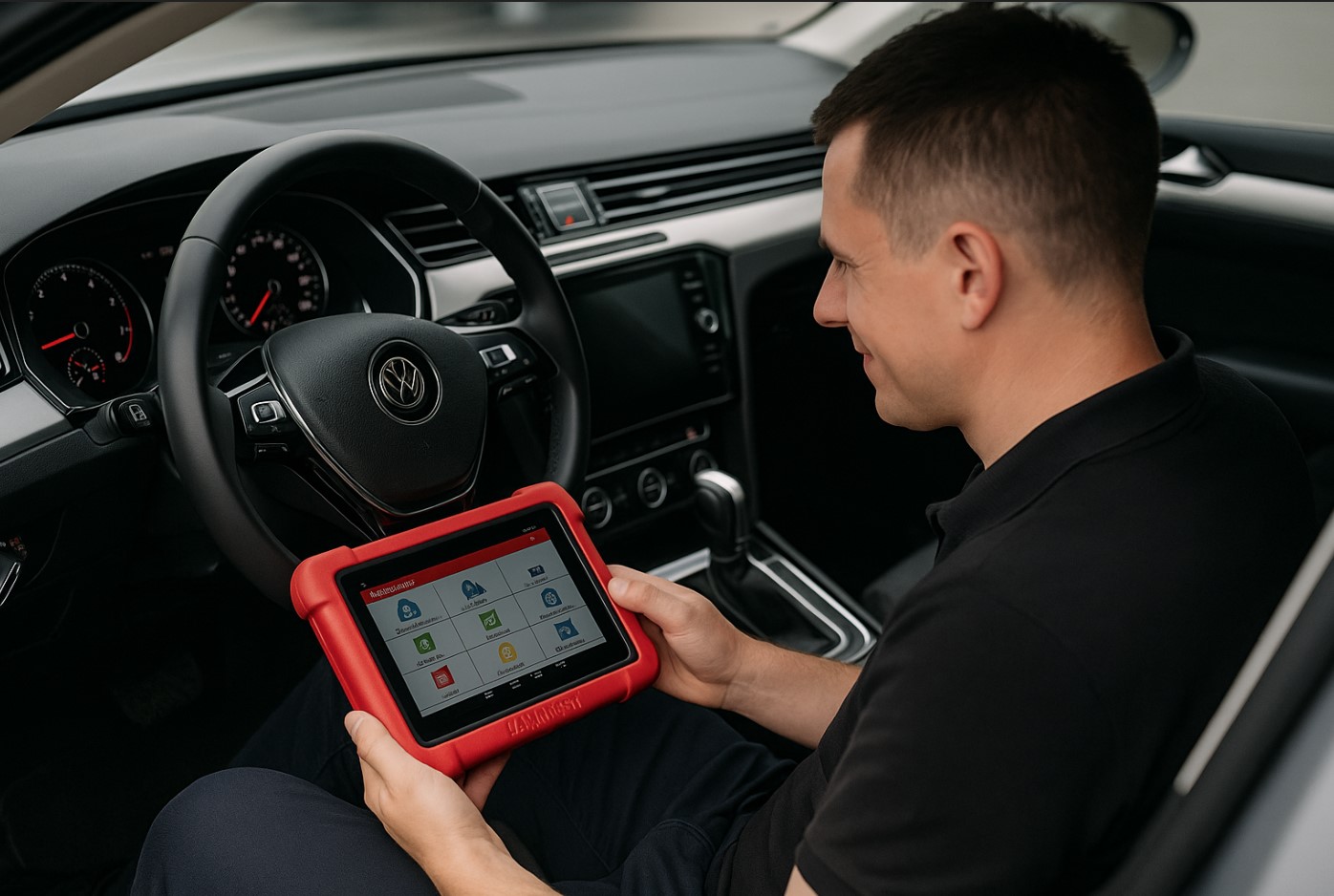
A professional scan tool such as LAUNCH X-431 connects to the car’s OBD port and reads out these codes. Once the code is decoded, a specialist understands which component or parameter triggered the ECU’s concern and how serious the problem is likely to be.
What LAUNCH X-431 can do when checking an engine
- 💎Read engine fault codes – both standard OBD-II codes and manufacturer-specific codes for Audi/VW, BMW and Mercedes. A proper scan tool sees far more than cheap “Bluetooth dongles” from online marketplaces.
- 💎Show code status – whether a fault is currently active or stored in the ECU’s memory as a past event. LAUNCH clearly separates active and history codes, which helps prioritise what needs attention now and what happened in the past.
- 💎Clear codes after repair and check if they come back – simply erasing a fault is not the same as fixing it. Permanent problems usually reappear quickly after a short drive. The scanner lets you verify that the underlying issue is actually resolved.
In other words, a proper diagnostic session gives you a “health snapshot” of the engine. For a used car this is invaluable: you can see problems that the seller may not mention – or may not even know about. Let’s look at typical fault codes for the most popular German brands and what they usually signal.
Common fault codes on petrol engines
The ECU can store hundreds of different codes, but in real life we see some patterns again and again. Below we list typical engine-related DTCs for petrol and diesel engines in Audi, VW, BMW and Mercedes and explain what they usually point to. Keep in mind: the code describes a symptom, not always the precise root cause. For example misfires can be caused by spark plugs, coils, injectors or low compression. With experience and model knowledge we can still estimate how serious it is.
📜 Misfires (P0300–P030X)
These codes indicate that the air-fuel mixture in one or more cylinders did not ignite correctly. P0300 stands for random misfires across several cylinders, P0301 – misfire in cylinder 1, P0302 – in cylinder 2, and so on. Typical causes:
- worn or incorrect spark plugs;
- failed ignition coil on one cylinder or on a coil pack;
- clogged or malfunctioning fuel injector;
- low compression due to valve issues, piston wear or head gasket problems.
On many BMW petrol engines the usual culprit is an ignition coil; on Audi/VW injectors or a fuel pump are often to blame. In any case, misfires lead to rough running, loss of power and, if ignored, can destroy the catalytic converter (unburned fuel overheats it). Replacing plugs or coils is usually not too expensive, but if diagnostics reveal a burnt valve or low compression, we’re talking about a major repair.
📜 Lean or rich mixture (P0171/P0174, P0172/P0175)
Codes P0171/P0174 appear when the mixture is too lean (too little fuel) on bank 1 and/or bank 2. Common reasons:
- unmetered air entering the intake – for example cracks in the intake manifold or leaking vacuum hoses let in extra air and make the mixture lean;
- a faulty mass air flow sensor (MAF) providing incorrect air flow readings, causing the ECU to inject less fuel than needed;
- leaking gaskets or injector seals.
Lean mixture symptoms: unstable idle, hesitation, backfires into the intake. Driving like this can overheat combustion chambers. Rich mixture codes (P0172/P0175) usually point to the opposite side: too much fuel due to a bad oxygen sensor, excessive fuel pressure or a leaking injector. Again, the scanner plus experience helps separate sensor issues from deeper engine problems.
📜 Oxygen sensor (lambda) problems
The ECU may raise codes such as P0130–P0135 (fault in the oxygen sensor circuit or heater) or complain about implausible readings. Lambda sensors fail with age (often around 100,000 km) or get contaminated by soot and oil. Replacing the sensor often restores normal operation.
However, an oxygen sensor code does not always mean “just fit a new sensor”. Sometimes the sensor simply reports a real problem in the engine – for example a constantly rich mixture due to a leaking injector. That’s why you want a human diagnostician to interpret the data. Typical symptoms of a bad lambda: increased fuel consumption, sluggish performance, higher emissions and premature catalyst failure.
📜 Catalyst efficiency below threshold (P0420 and similar)
P0420 means the catalytic converter is no longer cleaning the exhaust gases effectively. The ECU compares readings from the lambda sensor before and after the catalyst. If both sensors show very similar values, the exhaust is hardly being cleaned.
Possible reasons:
- age-related degradation or physical damage to the catalyst;
- melted honeycomb structure after long-term misfires;
- “poisoning” by additives or poor-quality fuel;
- mixture problems that were ignored for a long time.
On many modern cars a new catalyst is extremely expensive, especially on premium models. As soon as P0420 appears we look at oxygen sensor operation, mixture adaptation, misfire history and decide whether the catalyst can still be saved or replacement is inevitable.
📜 Timing and stretched timing chain (P0011, P0016 etc.)
Most modern Audi/VW, BMW and Mercedes engines use variable valve timing systems (VVT, VANOS, Valvetronic) and quite often timing chains instead of belts. Faults related to camshaft timing or correlation between crankshaft and camshaft are among the most serious:
- P0016 – crankshaft/camshaft correlation error (timing reference misaligned);
- P0011/P0012 – incorrect camshaft timing (over-advanced or over-retarded);
- manufacturer-specific codes for VVT actuators and solenoids.
In real life P0016 very often points to a stretched timing chain or problems with the tensioner and guides. Simply put, timing has drifted and the engine is warning you. Errors P0011/P0012 can indicate a sticking or worn VVT unit. On many BMW petrol engines VANOS issues are tied to dirty solenoids or worn cam phasers.
Ignoring timing-related codes is dangerous: if the chain jumps further, pistons can hit the valves and the repair quickly turns into a full engine rebuild. Replacing a stretched timing chain is labour-intensive and not cheap, but still far less painful than catastrophic engine damage.
Common fault codes on diesel engines
Diesel engines in Audi, VW, BMW and Mercedes have their own “favourites” – faults that repeatedly show up and often precede very expensive repairs. Here are the ones we pay special attention to.
📜 Glow plug faults
Glow plugs help the engine start in cold conditions by heating the combustion chamber. If one or more plugs fail, the ECU stores a code for a specific cylinder (e.g. P0673 – glow plug cylinder 3 circuit). On many diesels a warning coil symbol on the dash will light up or flash.
On VW/Audi diesels a flashing coil is a universal “engine trouble” warning. Besides glow plugs it can indicate serious issues with the turbocharger, fuel system, EGR or a clogged DPF. So if the coil is flashing, do not postpone diagnostics.
Glow plugs themselves are relatively cheap and usually replaced as a set (typical life 100–150k km). The main risk is that on some engines plugs seize in the head and may snap on removal, turning a simple job into a cylinder head-off operation. Fortunately, this is the exception, not the rule.
📜 Diesel particulate filter (DPF) efficiency (P2002 and similar)
Modern Audi, BMW and Mercedes diesels are fitted with a diesel particulate filter that traps soot. Over time it becomes saturated. The ECU monitors exhaust backpressure and DPF efficiency. Code P2002 generally means the filter no longer works as intended – in practice it is heavily clogged.
Before that, drivers often notice more frequent regenerations, reduced power and increased fuel consumption. Once the filter is too full, a DPF warning light appears, the engine may enter limp mode and P2002 becomes hard to ignore.
Driving with a badly clogged DPF can overheat the exhaust, damage the turbocharger and cause other collateral issues. Possible solutions:
- proper regeneration of the DPF (including forced regeneration with specialist equipment);
- professional cleaning or flushing of the filter;
- in severe cases – replacement with a new DPF.
Removing the DPF and “tuning out” emissions controls is illegal in the EU and will cause problems at inspection. It’s far better to catch DPF issues early on a diagnostic session and fix them correctly.
📜 EGR valve problems (P0400–P0402)
The EGR system (exhaust gas recirculation) reduces NOx emissions by routing part of the exhaust back into the intake. On diesels the EGR valve and passages are prone to soot build-up. P0400 usually means the ECU does not see expected exhaust flow through the EGR system – the valve may be stuck closed or the passages completely clogged.
Other codes such as P0401 (insufficient flow) or P0402 (excessive flow, valve stuck open) are also common. Symptoms: unstable idle, loss of power, black smoke on acceleration. On many VW/Audi diesels EGR faults go hand in hand with a flashing glow plug light.
Fixing the issue typically involves cleaning the EGR valve and intake tract from soot or fitting a new valve and then performing adaptation with LAUNCH. On some engines broken EGR components can even get into the intake and damage the engine, so leaving this “for later” is not a good idea.
📜 Turbocharger boost pressure faults (P0299, P0234 etc.)
Turbo issues are among the most expensive failures on both diesel and turbo petrol engines. The ECU monitors boost pressure and logs P0299 when it is too low (“underboost”) or P0234 when it’s too high (“overboost”).
Underboost (P0299) on VAG cars means “boost pressure too low”. Typical causes:
- boost leaks (split hose, cracked intercooler);
- worn turbocharger, sticking variable geometry, faulty actuator;
- severely clogged catalyst or DPF that prevents exhaust gases from spinning the turbo.
Ignoring boost-related codes is risky: loss of power is just the first stage. Continued driving may end with turbo failure or even engine damage if metal fragments get into the intake. A proper diagnostic session includes visual checks, boost pressure tests and control of all relevant valves and sensors.
📜 Fuel system pressure and injector issues
Common-rail diesel fuel systems operate at very high pressure and are sensitive to wear and contamination. Code P0087 means fuel rail pressure too low – the ECU detects that actual pressure drops below the required value. This can happen under heavy load or even at idle on high-mileage engines.
Possible causes include:
- clogged fuel filter or pickup in the tank;
- worn high-pressure pump (HPFP) or low-pressure lift pump;
- leaking fuel lines or a faulty pressure regulator;
- injectors returning too much fuel back to the tank (“leaking” injectors).
Symptoms: poor performance, hard starting, engine going into limp mode during acceleration, revs limited to about 3,000 rpm. Injector-related codes and abnormal correction values are especially worrying – repair or replacement of injectors and HPFP can easily cost thousands of euros. Sometimes cleaning and fresh filters help, but often the only real fix is new or rebuilt hardware.
(Of course this is not a complete list of all possible engine faults. There are many other codes – from overheating coolant to knock sensor problems or misfires in a specific cylinder. Here we focused on those that most often point to expensive issues that can seriously hurt your wallet. That is exactly why they are so important during a pre-purchase inspection.)
Current vs “history” codes: how to read them and what they mean for you
During diagnostics it’s essential to understand whether a fault is present right now or it happened in the past and is no longer active. The ECU keeps codes stored for a certain number of drive cycles even after the symptom disappears.
LAUNCH clearly separates several types of DTCs when connected to the car:
📌 Active (current) faults
These are problems that exist at this moment. With an active engine fault the Check Engine lamp is usually on or, on diesels, the glow plug symbol may flash. Examples: misfires, faulty sensor, fuel pressure issues, coolant overheating. Active codes must never be ignored – they indicate a real, current problem. After repair, we clear the codes and monitor whether they reappear.
📌 Pending faults
Pending codes are “warnings” – the ECU noticed an anomaly but has not yet confirmed it as a persistent fault. For example, a sensor glitch happened once during a trip. If it does not repeat, the pending code disappears on its own. If it recurs, the ECU promotes it to an active code and may light up the warning lamp. For car selection these pending codes are important: they show early stages of potential problems.
📌 Stored (history) codes
History codes are like an event log. They show faults that occurred in the past but are not currently active. For example, a week ago there were misfires due to bad fuel; the ECU stored the codes, but now everything is fine. A single history entry is not a tragedy. But if the same fault repeats over and over, this tells us the car has an ongoing issue even if everything seems fine today.
📌 Permanent codes
Permanent DTCs are a newer category. They remain in memory even after a general reset and disappear only once the system confirms that the fault has really been repaired and all tests have passed. This was introduced to combat “cosmetic” code clearing before selling a car. A classic example is P0420 for the catalyst: as long as the catalyst does not work within specifications, the permanent code will stay.
How do we know whether a fault is old or fresh? A professional scan tool helps a lot: LAUNCH not only shows code status but also readiness monitors (on-board self tests). If most monitors are “not ready”, this usually means the ECU memory was cleared very recently – quite possibly right before putting the car up for sale.
Some systems also record mileage and time when the code last occurred, as well as the number of engine starts since then. An experienced diagnostician reads this context just like you read the service history: together with visual inspection it tells the real story of the car, not just the sales pitch.
LAUNCH diagnostics during car selection — your shield against hidden problems
Buying a used car always involves risk. Sellers can hide defects that are not visible at first glance and will definitely not be mentioned in the advert. Our used car selection service in Germany is designed to minimise these risks.
One of the key stages is a full computer diagnostic check of all major systems using a LAUNCH X-431 scanner.
What diagnostics give you during a pre-purchase inspection
- Full scan of engine, automatic transmission, ABS/ESP, airbag and other ECUs.
- Detection of hidden faults even if no warning lamp is on yet.
- Early warning about “expensive” problems: catalyst efficiency, stretched timing chain, growing fuel system issues, turbocharger, DPF saturation.
- Separation of really critical faults from minor issues such as a faulty parking sensor.
- Ability to estimate repair costs in advance and use that as a strong argument when negotiating price.
We pay special attention to error codes indicating costly repairs – exactly those that we discussed above. A dying catalyst, worn timing chain, weak high-pressure pump or nearly clogged DPF will all leave fingerprints in the diagnostic data.
Knowing this before you sign anything allows you to:
- walk away from a problematic vehicle and keep looking;
- negotiate a substantial discount and include repairs in your budget;
- ask the seller to fix issues properly before the sale.
Equally important is the combination of VIN report + computer diagnostics. In the article “Why a carVertical report cannot replace an expert inspection” we explain in detail that a VIN report shows the car’s history (accidents, mileage, number of owners), while LAUNCH diagnostics show its current technical condition. Together they provide a much more complete picture.
Conclusions: why diagnostics is the wrong place to save money
Engine diagnostics are an irreplaceable tool for both professional mechanics and buyers of used cars. They allow you to “talk” to your future Audi, Volkswagen, BMW or Mercedes and learn far more about its true condition than any seller will ever tell you.
We should not forget that these are premium brands and their repair costs are accordingly high. Skipping a proper diagnostic session to save a small amount at the buying stage often ends in a much bigger bill at the workshop later.
A LAUNCH diagnostic scan only takes 15–30 minutes, but its value is immense: you get a detailed picture of the engine (and, if needed, the gearbox, ABS, airbags and other modules). Our experts explain every code, separate scary-looking but minor issues from truly dangerous ones and outline expected repair costs.
Used car selection combined with professional diagnostics means peace of mind. We help you filter out cars with obvious and hidden defects, highlight potentially very expensive risks and protect your investment. In the end you either buy an Audi, Volkswagen, BMW or Mercedes with a healthy engine – or you at least know exactly what you are getting into and can decide with full information.
This is what we do for our clients: we check premium-segment cars in detail, identify hidden risks and help you make a well-informed decision. Visit our website or contact us to learn more about our car selection and full diagnostic services. Buy cars wisely and safely – and let professional LAUNCH diagnostics work in your favour.
Werbung / *Affiliate-Link
Links and banners marked with an asterisk (*) are affiliate links/banners. If you use such a link and subsequently request an offer, sign a contract or make a purchase, we receive a commission from the respective provider. For you, there are no disadvantages: the price and conditions remain the same.
FAQ — frequently asked questions about computer diagnostics
Do I really need diagnostics if there is no warning light and the car “drives fine”?
Yes. The absence of a Check Engine light does not guarantee the absence of problems. Many faults may be stored only as history codes, and some sellers clear codes shortly before showing the car. A LAUNCH scan shows both active and stored faults and reveals whether onboard tests have been recently reset.
Can you scan only the engine and ignore the other control units?
Technically we can, but we don’t recommend it. For a serious pre-purchase inspection it makes sense to scan all systems: automatic transmission, ABS/ESP, airbags, climate control and so on. Sometimes the biggest bill comes from a failing gearbox or airbag system, and only a full scan will reveal it.
How long does a LAUNCH diagnostics session take during a mobile inspection?
On average it takes 15–30 minutes per car. While the scanner is connected our expert also inspects the engine bay, checks fluid levels and condition and performs a test drive. You receive an on-the-spot explanation plus a detailed report with decoded codes.
Does computer diagnostics replace a carVertical or other VIN report?
No. VIN reports and diagnostics solve different tasks. A VIN report shows the car’s past – accidents, mileage history, number of owners. LAUNCH diagnostics show its present – real technical condition and faults. The safest approach is to combine both tools, which is exactly what we do in our used car selection service.
Related posts
How to buy a car in Germany — step-by-step guide
 Why a carVertical report cannot replace a live expert inspection