
 Brakes after winter — discs, calipers and brake lines: inspection checklist before buying
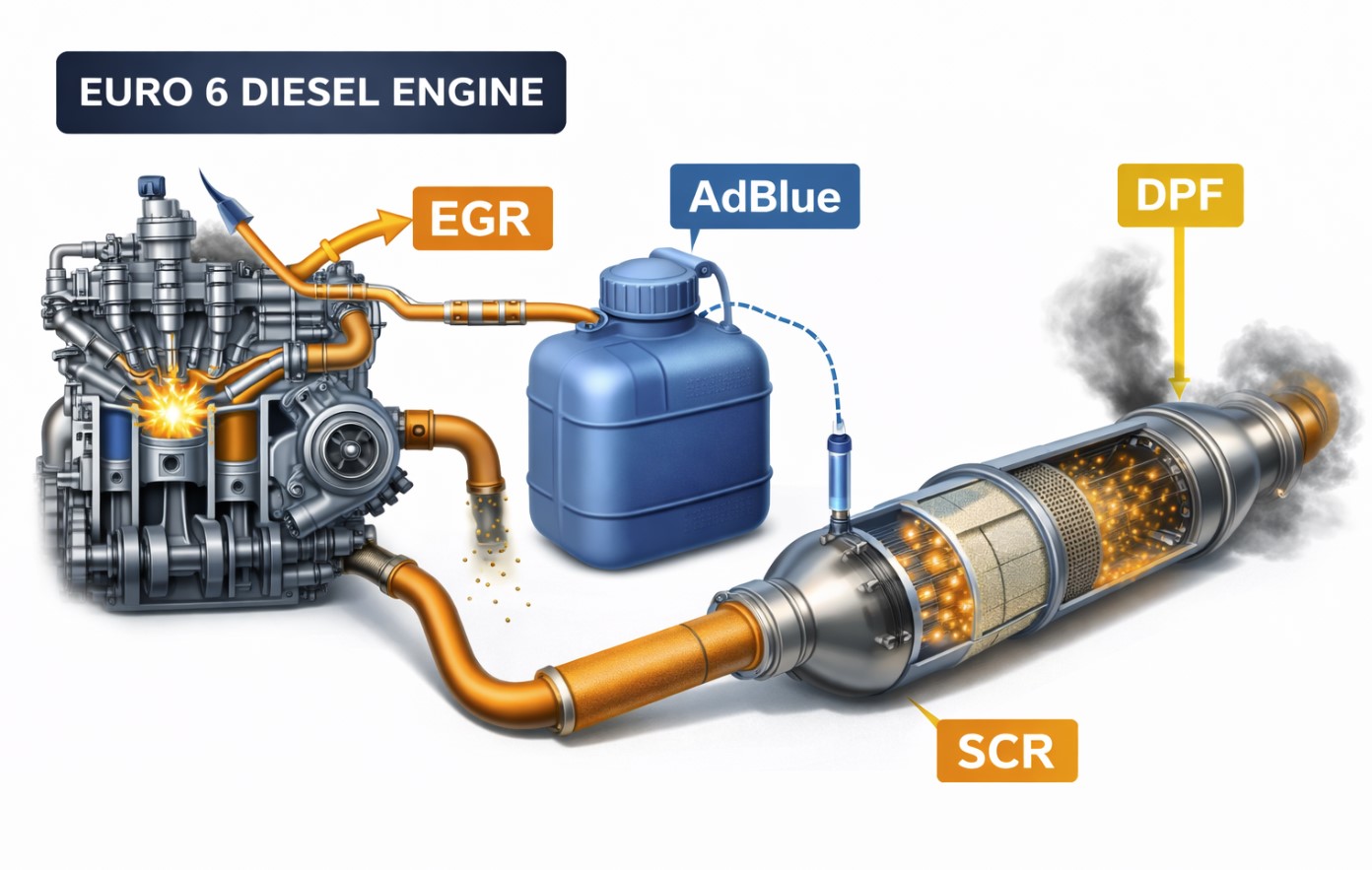
A Euro 6 diesel often looks like a smart buy: low fuel consumption, strong torque, good motorway comfort and solid long-distance efficiency. But for Berlin and other city-driving patterns there is a second side to that story: traffic jams, repeated cold starts and short trips do not let the exhaust aftertreatment system work the way it was designed to.
That is why DPF, EGR and AdBlue / SCR problems appear much more often on city-driven diesels than on cars that regularly see the Autobahn. This article is not here to “scare you away from diesel”, but to give you a practical system: how to tell before the purchase whether the car has lived on short trips, how high the risk is and what must be checked in diagnostics.
🧩 How the DPF works and why regeneration matters
DPF (diesel particulate filter) is designed to trap soot particles from the exhaust of a diesel engine. When soot load becomes too high, the system triggers regeneration: exhaust temperature rises and the trapped soot is burned off.
In practical terms, this means the filter does not just need mileage — it needs the right driving conditions: stable temperature, enough load and enough time for the regeneration cycle to finish. If trips are too short, the filter gradually moves toward the point where faults appear, power drops, limp mode starts and repair bills get expensive.
It is important to understand the difference:
- 🔥 Soot — the “burnable” part that the system can remove during regeneration.
- 🪨 Ash — non-burnable residue that slowly accumulates and reduces the remaining service life of the filter.
In OBD data this is often shown separately, for example as soot mass and ash load. Even if regeneration still works, high ash load already points to an aging filter with limited remaining life.
Useful visual ideas for this article:
1) a simple DPF regeneration diagram; 2) an OBD screenshot with soot / ash / differential pressure; 3) a city / short-trip icon block; 4) a short note on the kind of route that helps regeneration complete.
1) a simple DPF regeneration diagram; 2) an OBD screenshot with soot / ash / differential pressure; 3) a city / short-trip icon block; 4) a short note on the kind of route that helps regeneration complete.
🚦 Why short trips are harmful: DPF, oil, EGR and the chain of problems
1) Incomplete warm-up and interrupted regeneration
The problem with city use starts with temperature. On short trips, the engine and exhaust system often do not reach a stable operating range. As a result, regeneration may start but fail to finish. For the buyer, this means something very simple: when a seller says “the car was used mostly in the city”, that is not neutral information — it is already a risk factor for the DPF.
2) Fuel dilution in the oil — the hidden risk many buyers underestimate
On DPF-equipped diesels, city use is dangerous not only for the filter itself but also for the oil. If the car lives on cold starts and short routes, the oil may spend too much time below ideal temperature, and interrupted regeneration cycles can contribute to fuel entering the crankcase. For the buyer, that means you should not look only at DPF fault codes, but also at indirect markers — oil level, smell, service intervals, maintenance history and the way the engine behaves while warming up.
⚠ Practical conclusion: if the oil level looks suspiciously high and the oil smells of fuel, that is not a “small detail”. It is a serious indirect sign of short-trip use and possible fuel dilution.
3) EGR gets clogged faster
EGR sends part of the exhaust gas back into the intake to reduce NOx emissions. But the system works in a harsh environment: soot, oil vapor, high temperature and frequent load changes gradually contaminate the valve and related passages. On cars that spend a lot of time in the city and rarely get fully warm, carbon buildup happens faster.
What does the buyer actually see? Usually not the theory, but the symptoms: Check Engine, rough idle, hesitation, weak power delivery, limp mode, increased fuel consumption and sometimes black smoke. Even if the code has been erased, the way the car behaves during warm-up and under load often still reveals the problem.
4) AdBlue / SCR is not optional — it is now a core part of the system
On modern Euro 6 diesels, the SCR system using AdBlue is responsible for reducing NOx. If faults start there, the problem is no longer something you can postpone casually. It can mean warning messages, restricted operation and repair costs for sensors, pump, dosing system or related wiring.
💡 The key buyer’s rule: do not look at DPF, EGR and SCR separately. On a city-driven diesel, they are often one chain: short trips → incomplete regeneration → higher stress on oil and exhaust treatment → faults and degradation in related systems.
✅ What a “healthy” diesel usually looks like
- stable pull once fully warm;
- no active DPF, EGR or SCR faults;
- service intervals that make sense;
- oil without obvious signs of dilution;
- regeneration that does not seem unusually frequent.
❌ What should immediately make you cautious
- pure city use, “only home to work”;
- repeated exhaust-related faults that were deleted;
- hesitation, weak power or rough idle;
- very frequent regeneration or high soot load;
- AdBlue, SCR or NOx warnings.
📟 OBD values and the inspection protocol before buying
At this stage, your goal is to eliminate subjective impressions like “it seems to drive fine” and turn the inspection into concrete data. A Euro 6 diesel without OBD diagnostics before purchase is an unnecessary risk, especially if the car has spent most of its life in city traffic.
1) What to check for the DPF
- calculated soot load: soot mass, Beladung Ruß;
- DPF differential pressure: DPF differential pressure;
- regeneration status: active / completed / interrupted;
- regeneration counter and distance or time since the last regeneration;
- calculated ash load — if the parameter is available.
Symptom
What to check
What it may mean
Regeneration starts too often
soot mass, distance since last regeneration, differential pressure
city use, interrupted cycles, overloaded DPF
Power loss on a warm engine
DPF pressure, EGR position, boost / exhaust-related faults
exhaust restriction, carboned EGR, limp mode
Oil level above normal
service history, oil smell, usage pattern
possible fuel dilution and short-trip use
AdBlue / SCR warning
NOx sensors, pressure, pump, start-limit counter
high repair risk and possible “no engine start in ... km” scenario
2) What to check for EGR
- active and stored faults related to EGR, sensors and flow;
- commanded versus actual valve position — if available;
- engine behavior during warm-up, idle and load changes;
- signs of weak power, hesitation, unstable operation or limp mode.
3) What to check for SCR / AdBlue
- faults related to SCR, NOx sensors, pump, pressure and dosing;
- actual AdBlue level as seen by the system;
- dashboard warnings and their history;
- any signs of a no engine start in ... km scenario.
🚨 Especially dangerous: if the seller claims “nothing ever happened” but the control units contain SCR, NOx or AdBlue dosing faults. That is already a solid reason either to negotiate hard or to walk away.
4) What must be checked outside the scan tool
- service book and invoices: how often the oil was changed and when;
- declared usage pattern: city, motorway or mixed driving;
- the way the exhaust system behaves after a cold start;
- evidence that old faults may have been cleared right before sale;
- undercarriage condition, corrosion, exhaust mounting, and any signs of repair or tampering.
| System | Values / signs | What it means for the buyer |
|---|---|---|
| DPF | soot mass, ash load, differential pressure, regeneration counter | Shows current stress level and remaining useful life of the filter |
| EGR | fault codes, valve position, rough running, weak power | Helps reveal carbon buildup and hidden problems before the deal |
| SCR / AdBlue | NOx sensors, pump, pressure, start-related warnings | Shows the risk of expensive repairs immediately after purchase |
| Oil / usage pattern | level, smell, change intervals, type of use | Indirectly reflects short-trip use and possible fuel dilution |
🛣 How to test-drive a Euro 6 diesel properly before buying
A short lap around the block is a poor test for a modern diesel. What you really need is at least a 20–30 minute route with a section where the car can drive steadily at around 80–100 km/h, if traffic conditions allow it.
Why is that important? Because only then do you see what happens once the system is fully warm: whether power drops, whether regeneration seems to start too frequently, whether there is a hot exhaust smell, unusual smoke, unstable throttle response or signs of limp mode.
📌 A proper Euro 6 diesel test drive should include:
- a cold start;
- real warm-up in traffic, not just idling before you arrive;
- a city and suburban section;
- steady pull under load;
- a second diagnostic scan after the drive.
After such a drive, always repeat a short diagnostic check. Sometimes faults that were not visible at the seller’s place show up only after the car is fully warm.
🚩 Red flags: when to negotiate and when it is better to walk away
When it is smarter to leave the deal
- the seller openly confirms that the car was used only for short trips, but cannot show long-distance use or meaningful service records;
- OBD shows frequent interrupted regenerations and high calculated soot load;
- oil level looks suspiciously high and the oil smells of fuel;
- there are active SCR / NOx / DPF faults, especially with a start-limit warning;
- the test drive shows weak power, hesitation, rough running or a check-engine light.
When negotiation still makes sense
Sometimes the car still fits your needs overall: good body, understandable history, attractive price. In that case, your negotiation position should be based on facts, not emotion:
- document the DPF values and regeneration history;
- save the list of SCR, NOx and EGR faults;
- explain to the seller that exhaust-related defects are becoming harder and harder to ignore;
- evaluate not just the filter itself, but also the risk around sensors, pump, valves, oil contamination and labor.
💶 A strong negotiation position sounds like this: “The car already shows measurable DPF or SCR risk. This is not cosmetic and not just a warning light. After purchase, diagnostics and repairs may be needed immediately. The price has to reflect that.”
🧰 How Sicher-Check inspects a Euro 6 diesel in Germany
If you are considering a Euro 6 diesel for Berlin or another urban-use pattern, it is better not to buy it “by feel”. We inspect these cars not only for body condition and paperwork, but also for the real stress level on the DPF, EGR and AdBlue system.
What is included in our inspection
- full OBD diagnostics for DPF, EGR, SCR, NOx and AdBlue;
- evaluation of soot load, ash load, differential pressure and regeneration history;
- a proper test drive with warm-up and a second scan after the drive;
- inspection from underneath: exhaust, mountings, corrosion, repair traces and signs of tampering;
- review of service history and indirect short-trip markers;
- a written conclusion: buy / do not buy / buy only with a discount.
Advertisement / *Affiliate link
Links and banners marked with an asterisk (*) are affiliate links or affiliate banners. If you use such a link and later request an offer, sign a contract or make a purchase, we may receive a commission from the provider. For you, nothing changes: the price and terms remain the same.
FAQ
Is a Euro 6 diesel suitable for short city trips?
It can be, but the risk of DPF, EGR and SCR problems is noticeably higher than on a car that regularly sees motorway driving. For a city-driven diesel, OBD diagnostics and a proper test drive are especially important before purchase.
If there are no DPF faults, does that mean the filter is fine?
Not necessarily. Fault codes may not be active yet, while the measured values already show high load, frequent regeneration, elevated differential pressure or growing ash content. That is why dashboard lights alone are not enough.
What is more dangerous in the DPF: soot or ash?
Soot is dangerous because it can overload the filter right now, but it can usually be burned off during regeneration. Ash is dangerous because it does not burn and permanently reduces the life of the filter. Both values matter.
Can an AdBlue warning be ignored before purchase if the car still drives?
No. Even if the vehicle still starts and drives, SCR and AdBlue faults can quickly turn into restricted operation or a “no engine start in ... km” scenario. For a buyer, that is a serious red flag.
Do I still need a long test drive if the seller has already warmed the car up?
Yes. A pre-warmed engine can hide part of the symptoms. It is better to see the cold start, the warm-up and the behavior under load. After the drive, it is useful to read the faults and live values again.
Related posts
Brakes after winter — discs, calipers and brake lines: inspection checklist before buying
 Pre-purchase car inspection in Germany: diagnostics, risks and negotiation arguments