
 Pre-purchase car inspection in Germany: how to avoid expensive mistakes
In real pre-purchase work in Germany, the questions about hybrids are almost always the same: how long does the battery last, how expensive is replacement, can the car be kept as a seasonal vehicle, is there any real tax benefit, is a PHEV actually better than a diesel, and what exactly must be checked before buying?
The core problem is that many buyers see only the abstract idea of “combustion engine plus battery”, but do not calculate the real cost of ownership. That, more than anything else, determines whether a hybrid becomes a smart purchase or an expensive compromise.
🔋 Which hybrid types are common in Germany
1️⃣ 48V Mild Hybrid
This is the so-called mild hybrid. It has a small 48-volt battery, a starter-generator and energy recuperation, but normally it cannot drive as a true electric car for any meaningful distance and it does not charge from an external power source.
Its purpose is not to replace the combustion engine, but to support it in certain situations:
- start-stop operation;
- brief assistance while accelerating;
- energy recuperation;
- sometimes smoother coasting and more frequent engine-off phases.
2️⃣ Plug-in Hybrid (PHEV)
This is a different category. The battery is much larger, the car can be charged from the grid, and it can cover part of the route on electric power without starting the combustion engine. In Germany, that becomes especially attractive for city use when home charging is available.
⚙ The key difference between a 48V mild hybrid and a plug-in hybrid
Parameter
48V Mild Hybrid
Plug-in Hybrid
Driving purely on electricity
Practically no
Yes
Charging from the grid
No
Yes
Battery size
Small
Much larger
Fuel-saving potential
Moderate
High, but only with the right usage
Technical complexity
Lower
Higher
Risk of expensive repair
Usually lower
Medium to high if history is poor
Main conclusion: a 48V mild hybrid is still very close to a normal car with a small electric helper. A plug-in hybrid is already a vehicle with two propulsion systems, more complex electronics and much stronger dependence on battery condition.
💶 Real ownership cost in Germany
48V hybrid
From an ownership-cost perspective, a 48V mild hybrid usually remains much closer to an ordinary petrol or diesel car. The technical risk is relatively moderate: there is an additional system, but it does not reshape the whole architecture of the vehicle in the same way as a PHEV does.
Potential costs here are more likely to be linked to the 48V battery, a DC/DC converter or the starter-generator. That is why a 48V hybrid is usually a “low-risk compromise” rather than a full step into the world of complex high-voltage electrified drivetrains.
Plug-in hybrid
The economics of a PHEV are more complicated. It can genuinely be a good choice if you:
- drive around 40–60 km per day;
- charge the vehicle regularly;
- have convenient home charging;
- do not buy a car with a tired battery or hidden high-voltage system faults.
But if a PHEV spent most of its life as a heavy petrol car, was rarely charged or was stored badly, it can end up being more expensive than a diesel in both fuel use and repair risk.
⚠ One of the most common mistakes: assuming that a PHEV is automatically economical just because it “can drive on electricity”. Without convenient home charging and with large motorway mileage, much of that advantage disappears.
🔋 How long a hybrid battery lasts and what degradation means
Buyers almost always ask the same question: how long does the battery last? But the more useful question is: what condition is it in now, how was it used and is there any remaining battery warranty?
48V
In a mild hybrid, the battery is smaller, the system is simpler and any eventual replacement cost is usually much lower than in a plug-in hybrid. That means a 48V car often ages more gently from the point of view of repair economics.
Plug-in Hybrid
In a PHEV, the traction battery is one of the most expensive components in the whole car. What matters is not only age and mileage, but also:
- charging frequency;
- thermal conditions;
- depth of discharge;
- long-term storage habits;
- faults in the battery-management system and battery cooling.
What battery degradation actually means
Over time, every traction battery loses part of its usable capacity. That is what degradation means. For a buyer, the critical issue is not that degradation exists — that is normal — but how fast it progressed and how severe it already is. That is why SOH (State of Health) is such an important value during inspection.
In practical terms: moderate capacity loss with age is normal. But if SOH is already significantly lower than expected for the age and mileage, the car deserves deeper diagnostics. It may point to a difficult usage pattern, poor storage, frequent deep cycles or internal module imbalance.
🧊 Can a hybrid be used as a seasonal car?
Yes, but not without conditions. A hybrid can be kept as a seasonal vehicle, but the battery makes correct storage much more important than on a conventional combustion-only car.
If the vehicle sits for three to six months, it is wise to avoid:
- leaving the traction battery fully discharged;
- storing it at 100% state of charge for months;
- extreme cold or repeated heat stress during storage.
Ideally, the battery should remain at a moderate charge level, and the car should not be left completely neglected. In used-hybrid inspections, poor storage is one of the reasons why a battery can be “not old on paper” yet still show visible degradation or HV-system faults.
🔌 Charging from a home electrical supply in Germany
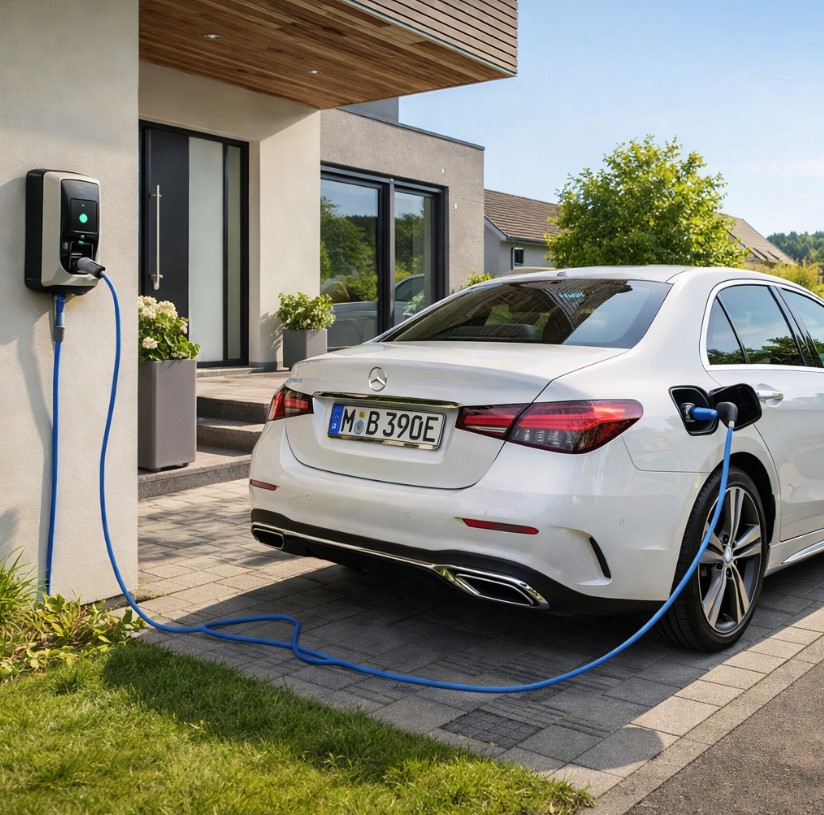
One of the key questions when choosing a PHEV is how exactly you are going to charge it. In many cases, a plug-in hybrid can be charged from a normal household socket, but that is not always the most comfortable or best long-term solution.
In real everyday use, a wallbox is usually the more practical option. At the same time, you need to think about:
- a proper electrical circuit and correct installation;
- qualified electrical work;
- the rules of the local grid operator;
- the fact that private wallboxes are generally notified to the grid operator, and higher charging power can require additional approval.
The practical point is simple: a PHEV only starts to make full economic sense when charging is convenient and regular. If home charging is always awkward, a large part of the plug-in hybrid advantage disappears.
🧾 Does a hybrid really save money on taxes?
With taxes and incentives in Germany, it is important not to rely on old marketing promises. For a private owner, a 48V mild hybrid is usually taxed very much like a conventional combustion vehicle. A PHEV can look more attractive in some ownership scenarios, especially when company-car taxation enters the picture, but the real benefit depends on current rules, emissions, electric range and how the car is actually used.
That is why tax advantage should never be calculated in theory only. It has to be calculated around your exact driving profile: daily route length, home charging, annual mileage, city share, motorway share and the actual purchase price.
✅ Good hybrid options on the German market
Interesting and generally well-regarded PHEV / hybrid models
- Toyota Prius Plug-in
- Toyota RAV4 Hybrid (not a PHEV, but a very strong hybrid option)
- BMW 330e (G20)
- Volvo XC60 T8 — with good maintenance and a transparent history
- Mercedes C300e — if the battery and hybrid system are clean
Good 48V mild-hybrid options
- Audi A6 45 TDI Mild Hybrid
- Mercedes E-Class with 48V system
- BMW models based on B48/B58 with mild-hybrid setup
But even a “good model” does not change the main rule of the used-car market: what matters is the condition of the individual example, not only the reputation of the platform.
📟 How to diagnose a hybrid before buying
In a proper pre-purchase inspection in Germany, a hybrid requires a more advanced diagnostic approach. For a normal combustion-engine car, a basic fault scan and visual inspection may be enough. For a PHEV or a technically complex hybrid, that is not sufficient.
What should be read through OBD
- SOH (State of Health) — the real health status of the battery;
- SOC (State of Charge) — the current charge level;
- charge-cycle count;
- voltage spread between modules;
- BMS-related faults;
- faults in the cooling system of the high-voltage battery;
- history of high-voltage faults, if accessible.
| Parameter | What it shows | Why it matters before buying |
|---|---|---|
| SOH | Remaining battery health | Helps estimate remaining life and the risk of major future cost |
| SOC | Current battery charge | Needed to interpret other battery values correctly during the inspection |
| Module voltage spread | Balance between battery cells or modules | A strong spread can indicate aging, imbalance or a weak module |
| BMS / HV faults | Condition of battery control and high-voltage system | Can expose hidden problems before the deal |
| Charge history / cycles | How the vehicle was actually used | Helps interpret the battery’s real life story, not just its mileage |
Which fault codes are especially serious
- HV Isolation Fault
- Battery Cell Imbalance
- High Voltage System Error
- Cooling Circuit Fault
🚨 Important: if the seller says “everything is perfect” but the hybrid system shows active or very recent high-voltage faults, that is already a reason either for a serious discount or for walking away.
🚗 What to watch during the test drive
A hybrid cannot be judged only by a smooth body and a calm engine idle at a standstill. During the drive, you need to observe how the car behaves as a hybrid system.
- Are there harsh transitions between combustion engine and electric drive?
- Are there any power drops under load?
- Does battery cooling sound unusually loud?
- Do warning messages appear after the car warms up?
- Does charge drop unusually fast, or is electric drive used illogically?
A proper hybrid test drive is not a five-minute lap around the block. It should be a real drive with warm-up, mode changes and a second diagnostic check after the route.
❌ Common buyer mistakes
Mistake No. 1
Buying a hybrid without checking the battery. This is the most expensive mistake, because the HV battery and the electronics around it are the main source of major future cost.
Mistake No. 2
Judging the car only by mileage. Low mileage does not guarantee a healthy battery if the vehicle was stored badly, charged irregularly or stood unused for long periods.
Mistake No. 3
Ignoring the charging history and usage pattern. For a PHEV, this matters enormously: the battery ages not only by kilometres, but by the way the whole cycle life was used.
Mistake No. 4
Buying a PHEV without any realistic way to charge it regularly. Then the hybrid part cannot deliver its main advantages, while the extra weight and complexity remain.
🧭 When a hybrid is the right choice and when a diesel still makes more sense
When a hybrid really makes sense
- mainly urban driving;
- home charging is available;
- daily route is often below 50 km;
- you know clearly how the car will actually be used.
When a diesel is still the more logical option
- frequent motorway use;
- high annual mileage;
- no convenient access to charging;
- you want simpler and more predictable ownership economics.
The realistic ownership-cost conclusion: 48V is often a low-risk compromise. A PHEV can be genuinely efficient, but only if used correctly. If used incorrectly, it can become more expensive than a diesel.
🧰 Why hybrid inspection before buying is essential
A hybrid is not just an “economical car”. It is a vehicle with two propulsion systems, complex electronics, a battery pack and several expensive components that cannot be judged from looks alone.
During hybrid-focused pre-purchase inspections in Germany, we:
- read advanced battery parameters;
- check the fault history;
- assess HV-system condition;
- analyze the usage pattern;
- help estimate the real ownership cost;
- show whether this exact hybrid is actually worth the asking price.
The final point is simple: a hybrid can be either a very sensible car or a very expensive one. The difference usually comes down to usage history, battery condition and correct diagnostics before the deal.
FAQ
Which is usually more reliable for Germany: a 48V mild hybrid or a plug-in hybrid?
If we speak strictly in terms of major repair risk, a 48V mild hybrid is usually simpler and calmer by design. A plug-in hybrid is more attractive in city use, but it depends much more on the battery, charging and usage history.
Can I buy a PHEV without checking the battery?
No. The battery and the high-voltage system are the main risk area. Without SOH diagnostics, BMS fault reading and module analysis, the purchase becomes far too speculative.
If mileage is low, does that mean the battery is definitely healthy?
Not necessarily. For a hybrid, mileage is only one part of the story. Charging frequency, storage conditions, depth of discharge and thermal history also matter. Low mileage alone proves very little.
Can a PHEV be charged from a normal household socket in Germany?
Usually yes, but for regular use a wallbox is far more comfortable. Proper installation and the local grid-operator requirements should also be taken seriously.
When is a diesel still the better choice than a hybrid?
If you drive a lot on the Autobahn, cover high annual mileage and do not have convenient home charging, a diesel often remains the simpler and more cost-transparent option.
Related posts
Pre-purchase car inspection in Germany: how to avoid expensive mistakes
 Car sourcing in Germany: technical diagnostics and pre-purchase checks